
News Archive
Past News and Events of interest in RARS and Amateur Radio
A Note About Links: Links in news items on this page may not work, especially with older stories. This page is here to preserve these stories for historical purposes only. The content of linked pages, and even the pages themselves, may be changed, updated or deleted over time, which may invalidate these links.
posted September 23rd, 2009
20090923-20100815.html
posted May 23rd, 2009

|

|
|||
| The Dayton Amateur Radio Association selected Danny Hampton, K4ITL, of Raleigh, as the "2009 Amateur of the Year". Read the details here. | ||||
20090523-20100824.html
posted March 2nd, 2009
ARRL Media and Public Relations Manager Allen Pitts, W1AGP, said he has been getting e-mails and phone calls from Amateur Radio operators concerning the digital TV conversion, now set to take place on Friday, June 12. "People are asking what's happening with the DTV conversion -- especially now that it's been delayed -- and wondering what we as hams can do to help," he said. "There has been considerable confusion concerning the extension of the date, but the role of Amateur Radio is simply to be helpful to the people in our communities."
Read the full story on the ARRL Website.
20090302-20090801.html
posted March 2nd, 2009
According to ARRL VEC Manager Maria Somma, AB1FM, there continues to be a heightened interest in Amateur Radio following the FCC's elimination of the Morse code exam requirement in February 2007: "The number of new license applicants remains strong under the new Amateur Radio Service rules. The following table chronicles all 14 FCC authorized VEC organizations' new license activity over the last few years." In 2008, the total number of US amateurs rose 1.2 percent, from 655,800 in 2007, to 663,500 in 2008:
-----------------------------------

       New Amateur Totals

   2006 through November 2008

-----------------------------------

Month       2006    2007    2008

-----------------------------------

Jan         1274    1647    1755

Feb         1605    2435    2998

Mar         2531    3478    2816

Apr         1728    2673    3090

May         2283    2607    2562

Jun         1967    2281    2402

Jul         1401    1786    2077

Aug         1623    2183    2084

Sep         1357    1462    1763

Oct         1781    2109    2303

Nov         1993    2132    2197

Dec         1569    1935    2019

-----------------------------------

Totals:   21,112  26,728  28,066

-----------------------------------
Somma said that the number of General and Extra class upgrades is also on the rise. "When looking at 2006 totals," she said, "we see that upgrade applications for 2007 were up 286 percent; in 2008, they were up
146 percent over 2006. Requests for new club licenses also remain strong. In 2008, we had 671 applications for club licenses come in, while in 2007, there were 506 applications. That's an increase of 133 percent."
Calling it a "ripple effect," Somma said that the number of amateurs who want to be volunteer examiners and who want to teach Amateur Radio classes is also going up. "Here at the ARRL VEC, we've seen a spike in the number of applications from General and Extra class radio amateurs who want to give back to their community by serving as examiners and instructors," she said.
Somma further broke down the numbers to show the approximate number of licensees per FCC license class:
Novice:               18,500

Technician:          322,500

General:             145,000

Advanced:             62,000

Extra:               115,500

Total US Amateurs:   663,500
"I can think back to the mid 1980s when there were approximately 450,000 US Amateurs," Somma recalled. "These are the highest numbers of General and Extra class licensees I have ever seen." As of April 15, 2000, the FCC no longer issues Novice or Advanced class licenses. "As expected, the number of Novice and Advanced class licensees has decreased," she said. "As I look toward 2009, I see Amateur Radio growing in a positive direction." -- Some information provided by Joe Speroni, AH0A
20090302-20090715.html
posted January 23rd, 2009
20090123-20091115.html
posted January 15th, 2009
NEWS RELEASE
FOR IMMEDIATE RELEASE: January 13, 2009
CQ to Accept eQSL Confirmations for Award Credit
(Hicksville, NY and Bedford, TX, January 13, 2009) - CQ magazine will accept contact confirmations made on the eQSL.cc electronic confirmation system for its operating awards effective immediately, CQ Editor Rich Moseson, W2VU, and eQSL Founder and Webmaster Dave Morris, N5UP, announced today.
There will be certain limitations and procedural differences for different awards, at least to start. Only confirmations from "Authenticity Guaranteed" members of eQSL will be accepted, and in accordance with existing eQSL policy, a membership level of bronze or higher is required in order to participate in award programs via eQSL.
"This is the first time that CQ has formally accepted anything other than traditional paper QSL cards for its awards," said Moseson. "We have been working with Dave Morris and his team for several months to assure that the integrity of our awards programs will be protected and to create mechanisms to make it easy for both award applicants and award managers to use eQSL credits toward our awards. All of our award managers have been involved in this process and support this action."
"We want to express our great appreciation to Dave and his team for their willingness to do whatever was necessary to make this agreement possible," Moseson added. "It has been a pleasure working with them and we look forward to a long-lasting relationship."
"We are pleased to be adding CQ to the top of our list of amateur organizations that accept electronic QSLs," said Morris. "CQ has some of the most highly sought-after awards, and we have been working behind the scenes for years to create credit submission mechanisms that would ensure the integrity of their programs without introducing any additional labor for the award managers. We believe the electronic QSL can drastically reduce costs, and the award application mechanisms we have developed will provide for more efficient processing at reduced cost for both the applicant and the award manager."
Applicants for the CQ DX and CQ DX Field Awards must print out their eQSLs and submit them along with their traditional QSLs to a CQ checkpoint or to CQ DX Awards Manager Billy Williams, N4UF. eQSL has an automated process in place for applicants for CQ's Worked All Zones, WPX and USA-Counties awards. N5UP explains how that will work for the applicant:
"The applicant goes to the My Awards screen. He clicks on the particular award he wants to apply for. This brings up a list of the credits our system 'thinks' he is entitled to. There are checkboxes that allow him to check which ones he wants to use, and we automatically pre-fill one credit per category so he doesn't have to do anything if he wants to take the defaults. At the bottom of the screen are two buttons: 'Submit to CQ' and 'Print Paper Application'."
The "submit" button will place all the selected QSOs into a file for the award manager to access, while the "print" button will generate a printed list to be submitted along with the traditional application. PLEASE NOTE that ALL applicants must send the award fee payment to the CQ Award Manager, regardless of how the application is submitted. Some CQ award managers are now accepting PayPal; see individual award web pages for details. All awards will continue to accept traditional QSLs as well as eQSLs. For the USA-Counties Award (USA-CA), applicants must note on their record books (or printouts) whether each county has been confirmed traditionally (with an "X" to the right of the entry) or electronically (with an "E" next to the entry).
For more information on eQSL, visit
For more information on CQ awards, visit the awards page on the CQ website at < http://www.cq-amateur-radio.com>. Please note that the award rules posted on the website have not yet been updated to reflect the acceptance of eQSLs. This will be done as soon as possible, but the policy takes effect immediately.
20090115-20090315.html
posted December 20th, 2008
[Source: NOVEMBER NORTH CAROLINA SECTION NEWS]
Many of you have heard that through the ARRL, the FCC has asked radio amateurs to provide technical educational assistance to their communities concerning the FCC-mandated digital television (DTV) conversion scheduled for February 17, 2009. Clubs are encouraged to look for opportunities to distribute technical information and FCC materials in their communities. This might involve volunteering to speak at local civic clubs or church groups or setting up information booths at malls and community events. Hams should NOT make "house calls," sell any equipment or do actual installations. Beginning in early January, FCC staff will contact Section Managers and leaders of interested clubs and, where possible, arrange to meet to share even more information, audio, visual and printed materials. These efforts will also give you an opportunity to share information about Amateur Radio with the public and educate your community on the work of your local club. Wilmington was the first market to go 100% DTV on September 8th as an FCC test market. Wilmington area hams observed that the week before the transition and the two weeks after the cutover were the busiest, with lots of questions. The elderly and inorities are two groups who will largely be impacted by the transition.
If you're club is planning any activities related to this effort, please let me know (n4ib@arrl.org).
20081220-20090301.html
posted December 18th, 2008
(Zebulon) The 38th Regiment of the North Carolina Emergency Reserves (NCER) is seeking capable communications personnel to form a specialized Communications Unit for service in its 18-county area of Operation.
NCER is a statewide disaster-response organization which has seven regimental areas established to cover the state in time of emergency. "Maintaining basic effective communication is among the top vital necessities in a disaster", says COL Dave Tuttle, the regiment's commander. "The ability to provide relief and rescue can't depend on downed or severed telephone lines, overloaded cell towers, or power outages that incapacitate e-mail and fax service."
"Even at the family level, a simple system of simple low-cost walkie-talkies can be a lifesaving forethought", Tuttle added. Simple FRS (Family Radio Service) radios can cost as little as $12.00/pair.
Amateur Radio Operators, former military M.A.R.S. operators, and even long-time Citizens' Band (CB) hobbyists perform a vital function in disaster relief. NCER is seeking all of the above and more with an eye toward complete coverage of both localized areas and intrastate disaster zones. Members of ham radio and CB clubs, as well as former members of groups like REACT (Radio Emergency Associated Communications Teams) will find a suitable place in NCER's plan.
While NCER has some of its own radio systems, members also use their own personal mobile and portable equipment to establish fully operational networks. The organization offers FREE communications training, as well as a wide variety of FREE training in other phases of disaster-response, as well as FEMA courses at no charge.
An overall view of the group and it's mission can be found on the official web site at www.ncer.us, where there is also a page dedicated to the 38th RGT. The area of the 38th consists of the line of Harnett, Johnston and Wayne counties going northward to the Virginia border, encompassing 18 counties in all.
General inquiries about membership in NCER may be directed through the web-site or by phone to (910) 717-2627. Questions specific to communications issues for the regiment can be directed to COL Tuttle, (amateur call sign NC4DT) at (919) 269-3453 or via email at ncerpio@yahoo.com .
20081218-20090120.html
posted December 12th, 2008
For many years, RARS has been using the facilities at Forest Hills Baptist Church for our member gatherings. The church’s ministries have grown and the space available to outside groups has been caught in the squeeze. As one of those groups, the last year has meant using a much smaller room for our meetings, and the situation has not been a comfortable one. Change is always uncomfortable, and at times inconvenient for some. There is never a solution that will be the best for everyone.
After months of searching, the RARS Board has decided to move the membership meetings and quarterly VE test sessions to the First Alliance Church, 4400 Buffaloe Rd, Raleigh, NC, beginning with the holiday gathering on December 2. Several past RARS events have been held at this location, including the October auction. For membership meetings we will be using the sanctuary, which we can configure as needed. There will be audio-visual equipment and a kitchen available to us, plentiful parking, easy access for all, and convenient restrooms. We’ll use a classroom for quarterly VE testing.
This seems to be the best outcome for the club as a whole. There will be space for socializing, programs, entertainment, and refreshments without stumbling over each other. The financial arrangement is well within the line item on our budget for meeting expense.
Special thanks go to Steve Ferrarini KJ4BX, for working out the details with First Alliance Church.
RARS will continue to need your help. If you can come early to help with setting up our space, please do so. Help will also be needed at the end of the sessions to put things back as we found them. The normal schedule will be:
- Setup 6:30 pm
- Refreshments: 7 pm
- Meeting: 7:30 pm
- Reset and Cleanup: After the meeting
RARS is grateful to Forest Hills Baptist Church for being our host over the last 14 years or so, and we wish them continued growth. We look forward to calling First Alliance Church our new home and hope to see you and your family on December 2nd.
20081212-20090415.html
posted November 11th, 2008
RARS will sponsor an ARISS (Amateur Radio on the International Space Station) contact with Enloe Magnet High School this Friday (November 14) at 10 AM. Four Enloe students will ask questions of astronaut Mike Fincke aboard the ISS during the 10-minute pass.
The contact will be broadcast over the 146.64 repeater, with activity beginning about 9:30 AM. Dick Orander KD4ISC will be our Master of Ceremonies on the repeater.
This contact is going to be via Telebridge, with the uplink handled by Nancy WH4PN in Honolulu as the space station passes over Hawaii. We won't be doing the RF on our end. That's because there will be two other schools on the line at the same time - one in Marylend, and one in Quito, Ecuador. The ISS can't see all those locations at once, so we'll all be on the phone.
That may be less work on our end, but don't tell that to Jeff Wittich AC4ZO. Jeff is the project leader for RARS, and he put hours into building, testing and perfecting an interface box that could patch from a computer (using Skype to make the phone call) into the PA system at Enloe. Dick and Gary Pearce KN4AQ helped in the system testing. Jeff made all the arrangements between the NASA/ARISS team and the Enloe staff, with a little last-minute help from Gary.
Jeff, Dick, Gary and George Richards WA4EKJ will be on hand Friday to make sure all goes smoothly. Enloe physics instructor Sam Wheeler is our contact at Enloe. Wheeler is a Presidential Awardee for Excellence in Math & Science Teaching, and a NASA Educator Astronaut Teacher.
This contact will be the third time Triangle area students have had a chance to talk live with astronauts in space, courtesy of Amateur Radio. In 1992, RARS linked students at Cary HS, East Wake Middle School, West Millbrook Middle School and Effie Green Elementary to the Shuttle Endeveour. In 2001, the Orange County Radio Amateurs (OCRA) linked students at Phillips Middle School in Chapel Hill to the Space Station. Be sure to tune in! If you can't get to a radio, the contact should be available via Echolink.
20081111-20090405.html
posted July 1st, 2007
June 2007 RARS Exciter Article by Bob Conder K4RLC
The ham radio contribution to the 2007 Multiple Sclerosis Walk was a great success on many fronts. First, Phoebe, the MS Society Director, reported that this Walk was their best ever, with over 3,000 walkers raising three-quarters of a million dollars for research into a cure for this crippling and incurable disease of young adults. That really made all the work that Alanna K4AAC and I put into organizing the event terrifically worthwhile.
Second, we had almost 20 ham radio volunteers give their valuable time for this event. They were a fun and easy group to work with. And without the hams as part of the 200 overall volunteers, this event could not have happened.
Lastly, public service can be good practice for emergencies. This walk was a 5 mile event, covering a large part of RTP. Not all hams could hit the designated repeater, so we had to use simplex. Covering a large area on simplex with HTs can be challenging. A few used mobiles (Net Control and SAGs) and one ham used crossband from his HT at a rest station to his more powerful mobile. Others experimented with gain antenna for HTs. Another made a “possum tail” of 19-inch solid copper wire wrapped around the base of the rubber duck – this essentially made a vertical dipole, and increased the gain significantly over the basic HT antenna. Others provided relays when none of the above worked. All these creative and practical solutions are exactly what hams do in real emergencies.
In summary, Alanna and I want to thank all the volunteers for making the 2007 MS Walk a great event and hope to see you next year.
20070701-20081231.html
posted June 15th, 2007
From the May 2007 RARS Exciter
WOW – What a difference from previous years. By all accounts, RARSfest 2007 was a tremendous success! The move to the Exposition Center provided just the right size, and it was a much more attractive environment. This made a big impression on those attending the hamfest, and all the reports I have heard were wonderful. I have not received a single negative comment from anyone attending the hamfest. And in spite of the downward trend over the last 12 years, RARSfest attendance was actually up this year. While the final numbers are not in yet, it is apparent that any fears of a financial loss are over and the RARSfest budget will be in the black again this year.
While the new venue provided a good first impression, the real key to the success of RARSfest is the volunteers who put in many hours to make everything work smoothly. The fact that there were no complaints speaks volumes as to how good a job the membership did. You, the volunteers who worked at the hamfest, scored an A+ in making RARSfest what I think is the friendliest hamfest around.
I especially want to thank several new planning committee members this year – they did a great job. Glen Whitehouse K1GW managed the test station and J-pole building station; Ken McEwen KI4OTO handled talk-in; Steve Mowels KA0GMY ran the N4C Special Event station; Steve Ferrarini KJ4BX took over pre-registration and the flea market; and Dennis Keith NC4DK took care of security.
The J-pole building table was a last minute addition in 2006 and so we were able to promote it more this year. As a result, it stayed busy all day – so much so that we had to purchase additional materials from our vendors twice. Participants practiced the basic skills of working with wire and solder to create a working antenna. You can be sure this activity is a keeper.
The N4C Special Event station was another busy location. Steve Mowels KA0GMY did a great job as control operator for the station. The station was located near the RARSfest entrance, and with Steve as the control operator, it was available for anyone with or without a license to operate. See Steve’s report on page 9.
Again this year we had several dealers selling new radios, antennas, and related amateur radio equipment. All of the dealers I spoke with were very happy with this year’s hamfest.
Ken McEwen KI4OTO stepped in to do talk-in this year. He was supposed to be getting a break in this picture but stayed on the job (maybe because the relief worker didn’t know how to find the hamfest). Ken did get some real help from John AI4RT, but he spent most of the day on the repeater. Cyndi didn’t have much time for skating this year because she stayed busy providing information and handling 50/50 tickets at the stage. She is our top seller for 50/50 tickets every year. Her OM, Gary KN4AQ, manages the stage with assistance from Cyndi KD4ACW and Chip WB4ZVA.
Steve, KJ4BX, was one of the new planning committee members this year. His job starts early in the process because he has to handle all the pre-registrations that come by snail mail and online orders on the website, as well as lay out the table assignments. Then on hamfest weekend, he has to find places for those who buy tables at the door. As well as being a busy job, this can be tough when someone is not satisfied with their table location. But Steve managed to keep everyone happy – great job, Steve!
There just aren’t enough words, and there isn’t enough room here, to thank everyone who helped make the 2007 RARSfest a great success – folks like Mary Jo K4MJL, who manages the Saturday evening social each year; Greg KE4PAX who manages the finances with Mike WA4BPH; Chuck K4HF, “Mr. Hamfest,” who has been involved in every one of the 35 RARSfests; Doug Sweet AD4UL who comes from Florida every year to spend his weekend working at RARSfest; the VE team headed by Joe and Liz White; all of the RARSfest planning committee; and all of the workers who volunteered their time – these are the folks who really made the hamfest such a success again this year. And lest I forget, Gary KN4AQ took lots of pictures at RARSfest and I hope to have many of them on the website soon. Lastly, like Yogi Berra said, “It ain’t over till it’s over.” Let’s not forget about the workers’ party! Everyone who volunteered time to support RARSfest is invited to attend this gala event on Saturday, June 16th at Lake Crabtree Park. More information about this will be available in the near future.
73 & Thanks for a GREAT RARSfest 2007!
K4HM - Hank
20070615-20090630.html
posted December 14th, 2007
June 2007 RARS Exciter Article by Bob Conder K4RLC
The ham radio contribution to the 2007 Multiple Sclerosis Walk was a great success on many fronts. First, Phoebe, the MS Society Director, reported that this Walk was their best ever, with over 3,000 walkers raising three-quarters of a million dollars for research into a cure for this crippling and incurable disease of young adults. That really made all the work that Alanna K4AAC and I put into organizing the event terrifically worthwhile.
Second, we had almost 20 ham radio volunteers give their valuable time for this event. They were a fun and easy group to work with. And without the hams as part of the 200 overall volunteers, this event could not have happened.
Lastly, public service can be good practice for emergencies. This walk was a 5 mile event, covering a large part of RTP. Not all hams could hit the designated repeater, so we had to use simplex. Covering a large area on simplex with HTs can be challenging. A few used mobiles (Net Control and SAGs) and one ham used crossband from his HT at a rest station to his more powerful mobile. Others experimented with gain antenna for HTs. Another made a “possum tail” of 19-inch solid copper wire wrapped around the base of the rubber duck – this essentially made a vertical dipole, and increased the gain significantly over the basic HT antenna. Others provided relays when none of the above worked. All these creative and practical solutions are exactly what hams do in real emergencies.
In summary, Alanna and I want to thank all the volunteers for making the 2007 MS Walk a great event and hope to see you next year.
20070601-20080516.html
posted December 14th, 2007
From the May 2007 RARS Exciter
WOW – What a difference from previous years. By all accounts, RARSfest 2007 was a tremendous success! The move to the Exposition Center provided just the right size, and it was a much more attractive environment. This made a big impression on those attending the hamfest, and all the reports I have heard were wonderful. I have not received a single negative comment from anyone attending the hamfest. And in spite of the downward trend over the last 12 years, RARSfest attendance was actually up this year. While the final numbers are not in yet, it is apparent that any fears of a financial loss are over and the RARSfest budget will be in the black again this year.
While the new venue provided a good first impression, the real key to the success of RARSfest is the volunteers who put in many hours to make everything work smoothly. The fact that there were no complaints speaks volumes as to how good a job the membership did. You, the volunteers who worked at the hamfest, scored an A+ in making RARSfest what I think is the friendliest hamfest around.
I especially want to thank several new planning committee members this year – they did a great job. Glen Whitehouse K1GW managed the test station and J-pole building station; Ken McEwen KI4OTO handled talk-in; Steve Mowels KA0GMY ran the N4C Special Event station; Steve Ferrarini KJ4BX took over pre-registration and the flea market; and Dennis Keith NC4DK took care of security.
The J-pole building table was a last minute addition in 2006 and so we were able to promote it more this year. As a result, it stayed busy all day – so much so that we had to purchase additional materials from our vendors twice. Participants practiced the basic skills of working with wire and solder to create a working antenna. You can be sure this activity is a keeper.
The N4C Special Event station was another busy location. Steve Mowels KA0GMY did a great job as control operator for the station. The station was located near the RARSfest entrance, and with Steve as the control operator, it was available for anyone with or without a license to operate. See Steve’s report on page 9.
Again this year we had several dealers selling new radios, antennas, and related amateur radio equipment. All of the dealers I spoke with were very happy with this year’s hamfest.
Ken McEwen KI4OTO stepped in to do talk-in this year. He was supposed to be getting a break in this picture but stayed on the job (maybe because the relief worker didn’t know how to find the hamfest). Ken did get some real help from John AI4RT, but he spent most of the day on the repeater. Cyndi didn’t have much time for skating this year because she stayed busy providing information and handling 50/50 tickets at the stage. She is our top seller for 50/50 tickets every year. Her OM, Gary KN4AQ, manages the stage with assistance from Cyndi KD4ACW and Chip WB4ZVA.
Steve, KJ4BX, was one of the new planning committee members this year. His job starts early in the process because he has to handle all the pre-registrations that come by snail mail and online orders on the website, as well as lay out the table assignments. Then on hamfest weekend, he has to find places for those who buy tables at the door. As well as being a busy job, this can be tough when someone is not satisfied with their table location. But Steve managed to keep everyone happy – great job, Steve!
There just aren’t enough words, and there isn’t enough room here, to thank everyone who helped make the 2007 RARSfest a great success – folks like Mary Jo K4MJL, who manages the Saturday evening social each year; Greg KE4PAX who manages the finances with Mike WA4BPH; Chuck K4HF, “Mr. Hamfest,” who has been involved in every one of the 35 RARSfests; Doug Sweet AD4UL who comes from Florida every year to spend his weekend working at RARSfest; the VE team headed by Joe and Liz White; all of the RARSfest planning committee; and all of the workers who volunteered their time – these are the folks who really made the hamfest such a success again this year. And lest I forget, Gary KN4AQ took lots of pictures at RARSfest and I hope to have many of them on the website soon. Lastly, like Yogi Berra said, “It ain’t over till it’s over.” Let’s not forget about the workers’ party! Everyone who volunteered time to support RARSfest is invited to attend this gala event on Saturday, June 16th at Lake Crabtree Park. More information about this will be available in the near future.
73 & Thanks for a GREAT RARSfest 2007!
K4HM - Hank
20070501-20080215.html
posted July 10th, 2006
From July 2006 Exciter
What’s so magical about 6 meters? Well, to begin with, it doesn’t take much to work 6 meters. Case in point; working with a modest little set up, I am able to work stations all over the country and out of the country as well. Although we are in the bottom end of the current solar cycle, the band comes alive from time to time. And when it does, WOW, the magic kicks in.
My modest little 6-meter set up consists of an ICOM 706 MK2G feeding a small M2 6-meter, horizontally polarized loop antenna. The antenna sits on a mast just below the 2M/440 vertical and is about 25 ft. up. Over the Memorial Day weekend for example, there were several good band openings that gave me the opportunity to make contacts to several states in the mid-west as well as Canada. In about a two-hour time frame, I was able to log several stations in Minnesota, Iowa, Kansas, Louisiana, Oklahoma, Texas, Florida, and Tennessee. I even logged a station in Prince Edward Island. Amazingly, I even heard a station in Florida running a HT using only 2 watts and was making several out of state contacts. So, when the band is open, almost any radio configuration will bag you some far away contacts.
This is especially important for some of our newer Hams to be aware of. In addition to repeater hopping on 2m/70cm, a small little 6-meter capable base set-up will allow them to “really get out there” and have some real fun. Sure, my little loop antenna and modest 100 watts has difficulty sometimes getting through pile ups and heavy QRN as well as going up against some stations that run 500 or more watts with large beam antennas 100 ft. in the air, I have found that patience and perseverance will eventually pay off. Doing a great deal of listening and using good operator practices is the best advice I can give newer hams interested in working the “Magic Band.” It’s fairly easy and can be financially affordable to go far beyond repeater range. A used rig and a simple antenna will usually do the trick. I can’t wait until the next solar cycle takes off. Six meters should really come alive.
Article by Joe Squashic, W4TTO
20060710-20081229.html
posted December 14th, 2007
From July 2006 Exciter
What’s so magical about 6 meters? Well, to begin with, it doesn’t take much to work 6 meters. Case in point; working with a modest little set up, I am able to work stations all over the country and out of the country as well. Although we are in the bottom end of the current solar cycle, the band comes alive from time to time. And when it does, WOW, the magic kicks in.
My modest little 6-meter set up consists of an ICOM 706 MK2G feeding a small M2 6-meter, horizontally polarized loop antenna. The antenna sits on a mast just below the 2M/440 vertical and is about 25 ft. up. Over the Memorial Day weekend for example, there were several good band openings that gave me the opportunity to make contacts to several states in the mid-west as well as Canada. In about a two-hour time frame, I was able to log several stations in Minnesota, Iowa, Kansas, Louisiana, Oklahoma, Texas, Florida, and Tennessee. I even logged a station in Prince Edward Island. Amazingly, I even heard a station in Florida running a HT using only 2 watts and was making several out of state contacts. So, when the band is open, almost any radio configuration will bag you some far away contacts.
This is especially important for some of our newer Hams to be aware of. In addition to repeater hopping on 2m/70cm, a small little 6-meter capable base set-up will allow them to “really get out there” and have some real fun. Sure, my little loop antenna and modest 100 watts has difficulty sometimes getting through pile ups and heavy QRN as well as going up against some stations that run 500 or more watts with large beam antennas 100 ft. in the air, I have found that patience and perseverance will eventually pay off. Doing a great deal of listening and using good operator practices is the best advice I can give newer hams interested in working the “Magic Band.” It’s fairly easy and can be financially affordable to go far beyond repeater range. A used rig and a simple antenna will usually do the trick. I can’t wait until the next solar cycle takes off. Six meters should really come alive.
Article by Joe Squashic, W4TTO
20060701-20080115.html
posted December 14th, 2007
From May 2006 Exciter.
The purpose of RARS public service is to provide opportunities for amateur radio operators to contribute their skills and equipment in support of community service organizations across the RTP area. We do this as our way of saying “Thanks!” for use of the amateur radio spectrum provided to us by the federal government. From charitable event support to emergency communications, there are many opportunities to help your community.
Whatever your area of interest, there’s a public service arena where you can have fun and provide valuable aid for local, regional, and national organizations.
Stay tuned for public service announcements – we need you!
20060501-20080101.html
posted June 9th, 2004
The MS-150 event will be held Sept. 11 and 12 this year. It's not too early to sign up. It is again held in New Bern as a figure eight event. It is important to get accommodations NOW. Details on the event can be found at http://www.nationalmssociety.org//NCT/event/event_detail.asp?e=8671.
Contact Bob Breyer, breyer@ix.netcom.com, for additional information or to sign up.
20040609-20040911.html
posted April 9th, 2004
Part 15 prohibits interference to licensed services from unlicensed devices, but do you need to have a license yourself to complain about interference? Can SWLs complain to the FCC if they receive interference from BPL systems?
Yes, they can, with limited exceptions, according to Chris Imlay W3KD, ARRL General Council:
"There is no doubt that international broadcast listeners have standing to complain about interference to the reception of foreign broadcast signals. One does not have to be a licensee of a transmitter in order to receive harmful interference from a United States based RF source and have standing to complain about it. No shortwave listener to a United States international broadcast station can complain because they are not in the target audience, but interference to non-U.S. based SW transmissions are fair game.
The FCC and court cases on standing to file various petitions, etc. with the FCC are complex, but the cases are clear that the allegation of suffering actual electromagnetic interference to reception of a broadcast service, even one generated internationally, from a domestic RF source, is sufficient in every case to demonstrate standing to file a complaint."
Further, ARRL Dave Sumner K1ZZ points out that International Telecommunications Union Radio Regulations require member nations to protect HF communications from harmful interference:
RR 4.11 reads: "Member States recognize that among frequencies which have long-distance propagation characteristics, those in the bands between 5 and 30 MHz are particularly useful for long-distance communications; they agree to make every possible effort to reserve these bands for such communications. Whenever frequencies in these bands are used for short-range or medium-distance communications, the minimum power necessary shall be employed."
RR 15.12 reads, "Administrations shall take all practicable and necessary steps to ensure that the operation of electrical apparatus or installations of any kind, including power and telecommunication distribution networks, but excluding equipment used for industrial, scientific and medical applications, does not cause harmful interference to a radiocommunication service and, in particular, to a radionavigation or any other safety service operating in accordance with the provisions of these Regulations."
The US is an ITU member nation, of course.
73,
Gary KN4AQ
20040409-20040530.html
posted April 8th, 2004
4/6/04, Raleigh, NC
Progress Energy is making an active attempt to avoid using Amateur Radio spectrum on overhead lines in their trial areas, with some success.
Tom N4TAB and I met with Bill Godwin today at the Phase II trial areas. We reviewed the spectrum in use. Bill had a chart showing where BPL could operate and avoid ham bands, and Amperion had adjusted their system to comply with that chart.
We found three problems.
1. They missed in the area of 20 meters, starting a BPL signal block on 14.300 MHz instead of 14.350. That may be a hardware or software problem, but more likely was an error calculating the spectrum needed. The equipment interface is still rudimentary.
2. The block edges are not brick walls. They taper with progressively weaker carriers which remain audible over 25 to 100 kHz of spectrum, depending on the noise floor (this is to a mobile about 75 feet from the line, running an Icom 706 MKIIG and an Outbacker Perth Plus antenna). We recommended compensating for this so that the residual carriers also fall outside the ham band. There is a fairly immediate 10 to 15 dB signal drop (estimated, over about 10 kHz) that defines the edge of the block. The remaining signals are very weak, but would bother a home station within a city block or two of the power line. And the goal in eliminating the ham spectrum would be so that the BPL could be placed on a line in the immediate vicinity of a ham.
3. The 17 and 12 meter bands fell inside the spectrum blocks, and are "notched". But the notch isn't perfect. They might be 40 dB down - just audible in the noise when the main carriers were S7, but they are clearly there. Again they would bother a ham within a city block of the line.
Perhaps N4TAB or W4FAL can provide a more technical explanation of this observation.
The mitigation process at this iteration of Amperion's hardware is neither simple nor precise. The hardware does not have a GUI interface with which the operator can simply type in the desired spectrum. And the adjustments to date require field monitoring and feedback, sometimes followed by another attempt to hit the target.
Bill had arranged for an Amperion operator to be available and make adjustments "on the fly" while we observed. Unfortunately, Bill's contact person was unavailable with no explanation (didn't answer his phone, didn't return a call in the 90 minutes we were there). Bill apologized profusely as the time had been set up in advance.
All of our observations recently have been on the overhead power lines. We have not been discussing the underground lines. The underground lines do radiate locally, near the pedestals that house the repeaters.
Whether or not this scheme will work in a dense environment is still unknown. Bill identified three 6+ MHz blocks of spectrum available (7.3-14.0 with 30 meters notched; 14.35-21.0 with 17 meters notched; and 21.45-28.0 with 12 meters notched). More spectrum can be used below 7 and above 30 MHz, but Amperion prefers to remain between 7 and 30 MHz. If this spectrum can be rotated between line segments, and the notches can be deepened some, they may satisfy the concerns of hams for the Amateur Radio spectrum.
However, there is currently no attempt to avoid other shortwave frequencies.
We appreciate this proactive attempt. We will point out again that there are other public uses and users of the spectrum in between the ham bands. Shortwave Broadcast is the notable one, but people roam the shortwave spectrum listening to all kinds of traffic - military, aviation, business, government - anything transmitted "in the clear" is legal and often interesting to monitor. Amateur Radio operators are often part of this group of listeners, and in any case we can not sit back and say, "Well, our problem's solved. Good luck with yours!"
Today, a shortwave radio listener can roam the bands at will, contending with a variety of natural noise and an increasing amount of man-made noise, but for the most part listening freely to the full spectrum. BPL, as configured today, would change that reality for any listener within a half-mile of a power line. In other words, everyone.
For this reason alone we can still consider BPL a flawed concept. If it appears that every time a utility makes progress (no pun intended), we raise the bar, that is not so. We have been inclusive in identifying a variety of spectrum users fro the beginning. Progress Energy and Amperion have been solving problems one at a time, and that's fine. We just want to make sure that everyone understands where the goal-line stands.
73,
Gary KN4AQ
20040408-20040531.html
posted March 24th, 2004
BPL Update #2 – FCC Releases NPRM, Time to Complain
By Gary Pearce KN4AQ, Wake County ARES PIO
Originally published in the Raleigh Amateur Radio Society Exciter, April, 2004
(permission granted for any print or web publication)
March 23, 2004. Events are moving quickly on the BPL front. Progress Energy has begun signing up customers for their Phase II trial, and announced two sites that they hadn’t told us about. Duke Power has announced that they will run a trial site in Charlotte, and are working with hams in the Mecklenburg ARS. The FCC released their Notice of Proposed Rulemaking (NPRM) for Part 15, the section of the rules that governs BPL as an unlicensed, “unintentional radiator.” And Tom N4TAB, Frank W4FAL and I have continued our investigation of the effects of BPL on ham radio, based on the Phase II trial systems. There’s still more work to do, but the future is getting clearer.
They’ve heard us
Amateur Radio’s complaints about the potential for interference from BPL have been heard. After months of industry denial that the systems cause interference, and the FCC’s apparent deaf ear to our evidence, the situation changed quickly at the Commission’s February 12th public meeting when they announced the Part 15 NPRM. The FCC engineering staff and most of the Commissioners commented on the potential for interference and the need to “mitigate” it and protect licensed services (Amateur Radio was mentioned by name only in a news conference that followed the meeting).
(You can see video of the meeting by going to www.fcc.gov/realaudio and selecting the “Commission Meetings” link under “A/V Archives” on the left hand column. Once you’re on that page, you’ll see a list of “On-Line Recordings.” Click on “February 2004 Meeting Video” and you’ll start seeing the meeting in streaming video. You’ll need a player that can handle the RealVideo format. BPL is the first item on the agenda, and takes about 18 minutes. But you’ll also want to slide down to the press conference, 1 hour and 27 minutes into the video, for the first few questions that address Amateur Radio interference directly as well.)
The NPRM
Reflecting the comments at the Commission meeting, the NPRM proposes statements and requirements that appear to insure protection from interference, while also giving strong support to BPL in general. The NPRM’s introduction paragraph includes this sentence: “…we are cognizant that the possibility of widespread operation of Access BPL raises interference concerns and that we must protect licensed radio services from any harmful interference that might occur.”
Briefly, the NPRM proposes these steps to reduce interfernce :
* No increase in Part 15 emission limits.
* Affirms that “operations must cease if harmful interference to licensed services is caused.”
* Requires “adaptive interference mitigation techniques” – reduce power, change or exclude operating frequencies by remote control.
* “Incorporate a shut-down feature” to quickly terminate interference (no details on how this would work).
* Notification requirements and public database that would show location and frequencies in use for all BPL systems were mentioned at the meeting, but did not appear in the NPRM.
Don’t celebrate yet
This might look good at first blush, but is it enough, and will it work? I have some doubts.
Will it fit? My first question is “will it fit?” Can BPL be implemented in a dense suburban environment, especially one with all overhead power lines? Our observations so far indicate that simple home stations running a dipole antenna can hear BPL from overhead lines at least a half-mile away, and sometimes more. A powerhouse station with a beam on a tower at 70 to 100 feet can hear it at 1.5 miles, maybe more. The system that Progress Energy is using requires 6 MHz of spectrum in two chunks (one 2.5 MHz wide, the other 3.5 MHz wide) for each leg of power line to a maximum of 2000 feet. Then the signals must shift to new frequencies, another 6 MHz of spectrum in two chunks. The original group of frequencies can’t be re-used for several legs, a mile away or more.
Overlay these requirements on a suburban area like most of Raleigh or Cary, with several hams per square mile, and see if you can find enough spectrum to fit BPL and keep the ham bands clear for up to a mile for each ham. Make it more difficult for BPL by making it avoid the Shortwave Broadcast bands as well. I suspect there just won’t be enough room for all these 6 MHz chunks without sitting on some ham or swl bands. The Phase II trial sites occupy all of the 12 and 10 meter bands with their overhead lines now.
Domino effect. In this same dense suburban area, what happens when one ham complains about interference and the utility moves the BPL signals on the power lines causing the problem? If spectrum is as tight as I expect, moving one spectrum block on one power line leg will sometimes require moving the spectrum used on the next leg, or the 2nd adjacent leg. The result could be that a ham a mile away will suddenly find interference on a band that had been clear.
What about mobile? Assume that the BPL provider can create clear spectrum for all the hams at home. What happens to mobile HF operators? If BPL is operating across ham bands in any areas, there is a chance that a mobile ham will drive along one of the power lines and receive interference that could cover a half-mile, right under the line. That’s a minute’s worth of interference at 30 mph, if the ham is just driving through. But if he stops in a parking lot or friend’s driveway, the interference is constant at that point. Are we to yield our spectrum even for a minute under these circumstances?
What’s “harmful?” The FCC rules define harmful interference as:
§97.3(a)
(23) Harmful interference. Interference which endangers the functioning of a radionavigation service or of other safety services or seriously degrades, obstructs or repeatedly interrupts a radiocommunication service operating in accordance with the Radio Regulations.
How does that relate to Amateur Radio? With some difficulty. On HF, hams tune across the bands looking for signals – often looking for weak signals from other hams in distant lands or with very low power transmitters. The Progress Energy BPL signal appears as a series of closely spaced carriers, completely filling the 2.5 and 3.5 MHz spectrum blocks they occupy, about one every kHz. Even if the BPL signal is weak, not even moving the S-meter, that series of carriers will make tuning the band a major irritation, and picking out weak DX or domestic signals difficult.
It doesn’t take interference to actual two-way communication to be harmful. Much of Amateur radio, and our entire sibling avocation of shortwave listening, is just that – listening. If something makes it difficult to just listen, it is harmful.
Does anyone outside ham radio understand this? Where will the FCC draw the line for “harmful” interference?
Amateur Radio by “Customer Service.” What we’re seeing here is a change from a mostly proactive prohibition of interference sources in the ham bands to a widespread permission to create an interference situation that forces the hams to react and complain in order to reclaim clear spectrum. A ham who suddenly finds one or more bands filled with carriers must now deal with a utility’s Customer Service. How responsive will they be? Will it take 10 minutes to make a change? 10 hours? 10 days? Progress Energy’s Customer Service phone line is currently open from 7 AM to 9 PM. What happens when you’re trying to operate in the middle of the night?
Their system will be remotely controlled – they won’t need to send a lineman out to tweak the box on the pole. But will they want to send someone out to confirm the problem before making a change? Will they understand that moving the BPL signals from 20 meters to 40 meters isn’t an improvement?
Are there any penalties for failing to promptly mitigate interference? For reinstating interference that was once cleared up?
Insult to injury. This is paragraph 35 from the NPRM:
35. We recognize that amateur operations are likely to present a difficult challenge in the deployment of Access BPL in cases where amateurs use high gain outdoor antennas that are located near power lines. In considering this interference potential, we note that ARRL acknowledges that noise from power lines, absent any Access BPL signals, already presents a significant problem for amateur communications. We therefore would expect that, in practice, many amateurs already orient their antennas to minimize the reception of emissions from nearby electric power lines. Further, we note that many Access BPL technologies have the capability to avoid using specific frequencies, if necessary, to avoid interference. This would permit Access BPL devices to avoid the use of amateur frequencies when in close proximity to amateur outdoor antennas.
This is a great example of how the NPRM authors at the FCC don’t understand us, and it’s a huge insult as well. My interpretation:
A. We already get power line noise, so we should know how to solve BPL noise, or just put up with it, by ourselves.
B. Just turn your antenna away from the noise and reduce it (and only talk to hams in parts of the world that are away from the power lines).
C. It’s OK to put BPL on nearby power lines because of A and B above. Don’t bother us with interference complaints.
Skip. This may be the most insidious problem of BPL. A single BPL signal is much weaker than even the lowest power QRP ham. BPL injects a few hundred milliwatts of RF into the line, but that power is spread over a few thousand carriers (with carriers about every one kHz, that’s 1000 carriers per MHz). We’re talking about a tenth of a milliwatts per carrier, into a not particularly efficient antenna. If I were the BPL company, that’s where I’d stop talking. One of those little signals might bounce off the ionosphere, but how strong is it going to be when it lands?
But now imagine several hundred, maybe several thousand BPL systems using the same spectrum blocks all up and down the east coast. All those weak signals add together at a receiving station via skip. The result, for a ham in the Midwest, might be an increased noise floor. How much? I don’t know. More than nothing.
No complaints?
In response to the press and regulators, Progress Energy and other BPL operators have stated that they have received no complaints of interference to Amateur Radio operators. That looks bad for us, but there is a good reason. The trials are in rural areas, and are just not big enough to attract the attention of many hams. Here are some local details:
The Phase II trial site that Progress Energy told us about is on Holland Church Road, about a mile south of 1010 Road, just east of Old Stage and Rock Service Station Roads. There are no hams living in the subdivision used for the test, and only three hams living within one mile. One of those hams is inactive. The other two, K4ITL and KM4UT, both hear the10 meter signal from the overhead lines just fine.
Four more hams live with a two mile radius. One is inactive, one hears nothing, and two hear weak 10 meter BPL signals.
The second site, that we didn’t know about until it was published in the paper, is in Fuquay-Varina, on James Slaughter Road, just north of NC-55, in the Woodchase subdivision. Once again, there are no hams living in the subdivision. There are seven hams living within one mile of this site. I’ve been able to contact three, and all are hearing the signal from the overhead lines, which is also on 10 meters. The one active station I’ve reached inside the two-mile radius is not hearing the signal.
We haven’t tested to see if any of these hams are hearing signals from the underground segments of power line. I’d be surprised if they did – the signal is much weaker. But it’s quite likely that they would present a problem to hams in the immediate neighborhood, if there were any.
These hams were generally aware of BPL, but did not know they were near a trial site, since the locations were kept secret until recently. One of them had heard the 10 meter signals, but didn’t know what it was or who to complain to. Progress Energy asked us not to divulge the location of the trials, out of respect to the people who lived there, but it is now public record.
Some trial freqs moved
In mid March, several hams who were receiving interference, and several of us who heard it while mobile, filed formal complaints (mine is appended at the end of this article). The result: Progress Energy moved at least one of the overhead lines off the ham bands (though they still cover the 40 CB channels, and just nick the edge of the 12 and 10 meter bands with a few carriers). As this is being written, the overhead line at the Woodchase site near Fuquay-Varina is no longer covering any ham spectrum.
Again, this sounds like a victory, but the effect is limited by the fact that this is a single overhead line in a rural area. Can this kind of mitigation work in a dense suburb like Cary or the neighborhoods of Raleigh?
Complain now!
If you have heard signals from the BPL trial sites, whether from home or while mobile, it’s time to complain. We need to stop the allegations that there have been no complaints from hams. These signals are in our bands. They interfere with our operation.
As this is being written, the overhead line segments in the trial areas were being moved as a result of complaints by area Amateur Radio operators. The Woodchase line was moved off the 10 and 12 meter bands, but still covered CB and some SWL bands. To find BPL signals, tune across the HF spectrum, from as low as 6 MHz to 30 MHz or above. There are a lot of signals across HF, but the “signature” of the Progress Energy BPL signal is easy to recognize, even when it’s weak. It is literally continuous carriers, all about the same strength, for 2.5 or 3.5 MHz of spectrum. A shortwave broadcast band, or CB, can sound something like BPL, but they aren’t nearly as wide and the signals vary greatly in strength.
Your complaint should be in writing (preferably via email). It should state, your name, amateur call, address, frequencies or range of frequencies on which the BPL signal was heard, level of interference (S units is OK), and some brief description of your station and antenna system. Include your daytime and evening phone numbers, and email address.
Send these complaints to:
Len Anthony, Progress Energy Regulatory Affairs len.anthony@pgnmail.com
Copy the following people:
Anh Wride, Anh.Wride@fcc.gov
James R.Burtle, jburtle@fcc.gov
Alan R. Stillwell, Alan.Stillwell@fcc.gov
The ARRL RFI desk at w1rfi@arrl.org
And to NC ARRL Technical Information Specialist Frank Lynch W4FAL:
w4fal@smithchart.org
See http://www.qsl.net/w4fal/smithchart/bpl.html for more details on filing complaints.
Conclusion
In my last article, I said that it’s too soon to draw conclusions. I’m ready to draw some now.
Hams have put up with and frequently solved problems with interference in our bands for decades. We’ve had traditional power-line noise since the beginning of radio. The advent of the computer and processor-based electronics, with their clocks and oscillators creating point-source carriers and other hash has increased the problem dramatically over the past decade. But these problems pale in comparison to BPL.
BPL literally invites the radiation of RF across wide swaths of the HF and low VHF spectrum. And while the signals will be very low power, they can be heard more than a mile away by a good HF Amateur Radio station, and a half-mile easily by an average one. Their wide proliferation, if BPL becomes popular, could overwhelm any attempts to “mitigate” the resulting interference.
This is somewhat theoretical, with the experience of very limited trials in rural areas being extrapolated to dense cities and suburbs. By the time it is proven in practice, it will be too late. So much money will be involved, and so many people affected, that the promise of “it must be shut down” would be difficult to enforce. Getting relief could be a major headache for individual hams, if relief is available at all.
The FCC may believe that the mitigation factors in the NPRM are adequate. I do not. Nor do I believe that the FCC will hold BPL operators to the promise of “shut it down” if we complain about interference.
What to do?
If you are “fortunate” enough to be near a trial area, listen for the signal. If you hear it on a ham band, a shortwave broadcast band, or anyplace else you want to receive a signal, complain. If it moves, complain again.
If you have HF mobile, visit one or more of the trial sites. If you hear interference to anything you want to receive, complain.
Read the NPRM, and then file comments with the FCC. You don’t have to be hearing BPL signals to file comments. You can download the NPRM from the FCC web site, and there are links to it from the ARRL web site. Instructions on filing comments are at the end of the NPRM document. There are recommendations and instructions on what to include and how to file on the ARRL web site.
The address to download the file in MS Word is:
http://hraunfoss.fcc.gov/edocs_public/attachmatch/FCC-04-29A1.doc
if you prefer Adobe Acrobat format, the address is:
http://hraunfoss.fcc.gov/edocs_public/attachmatch/FCC-04-29A1.pdf
Many hams have suggested writing their legislators and utility regulators. If you do that, keep it short – they don’t want a lot of detail. Distil the main points of this article in your own words. You don’t have to be a flowery writer.
If you have contacts in the press, talk to them, or direct your local PIO to your source.
You can also write to Progress Energy. If there is any hope of convincing them not to implement BPL, it is in making them realize that this will just be a nightmare of administration because of all the complaints they will have to address. Assure them that you will listen for BPL, and if it causes you any problems you will complain.
TAKE THE TIME.
There is a big bandwagon of support behind BPL. The FCC favors it. The press likes it. The public will appreciate a new avenue of broadband, especially if it comes with a lower price tag. There is little standing in the way but us.
KN4AQ’s complaint to Progress Energy:
Len Anthony, Progress Energy Regulatory Affairs
cc:
Bill Godwin, Progress Energy
Anh Wride, FCC
David H.Solomon, FCC
James R.Burtle, FCC
Riley Hollingsworth, FCC (FYI)
Ed Hare, ARRL
Frank A. Lynch, ARRL
Saturday, March 13, 2004
This e-mail letter is a formal complaint of interference received from several Broadband over Power Line (BPL) installations operated by Progress Energy in the Wake County, North Carolina area.
I am:
Gary Pearce KN4AQ
116 Waterfall Ct.
Cary, NC 27513
919-380-9944
kn4aq@arrl.net
I encountered all of this interference while mobile, or visiting the stations of other amateur radio operators. I do not hear any BPL interference at my home in Cary at this time.
November 16, 2003. I first encountered BPL interference on this date, near the Wakefield subdivision in north Raleigh, along Falls of the Neuse Road near Wakefield Pines Rd. The interference appeared as a series of closely spaced RF carriers, approximately 1 kHz apart, covering the lower half of the 10 meter amateur radio band, from 28 to near 29 MHz (and some spectrum below that band, including the 40 CB radio channels near 27 MHz). Some of the carriers had a little "tik-tik-tik" sound at about a 2 Hz rate. The interference was strong - S-9 - for about a half mile along Falls of the Neuse Road, and obliterated several amateur radio signals that I was monitoring.
I understand this was the Phase I trial area, and the test has been discontinued.
January 15, 2004. On this and several subsequent dates, I received interference while driving along Holland Church road between 1010 Road and Pagan Rd. in southern Wake County, specifically in the vicinity of Feldman Dr. The signature of the interference was the same: closely spaced carriers, about 1 kHz apart, some with a tik-tik-tik modulation, and occasionally a longer burst of what sounded like data. The interference covered two blocks of spectrum, from 23.44 - 26.08 MHz (including the amateur radio 12 meter band) and 27.9 - 31.7 MHz, (including the amateur radio 10 meter band). The interference was strong - S-9 - for about a half mile along Holland Church road, and audible in places along Pagan Rd. It obliterated several amateur radio signals that I was monitoring as I drove through the area.
I also received interference with the same signature in several spots along Feldman Dr., in various other segments of the high-frequency spectrum - near 11 and 15 MHz in particular. The signals were weaker, but plainly audible. Onc caused a "beat note" against the 15 MHz WWV time and frequency reference signal.
I have subsequently been through this area several times, and the interference is still present. My last visit was on February 28th.
February 20, 2004. On this and several subsequent dates, I received interference while driving along NC Highway 55 and James Slaughter Rd, just north of the town of Fuquay-Varina. The interference was strongest along James Slaughter Road, opposite the Woodchase subdivision. Again, the signature of the interference was RF carriers, about 1 kHz apart, with a bit of digital modulation now and then, including the tik-tik-tik at about a 2 Hz rate.
This interference was across 21.9-25.7 MHz (including the amateur radio 12 meter band) and 27.5-30.0 MHz (including the amateur radio 10 meter band). The interference was S-9 along James Slaughter Road, and S-5 in the Food Lion parking lot at NC-55, and obliterated several amateur radio signals that I was monitoring.
In the Woodchase subdivision, I also heard the "BPL signature" signals on several other points in the high frequency spectrum. The signals were weaker, but plainly audible. I also heard signals in the 7 and 24.5 MHz area about a mile further north on James Slaughter Road, near the Whitehurst subdivision. These signals were S-6 to S-9 for about 1/4 mile along James Slaughter Road.
I most recently heard this interference on March 5th, 2004.
Finally, on February 28, 2004, I personally visited the homes of three amateur radio operators who live in the vicinity of the Progress Energy Phase II BPL trials, and observed interference as received at their stations as follows:
Mike Payne KM4UT
Raleigh, NC
Mile lives .7 miles south of the trial site on Holland Church Road. He is using a dipole antenna at about 30 feet. I observed that he was receiving a clear but weak BPL "signature" in the top half of the 10 meter band, above 28.8 MHz, and many smaller clusters of individual carriers in the band below that.
Ted Root N1UJ
Fuquay-Varina, NC
Ted is about a half mile southwest of the James Slaughter Road site. He is also using a dipole antenna at about 40 feet. He was receiving weak but clear BPL signature signals across the 25 and 28 MHz areas.
Roland Erickson WA0AFW
Fuquay-Varina, NC
Roland is about a half mile south of the James Slaughter Rd. site. He is using a dipole antenna in the attic of a retirement village building. He has a very high ambient noise level (S-6) across the 25 and 28 MHz bands, but was receiving the BPL signature signals clearly above that noise level across those bands.
You might ask if my complaint of interference while mobile, some distance from my home, is justified. I contend that it is, for several reasons.
First, amateur radio is a very "mobile" service. Tens of thousands of amateur radio operators have and use high frequency mobile equipment, and we can be found anywhere, using all hf bands, at completely unpredictable times.
Second, the Progress Energy Phase II trials are in very limited area tests. There are no amateur radio operators living inside the neighborhoods being served, though there are several within interference range - about a mile. We are justified in traveling to the sites with normal amateur radio equipment, operated in a normal manner, to observe and complain about interference we receive. This observation must be extrapolated to a wider geographic area to anticipate the kind of interference that would be received if BPL were to be widely deployed, especially in denser suburban and urban neighborhoods.
You might also ask if weak BPL signals constitute harmful interference. I contend that they do. Amateur radio operation is unlike most other radio operation, in that amateurs tune across their band segments looking for signals. Often we are looking for weak signals from distant parts of the world. Our predominant modes are single sideband and cw. In those modes, a series of carriers 1 kHz apart presents a most irritating series of "beat notes" - tones that vary in pitch as the spectrum is tuned. At 1 kHz spacing, they are continuously present in a receiver using customary bandwidth filters. And even weak BPL signals can make weak amateur radio signals difficult or impossible to receive.
The presence of any BPL signal of any strength at either a home or mobile station at any location is an unwarranted incursion in the amateur radio bands, and is also a problem for anyone tuning shortwave broadcast or other radio services.
Thanks for your consideration. I look forward to hearing the results of the investigation into my complaints.
Sincerely,
Gary Pearce KN4AQ
20040324-20040430.html
posted February 4th, 2004
The Smith Chart Amateur Radio Society, K4OO announces an Amateur Extra License Class. The class begins Monday March 8, 2004, from 7:00 PM to 9:00 PM and meets every Monday night through May 10. The VE test session in Smithfield is the following Saturday.
The fee for the class is $25.00 and includes the ARRL Extra Class License Manual, 8th edition that we will be using as the text.
The class will be held at the Eastern Wake Fire Rescue Station #2 at the intersection of Poole and Clifton Roads. From the I-440 Poole Road exit, take Poole Road east approimately 4.5 miles. The station will be on your left.
Pre-registration is required for this class. I must have your class fee ($25.00) by Feb 26, 2004 so that the training materials can be ordered. In the event that we don't have enough pre-registrations to hold the class the class fee will be refunded.
To pre-pregister send checks payable to:
Frank A. Lynch, W4FAL
2528 Oakes Plantation Drive
Raleigh, NC 27610-9328
919-740-3957 (Cellphone)
919-905-2934 (Work)
w4fal@smitchart.org
The Smith Chart Amateur Radio Society, K4OO is an ARRL Special Service Club.
20040204-20040226.html
posted January 31st, 2004
The ARRL Board voted to back a grassroots lobbying campaign to fight BPL. Here's the board "minute":
56. On motion of Mr. Roderick, seconded by Mr. Isely, it was unanimously VOTED that the Executive Vice President, with such assistance as he deems necessary from ARRL Government Relations and the Washington Advocacy Team, provide as soon as possible, but in no case later than March 1, 2004, to each division Director, Vice Director, and Section Manager, a package of materials sufficient to permit the recipients to organize, at the appropriate time, a grassroots lobbying campaign regarding Broadband Over Power Lines (BPL). The materials will be designed in order to allow individual amateurs and Amateur Radio clubs to effect dialog with United States Senators and Congresspersons regarding the harmful interference potential of BPL.
The full minutes of this January 16-17, 2004 meeting are available at:
http://www.arrl.org/announce/board-0401/#thirteen
The rest of the minutes are every bit as compelling a read as minute 56, but there are some interesting gems buried in the slurry, such as:
27. Mr. Sumner presented the results of a market study conducted for the ARRL in September 2003 by Readex, Inc. A mail survey of a sample of all US radio amateurs yielded 1,530 usable responses, a 53% response rate from the reachable population. Compared to the results of a similar survey conducted in 1992, the new survey showed increasing age and declining activity in the amateur population, with inactive respondents most often citing competition for time and the use of other communications media as reasons for their inactivity. More frequently than long-time licensees, newer licensees cited emergency communications and personal safety as reasons for obtaining their license. ARRL members were far more likely to be active than non-members. Respondents identified the protection of Amateur Radio and defense of frequencies as the most valuable ARRL service.
This was the meeting where the Board approved the Restructuring plan you've seen elsewhere, but you might be interested in how some amendments to the motion on the plan were defeated, and some were approved.
20040131-20040227.html
posted January 20th, 2004
The ARRL will ask the FCC to create a new entry-level Amateur Radio
license that would include HF phone privileges without requiring a
Morse code test. The League also will propose consolidating all
current licensees into three classes, retaining the Element 1 Morse
requirement--now 5 WPM-only for the highest class. The ARRL Board of
Directors overwhelmingly approved the plan January 16 during its
Annual Meeting in Windsor, Connecticut. The proposals--developed by
the ARRL Executive Committee following a Board instruction last
July--are in response to changes made in Article 25 of the
international Radio Regulations at World Radiocommunication
Conference 2003 (WRC-03). They would continue a process of
streamlining the amateur licensing structure that the FCC began more
than five years ago but left unfinished in the Amateur Service
license restructuring Report and Order (WT 98-143) that went into
effect April 15, 2000.
''Change in the Amateur Radio Service in the US, especially license
requirements and even more so when Morse is involved, has always
been emotional,'' said ARRL First Vice President Joel Harrison, W5ZN,
in presenting the Executive Committee's recommendations. ''In fact,
without a doubt, Morse is Amateur Radio's 'religious debate.'''
The entry-level license class--being called ''Novice'' for now--would
require a 25-question written exam. It would offer limited HF
CW/data and phone/image privileges on 80, 40, 15 and 10 meters as
well as VHF and UHF privileges on 6 and 2 meters and on 222-225 and
430-450 MHz. Power output would be restricted to 100 W on 80, 40,
and 15 meters and to 50 W on 10 meters and up.
''The Board sought to achieve balance in giving new Novice licensees
the opportunity to sample a wider range of Amateur Radio activity
than is available to current Technicians while retaining a
motivation to upgrade,'' said ARRL CEO David Sumner, K1ZZ. Under the
ARRL plan, current Novice licensees--now the smallest and least
active group of radio amateurs--would be grandfathered to the new
entry-level class without further testing.
The middle group of licensees--Technician, Tech Plus (Technician
with Element 1 credit) and General--would be merged into a new
General license that also would not require a Morse examination.
Current Technician and Tech Plus license holders automatically would
gain current General class privileges without additional testing.
The current Element 3 General examination would remain in place for
new applicants.
The Board indicated that it saw no compelling reason to change the
Amateur Extra class license requirements. The ARRL plan calls on the
FCC to combine the current Advanced and Amateur Extra class
licensees into Amateur Extra, because the technical level of the
exams passed by these licensees is very similar. New applicants for
Extra would have to pass a 5 WPM Morse code examination, but the
written exam would stay the same. Sumner said the Board felt that
the highest level of accomplishment should include basic Morse
capability. Current Novice, Tech Plus and General licensees would
receive lifetime 5 WPM Morse credit.
''This structure provides a true entry-level license with HF
privileges to promote growth in the Amateur Service,'' Harrison said.
Among other advantages, Sumner said the plan would allow new Novices
to participate in HF SSB emergency nets on 75 and 40 meters as well
as on the top 100 kHz of 15 meters. The new license also could get
another name, Sumner said. ''We're trying to recapture the magic of
the old Novice license, but in a manner that's appropriate for the
21st century.''
The overall proposed ARRL license restructuring plan would more
smoothly integrate HF spectrum privileges across the three license
classes and would incorporate the ''Novice refarming'' plan the League
put forth nearly two years ago in a Petition for Rule Making
(RM-10413). The FCC has not yet acted on the ARRL plan, which would
alter current HF subbands.
The ARRL license restructuring design calls for no changes in
privileges for Extra and General class licensees on 160, 60, 30, 20,
17 or 12 meters. Novice licensees would have no access to those
bands.
See ''ARRL to Propose New Entry-Level License, Code-Free HF Access''
on the ARRL Web site, www.arrl.org/news/stories/2004/01/19/1/, for the specific subband allocations ARRL is proposing for each class.
20040120-20040302.html
posted January 20th, 2004
by Gary Pearce KN4AQ, Wake County ARES PIO
(Raleigh, NC, January 15th, 2004) Progress Energy fulfilled their promise to North Carolina amateurs and invited several Raleigh area hams to observe their Phase II BPL trial in a rural subdivision south of the city. The trial was in its early stages. The BPL equipment had been installed and connected, but no customers were on-line yet.
The hams included Wake County ARES EC Tom Brown, N4TAB, Technical Specialist Frank Lynch, W4FAL, and PIO Gary Pearce, KN4AQ. Network engineer Bill Godwin represented Progress Energy, and engineer Gerrett Durling represented Amperion, the equipment manufacturer. Also present were two hams who are also employees of Progress Energy: Don Duckett, N9MN and Will Roberts, AA4NC.
The BPL trial consisted of a half-mile of overhead feeder along a highway, and a few dozen homes passed by buried power lines carrying the BPL signal. The neighborhood was brand new, and was isolated from other residential areas by farm fields and a wooded stream.
Amperion’s Gerrett Durling explained the system. The overhead feeder brought the data to the neighborhood via BPL (in this trial case only for about a half-mile). An 802.11 based wi-fi system provided a bridge from the feeder to the neighborhood underground system, where it was again transported on the power line with BPL. There was a “repeater” in an above-ground pedestal every block or so, and most of those were connected to 802.11 wireless access points. The access points provided the Internet connection to the residences. Customers would not be connected to the BPL system directly from their ac outlets. Customers who sign up for the test will have 802.11 wi-fi transceivers connected to their computers or home networks.
The hams were particularly interested in the spectrum used for the BPL legs of the system. Durling explained that each run of BPL, from repeater to repeater, used two blocks of spectrum, about 3.5 MHz wide for the downstream signal, and 2.5 MHz wide for the upstream signal, for a total of 6 MHz. At each repeater, a different block of spectrum was required. The blocks could be anywhere between 2 and 50 MHz, but Amperion preferred to use spectrum between 8 and 30 MHz. The specific spectrum chosen for any line segment depended on the characteristics of the line, and the need to avoid frequencies that would interfere with other services in the area of that line (for example, Amateur Radio). The blocks could be as close as 100 kHz apart, or could be as far apart as opposite ends of the available spectrum.
Real interference: The overhead feeder segment in this trial used spectrum blocks around 25 MHz and 29 MHz. The hams listened with mobile equipment driving on the road adjacent to the power line, and received strong signals (S-9) in the immediate vicinity of the line. The signal fell off quickly when driving away from the line, and was faintly audible at about 400 feet. The BPL signal appeared as a series of carriers about 1 kHz apart, and completely filled each block of spectrum. Some of the carriers were modulated by slow clicks, but the system was not carrying data to homes. A ham at a home station just under a mile away heard the 10-meter BPL signal about S-6 using an 80-meter dipole antenna. A ham with a large beam on a 100-foot tower five miles away did not hear any signal.
The hams also listened to the underground segments. They found spectrum used near 10 and 15 MHz (including a strong beat note against WWV at 15 MHz). The BPL signal was weaker, and only audible within about 100 feet of the above ground pedestal. No signal could be heard by the mobiles in between pedestals. A home station with a larger antenna would have a better chance of hearing the underground signals anywhere in the neighborhood.
The hams tried a brief transmit test, with results reported by the Amperion Network Operation Center (NOC) by cell phone. The NOC sent data through the overhead feeder, and looped it back to measure throughput. A 5-watt FM signal on 29.6 MHz from a mobile parked directly under the overhead segment stopped throughput for the duration of the transmission. However, a 100-watt FM signal on the same frequency only caused a momentary blip in throughput. A 100-watt cw carrier on 40 meters had no effect on data. This was just a quick test, and the contradictory results shouldn’t carry too much weight.
The ham’s discussion with Amperion’s Gerrett Durling showed that Amperion is concerned with interference to hams and other spectrum users. Durling said that his company is especially interested in the report due from the NTIA sometime early this year. He said the NTIA had spent several weeks monitoring Amperion installations, among others. Amperion’s BPL equipment is frequency agile. The NOC can quickly move any repeater to another block of spectrum, or notch a few hundred kHz of spectrum in a block, by remote control. During this test, though, they were not able to move the overhead segment away from the 10-meter band. Durling said that the NOC operator was tied up with provisioning another system and didn’t have time to work with the test. There could be a little domino effect when one repeater is moved, since adjacent repeaters must use different blocks of spectrum. This could conceivably cause one ham to start receiving interference if his local spectrum block was moved to accommodate an interference problem of a ham on the other side of the neighborhood.
Skip skipped. One question not addressed was skip. All the discussion was about the effect of local signals. But it is possible that BPL signals, which have the characteristics of very low power QRP hams, could reflect off the ionosphere and appear hundreds or thousands of miles away. The energy of one isolated trial area might not have much impact, but a mature nationwide system with hundreds or even thousands of installations using the same spectrum blocks could be a very different story.
It’s too soon to draw many firm conclusions from this one observation. Amperion’s tests show that their signals meet Part 15 guidelines, though those guidelines were drawn more to measure the leakage from a computer cabinet than from a long unshielded wire. Amateur observation of this and other BPL trials show that, Part 15 limits notwithstanding, the radiation is clearly enough to cause harmful interference to Amateur Radio operators and other spectrum users in the immediate vicinity of the power line (which would violate Part 15, whether the signal is within radiation limits or not).
Amperion’s equipment appears to be frequency agile enough that, in the hands of a utility or service provider who cared enough and was responsive enough, interference problems to individual hams could be cured on a case-by-case basis, assuming that systems were not designed to avoid the ham bands altogether from the beginning. Shortwave listeners and other HF spectrum users might be able to avail themselves of the same assistance. At least, that’s what it looked like in an isolated, rural setting. But how viable is this flexibility in a dense urban environment, given the customer service realities of some utilities and the Internet Service Providers they might subcontract the system to? And not all BPL systems may have this flexibility. Durling said that he could not comment on the capability of competitor’s designs, although several competitors systems are based on the same “chip set” that provides most of the system control.
Even with that flexibility, fitting 3.5 MHz wide blocks of energy in between ham bands would be a delicate jigsaw puzzle. That much “empty” spectrum exists only between the 30, 20 and 17-meter bands, and it’s empty only from the perspective of Amateur Radio.
The good news is that Progress Energy and Amperion are clearly aware of and concerned about interference to spectrum users, especially Amateur Radio. They are considering ways to eliminate it. While the “BPL industry” has taken a general public stance that there is no interference problem,1 Progress Energy and Amperion have not made those public statements, and there was no evidence of that attitude at this meeting. The technology is still young and evolving, with interference mitigation a clear goal in next generation designs.
Got BPL problems already? Hams have begun asking if some of the strange noises they’re hearing here and there could be BPL. Probably not. As I approached a BPL trial site for the first time, tuning across the band that I was told to monitor, I wondered what I would hear. I had the volume cranked up, and I was sensitive to every pop and squawk from the speaker. I’d seen Ed Hare’s video, but there was enough variety in the sounds of the various systems that I wasn’t sure what to expect. Once I began hearing it, though, the Amperion system’s multiple-carrier sound was unmistakable as it rose out of the background noise.
These days the bands are full of computer generated noise. Some of it may be hard to distinguish from BPL system sounds, except for one thing: when BPL signals are present, they occupy a broad chunk of spectrum – hundreds of kHz. If you’re hearing noise at just one spot on the dial, it’s probably not BPL. Right now, BPL installations are so rare that it’s quite unlikely you are hearing one. Amateurs investigating BPL worry that if there are a lot of false complaints of BPL interference, it will hamper efforts to contain the real problem.
FCC Enforcement? The FCC’s Riley Hollingsworth said that interference complaints about BPL would be handled the same way as other power line complaints, if there are any (there have been none from the trial areas so far). Hollingsworth is actually the last stop in the interference resolution chain that begins with the utility itself and is usually resolved with help from the ARRL before the FCC needs to get involved. Each year he sends several letters to utilities that have failed to fix an Amateur’s interference problem, reminding them of their obligation to clear up interference, and advising them that the ARRL will help them do that.
Yet to come in BPL: The NTIA’s comprehensive report and recommendations due any time; an FCC Notice of Proposed Rulemaking for changes in Part 15, based on last year’s Notice of Inquiry; and a decision by your local utility about getting involved in BPL.
__________________________________________________
1 ET Docket No. 03-104, Reply Comments of the Power Line Communications Association, from the FCC web site:
“No matter how loud opponents may shout, they cannot point to evidence in this country that BPL systems are causing, have caused, or will cause, harmful interference to other spectrum users or other third parties.”
“The PLCA is a domestic trade association representing the interests of electric utilities, manufacturers, and Internet service providers interested in offering power line communications. The PLCA’s membership (at the time of this filing) includes Ameren Corporation, Dominion Resources, Inc., Southern Company, TXU Electric, Progress Energy, PPL, Earthlink, Main.net, Big River Telephone Company, Ambient Corporation, Plexeon Logistics, Inc., and Softential.”
20040120-20040301.html
posted January 13th, 2004
The RARS W4RNC 145.13 (82.5 tone) repeater went on the air from its final home at the DH Hill Library at about 5:30 PM Sunday. The repeater is a cooperative effort between RARS and the NCSU StARS club.
Coverage seems pretty good around Raleigh and into Cary. KF4OTN was able to hit it mobile past Zebulon. KI4BZB reached Wake Forest. AC4ZO's HT works inside his house on the Cary/Apex border. KD4BFH said it was stronger than 146.64 at his base station in Durham, but we don't have reports from RTP mobiles yet. It may be a little better there than 64, but I'm certainly not expecting HT coverage in RTP.
The antenna is about 120 feet above Hillsborough St, at the base of the WKNC tower on top of the library, and about 120 feet above average terrain. The 64 antenna is about 250 feet above ground, and about 350 feet above average terrain. But it is on the southeast leg of a big tower that shields the signal to the northwest. 145.13 may see some tower null to the northeast.
I'll post a longer message with some history and credit for all who worked on it, and put some info on the RARS web site, after I get the February Repeater Journal out.
For now, please use the repeater! Have fun, and let's see what coverage we get.
20040113-20040229.html
posted November 6th, 2003
Following the presentation on BPL (Broadband over Power Lines) and it's interference potential to Amateur Radio at the November RARS meeting, many club members wondered what they could do to help. Some asked about a sample letter to send to legislators and utility regulators.
I talked to Jennifer Hagy N1TDY, who does media relations at ARRL HQ, and she talked to CEO Dave Sumner K1ZZ. Here's what I learned.
Since this is an FCC matter, the ARRL isn't pursuing either legislators or utility regulators. There is no legislation pending or likely that will apply to BPL. And running an Internet service is outside the regulated area of utility companies, so the state utilities commissions don't have anything to say about it. ARRL Hq is not recommending that individuals do this, either.
The ARRL is going after media whenever a BPL story appears that doesn't include a reference to the interference potential, and is encouraging PIOs to follow up on local stories.
The only individual action on BPL they recommend right now is contributing to the Spectrum Defense Fund (https://www.arrl.org/forms/fdefense/). This will give the league the resources to continue documenting actual BPL interference, and for what I see would be the next two fights:
1 - a possible FCC Notice of Proposed Rulemaking, to follow up on last summers Notice of Inquiry, that might relax Part 15 rules to make BPL easier to implement. Nobody knows what rules might be proposed. A change in the prohibition on interference would be crippling to Amateur Radio.
2 - legal action if BPL systems are built and do cause interference. Manassas, Virginia has announced that they will build a BPL system next year. Since Part 15 hasn't changed, it must meet those guidelines. If it causes interference, the ARRL has promised to fight. No one knows how the FCC will react to an interference complaint by a ham against a BPL system.
Still want to take action?
Although the league hasn't made much noise about it lately, there are two bills in Congress directly affecting Amateur Radio that will stall (again) if there isn't a LOT more grassroots pressure on legislators.
The Amateur Radio Spectrum Protection Act is in both the House and Senate. It would require the FCC to give us new spectrum to replace any we lose to other services (mostly in shuffling UHF/Microwave allocations).
The Amateur Radio Emergency Communications Consistency Act is in the House only. It would extend PRB-1 type antenna protection to deed restrictions enforced by homeowners associations.
More information on both of these is at:http://www.arrl.org/govrelations/
Congressman David Price is a co-sponsor of both bills. Neither North Carolina Senator is a co-sponsor of the Amateur Radio Spectrum Protection Act.
Still want to act on BPL?
Writing to your legislators may just get you a referral to the FCC, but it may at least keep them informed and aware of Amateur Radio. Here are the key points to make:
BPL - Broadband Internet over Power Lines - is being tested and promoted as a third avenue of bringing high-speed Internet into homes and business.
What most people don't realize is that BPL has an undesired side-effect - it can create radio interference over a large part of the radio spectrum used for worldwide communications. This will affect Amateur Radio and shortwave broadcast listening for individuals, and other commercial, industrial and even military and government services that use this radio spectrum.
The power industry says there is no harmful interference, but ARRL tests show clearly that there is significant interference from many of the trial systems in operation (every system observed created interference).
The FCC has received documented evidence of the interference, and thousands of comments from Amateur Radio operators, commercial and government radio users, all warning of the problems they face if BPL is implemented. Yet the FCC commissioners have been ignoring this, and making only positive statements about how BPL will serve the public.
Ask the legislator to request that the FCC pay attention to the evidence of harm that BPL will do to users of the radio spectrum.
20031106-20050202.html
posted November 6th, 2003
Gary passed this article along about Progress Energy and BPL.
Progress Energy reaches out to hams on BPL
You will need Adobe Acrobat Reader to view the article. If you do not have Acrobat Reader, you can download it from the Adobe Website.
20031106-20040201.html
posted November 2nd, 2003
Calling a conclave of The Royal Order Of The Wouff Hong. Come forth
members of the Royal Order.
Too long have we been idle while chaos has abounded about us. The time for
an Initiation Ceremony draws near.
On the night of April 3rd, 2004, in the city of Raleigh, let the Royal
Order meet to carry out the Rite of Initiation to those who we would accept
into our Order. All current members of The Order are asked to reply to
this message stating your ability or willingness to meet with us to carry
out the required work. We will need about 8 members in order to be
successful.
As you know, the ritual can only be conducted at an ARRL State or Division
Convention. The RARSfest will be the NC State Convention in 2004.
If we are successful, we have more work to do. Our friends to the North
have asked us to assist them with an Initiation as well. The number of
members of The Order there have dwindled to the point they can no longer
conduct the Initiation Rite themselves. They need our help. If we can
send a delegation to Baltimore, MD in late March, we will be well taken
care of. They estimate that we would be initiating about 100 "Novices".
We can discuss the details of a road trip at a later date. For now, we
need to convene as soon as may be. Please emerge from the shadows and
contact me.
Jeff Wittich, (for the Supreme Council)
AC4ZO
(919) 362-4787
20031102-20040401.html
posted October 21st, 2003
Triangle area hams:
The News and Observer ran a story in today's Business section about Progress Energy's plan for a larger BPL test. The story is on-line at:
http://newsobserver.com/business/story/2962650p-2716401c.html
I wrote a reply (copied below) to the author, Johnathan Cox (and also to Paul Glister, who writes a column in the Connect section on Wednesday). Then I had a follow up telephone conversation with Johnathan. He said he's been getting a lot of e-mail from hams about the subject today (you guys are sharp, and faster than me).
He is very interested in our story on this, and in Amateur Radio in general. He had no idea there about this downside to BPL, and little idea how extensive Amateur Radio was (about 3000 hams in the Triangle, 18,000 in NC, and 700,000 in the US).
He said he would talk to his editor about a follow-up, soon. No promises (there never are), but from his interest level I'd say chances are very good.
73,
Gary KN4AQ
================================
Hello, Johnathan and Paul,
I am the Public Information Officer for the Raleigh Amateur Radio Society, the largest Amateur Radio group in North Carolina, and editor of the Repeater Journal, a regional Amateur Radio magazine covering the southeast.
There is a wrinkle to Broadband over Power Lines (BPL) that hasn't gotten much attention outside of the technical press. BPL has the potential to interfere with high frequency radio services, such as Amateur Radio, Shortwave Broadcast Radio, international aviation communication, business and industrial radio users, and even government and military radio systems.
Here's how: BPL uses radio frequency energy in the 3 to 80 MHz range to carry the data over the power lines. These frequencies cover the entire portion of the radio spectrum that supports long-distance radio communication. The BPL radio energy is carried over power wires that were not designed to carry and contain that kind of energy (not shielded). The power wires actually act as an antenna, and radiate - transmit - the radio signals into the air.
Anyone nearby trying to receive communications within the spectrum covered by the BPL signal will hear it, usually as a raucous hash or buzz (something like you hear on the phone line when you make a dial-up Internet connection, or sometimes sounding like a Geiger counter measuring a big chunk of uranium). The signal may be strong enough to obliterate the station you are trying to receive. And it is "broad" - it covers the whole spectrum. You can't tune away from it.
Use of this high-frequency radio spectrum may be considered "legacy" by some, as they point to the vastly greater communications capacity of fiber optics, satellites and other technology designed to carry communications around the world. But that technology isn't available everywhere, and it can fail. Amateur Radio routinely uses high-frequency spectrum to handle emergency communications during disasters, when all other systems are down.
The "wireless" connection that Progress Energy plans to use is a development I'm not familiar with. It MAY limit the radiation by keeping the BPL signal off of some local wiring. But BPL doesn't use the "high-tension" high-voltage power lines to distribute its signal over long distances. It uses the medium and lower voltage neighborhood lines to distribute it locally. I'd have to see a more complete description of the Progress system to know if the wireless connection mitigates the potential for interference.
Progress Energy did not notify or work with the local Amateur Radio community during its Wakefield test, and the test was complete before we learned of it. But our national organization, the ARRL, has monitored the airwaves in other test areas and found that significant interference did exist - it was not theoretical. In many cases the interference rendered an Amateur Radio station useless, unable to receive any but the strongest signals from other Amateurs around the country or world. We look forward to analyzing the larger Progress Energy test about to begin.
A debate about BPL can rapidly descend into technical mud-slinging, incomprehensible to anyone without an advanced degree and experience in this specialized field. Amateur Radio has people with this experience, and we make the technical arguments at their highest level. But the bottom line, understandable by all, is that if you turn on a receiver and can't hear anything over the noise, then BPL is a problem.
You can see some short on-line videos of actual interference tests, and some BPL industry produces video, at:
http://www.arrl.org/tis/info/HTML/plc/#Video
You can see the overwhelming technical data on the problems with BPL at:
http://www.arrl.org/tis/info/HTML/plc/
We are concerned that, in their zeal to promote the capabilities of BPL, the FCC and the power industry are deliberately sweeping these problems under the rug. So far, the general press hasn't caught on to the problem much, either. BPL could provide significant public service (although there are competing technologies that could do as good or better job of distributing broadband access without polluting a valuable natural resource). But it comes at a price. Amateur Radio operators and other high-frequency spectrum users feel the price is too high.
Please feel free to contact me for more information or an interview.
Sincerely,
Gary Pearce KN4AQ
kn4aq@arrl.net
20031021-20040201.html
posted October 21st, 2003
Grand Strand Amateur Radio Club's "BEACHFEST 2003", Saturday, November 8, 2003. South Carolina Section Convention. Check our web site for more information. www.w4gs.org. See you there.
-All Hamfests are good - but one at the beach is even better.
-73 de K4RLC Bob
20031021-20031108.html
posted October 17th, 2003
Gary Pearce (KN4AQ) recently gave a summary of dual-band mobile rigs on the RARS Mailing List...here it is...repixeled...for those looking for an early holiday present!
Do you want an OBAAT (One Band At A Time) or a TWOBAAT (Two Bands At A Time)?
OBAATs:
The Icom 208H is being touted as a simple, dual-band radio. I haven't used one, but my 207H is pretty good. $310.
Kenwood TM-G707, at $270, is below your price point. I'm not familiar with it.
Yaesu's FT-90R is the cheapest I see, at $230. It's the smallest, too. Again, I'm not familiar with it.
TWOBATTS:
I have Yaesu's FT 8900, a 4-band radio. They now have the 8800, a cheaper, dual-band version of the same radio. Not what I'd call "nothing fancy" - they've got all the bells and whistles, and programming and operation are a bit complicated. But you can ignore most of them, and they don't cost that much. Comm HQ shows it for $320 (after a $50 "instant rebate"). That is a super-bargain for this much radio.
And it's a good radio. The radios are based on the Standard C5900 that Yaesu got when the two companies merged. I love the Standard, and the Yaesu keeps the intermod-resistant receiver and many of the features I like, plus it adds alphanumeric display for those frequencies I need to be "prompted" on. With 800 memories (1000 in the 8800), that happens now and then.
I followed this radio carefully in on-line reviews, magazine reviews and talking to locals who bought them. Yaesu's previous model (FT-8500) was a trouble-plagued dog. Communications Headquarters didn't want to sell me an 8900 when it was new, based on all the returns they had with the 8500. But the 8900 is a new design, based on the technology Yaesu got from Standard (the 5900 I like so much). The reviews were overwhelmingly positive from all sources, and I'm happy with mine, though I haven't wrung it out in mobile service yet.
One gimmick to love are the six "hyper-memories." Set the radio up in some mode - monitoring two frequencies, scanning, crossband repeat, whatever... and hold down one of the hyper-memory buttons. The next time you push that button, the radio jumps back to all the parameters you had stored, including being in scan. Every time I fumble with my HT to get it monitoring two frequently used channels, I wish it had the hyper-memories.
The 8800's biggest competitor is the Icom 2720. I see it at $380 at CHQ. It's a good radio, but needs an external intermod filter that the Yaesu doesn't. And at least at CHQ, it's $60 more expensive, and way out of your ballpark
Kenwood's TM-V7A is still around. They think they can get $400 for this radio, but the new Yaesu beats it in features and quality, for less money. Kenwoods's other dual-banders are way out of the price range.
Alinco has two models at $340, the DR-605 and DR-620. Again, I haven't used them so can't make a recommendation.
If you call a bunch of dealers, you might be able to beat the prices above - they are the prices listed on chq and aes web sites.
You can pull up reviews of all from the ARRL member-only web site. I find them only moderately helpful, and unless a radio is a real stinker, they don't uncover the flaws very well. You can find user reviews at eham.net. They are 'unfiltered' reviews. Watch out for the "it's the greatest (worst) radio I've ever had. I've had it for three days!"
Good luck!
Gary KN4AQ
20031017-20040101.html
posted September 17th, 2003
The event this year will be held on Saturday, October 11th.
Time is from about 7:00 AM to 10:15 AM AT THE LATEST.
T-shirts, food, and fun provided.
Work? involves mainly being stationed at a street corner on the route in downtown Raleigh and moving in toward the finish line as the run finishes. We are assisted IN STRENGTH by the Raleigh Police Department.
We need to field about 18 HAM operators. Please tell me that you will be one of them!
Bob Breyer
K1RCB@arrl.net
breyer@ix.netcom.com
20030917-20031011.html
posted September 13th, 2003
For the latest hurricane information (currently Isabel), make sure you keep your radio tuned to the PCRN 146.88 repeater.
Also, visit the following web sites:
http://www.wakeares.org/
http://www.ccskywarn.net/
http://www.hurricanetrack.com/
http://www.weather.com/newscenter/tropical/
20030913-20031101.html
posted August 19th, 2003
From WCBS in Connecticut:
http://wcbs880.com/connnews/CT--Blackout-HamRadio-mn/resources_news_html
20030819-20031015.html
posted August 18th, 2003
From SM, John Covington, W4CC in the August 2003 NC Section News:
Congratulations is in order for our Technical Coordinator, Danny Hampton, K4ITL of Raleigh. Danny is the recipient of the 2002 ARRL Technical Service Award, so designated by the ARRL Board of Directors during the July meeting.
His technical service has been outstanding. Danny has served as ARRL Technical Coordinator under two different Section Managers in the North Carolina Section. Danny's technical expertise has served us well during disasters, including locating backup repeater resources on short notice during the aftermath of Hurricane Floyd (1999). His advice in resolving RFI problems between repeaters and commercial services, and other technical matters, have been extremely valuable to the Section.
Danny has provided equipment and countless hours of his time to creating and maintaining Amateur Radio repeater networks in the state of North Carolina during the last thirty years. This is important to ARES and NTS because repeaters provide a substantial portion of our disaster and public service communications capability.
Danny set up a pair of repeaters in the Raleigh area in the 1970s as a personal project. The repeaters became very popular and the Piedmont Coastal Repeater Network was formed to support this network. Today PCRN consists of over 30 independently-owned repeaters linked together using a linking system designed by Danny. His knowledge of the broadcast and two-way radio industry has helped others setting up repeaters also. As a result we have excellent coverage even in rural areas.
Danny is also the North Carolina Director of the SouthEastern Repeater Association, and has been involved in the Coastal Carolinas Health Alliance communications project.
I'm pleased that someone in our section has won this prestigious national award. Those of you that know him know this award is well-deserved.
20030818-20031001.html
posted August 16th, 2003
This is a two day 150 mile bicycle event sponsored by the Eastern North Carolina Multiple Sclerosis Society.
Date: September 13 and 14, 2003
Location: New Bern, NC
MS-150 web site: www.encms.org. This web site provides information on camping / hotel accommodations.
For answers to questions or to volunteer, contact Dick Orander at kd4isc@arrl.net.
Thanks for the help. If you have any questions, drop Dick a line or give him a call at home: 919-469-5322.
20030816-20030914.html
posted August 11th, 2003
The dates and location for the 2003 event have been finalized. It will take
place on the weekend of 20-21 September, at Virginia Wesleyan College,
conveniently just off Rt. 64 at the Northampton Blvd exit. It's a beautiful
facility of over 26,000 sqft. We had to make a couple of changes to our
normal hours of operation schedule due to our being at the College, those
being a load in time of 8AM-12 noon for vendors, with doors opening to the
public at Noon. We will, however, stay open until 6PM on Saturday. Sunday
will be the normal 9AM-3PM show hours. At the printing of this information
sheet, we already have commitment for attendance of Communications
Headquarters, T.C. Morgan, MFJ and our loyal friend Sam. (the gadget man),as
some of the major vendors. Table price, again, will be only $30.
Sorry, this year we won't be able to have Tailgating. It's our first time
in this new facility and we have to get ourselves established with
credibility before we try to expand our horizons.
Also, this year's Virginia Beach Hamfest will accommodate the American Radio
Relay League as their Virginia State Division Convention. Our Roanoke
Division Director Dennis Bodson, and Vice Director, Les Shattuck will be
available for you to speak with, and to head up an informative ARRL forum.
The QSL Bureau has also confirmed their representation for the checking of
your QSL cards.
Once again, we're staying at the lower ticket price of only $5, and yes,
parking will be free! For those of you traveling into the area, there are
plenty of close-by hotel/motels within 5-10 minutes of the show and less
than 20 minutes to the beach itself. Remember, this time in September is
still a beautiful time for late night walks in the sand. I can't forget to
mention some of the other great attractions we have in this area - the USS
WISCONSIN, the Virginia Air and Space Museum with operating amateur radio
satellite station, the Marine Science Museum, Nauticus, and the list is
endless.
Great dealers and manufacturers, door prizes, free parking and lots of
things to do for a fun-filled weekend for you and the family in Virginia
Beach. What more could a Ham ask for? Please visit our website,
WWW.VAHAMFEST.COM for ticket and table information, and other Virginia
Beach Hamfest information, and feel free to contact us at
hamfest@exis.net with any inquiries.
Recommended Area Hotelsare as follows:
Best Western
5718 Northampton Blvd.
Virginia Beach, VA 23455
(757) 363-2500
Days Inn Norfolk Airport
5708 Northampton Blvd.
Virginia Beach, VA 23455
(757) 460-2205
Holiday Inn Norfolk Airport
1570 N. Military Hwy.
Norfolk, VA 23502
(757) 213-2231
Lake Wright Quality and Sleep Inn
6280 Northampton Blvd.
Norfolk, VA 23502
(800) 228-5157
Hope to see you all there!
Lynn Lilla, W9DJQ
President, Virginia Beach Hamfest
--------------------------------------------------------------------
ARRL Roanoke Division
Director: Dennis Bodson, W4PWF
w4pwf@arrl.org
20030811-20030921.html
posted July 29th, 2003
The Supervision in Disaster Course will be taught at the Durham Red Cross building on Thursday and Friday, September 11 & 12, 2003, 9:00 AM to 5:00 PM.
Attendance on both days is required for certificate.
Form 5898H application must be submitted to Chapter by August 8, 2003.
Contact Glen Studinger at studingerg@trianglearc.org for additional information or to sign up.
20030729-20030912.html
posted July 24th, 2003
I would like to intoduce the new Carolina 440 Ragchew net. The Carolina 440 Ragchew net will begin on Monday night (July 28, 2003) at 7:30PM.
The net will use the KD4RAA and K4JDR full time linked repeater system.
These are the frequencies that you can use to access the net:
444.925+ Durham Pl=100.0
444.775+ Cary Pl=100.0
444.325+ Holly Springs Pl=100.0
444.375+ Henderson Pl=100.0
444.150+ Clayton Pl=100.0
441.725+ Raleigh Pl=100.0 backbone (hub)
We are excited about this new opportunity and hope you will share this with your club members and encourage them to check in. Our goal is to reach a broad audience and expand our circle of friends.
We ask you to advertise the CAROLINA 440 RAGCHEW net in your club meetings and on your local nets. Please send the attached document to your webmaster for inclusion on your website.
Thank you so much and see you on the net!
73,
Virginia KG4PFA
CAROLINA 440 RAGCHEW Net Manager
Jim W4CAD
CAROLINA 440 RAGCHEW Assistant Net Manager
20030724-20030901.html
posted July 22nd, 2003
You can view the latest Red Cross Disaster Training Schedule online at http://www.trianglearc.org/ARCweb/Disaster/schedule.htm
20030722-20030911.html
posted July 11th, 2003
The ARES Section Emergency Coordinator Bernie Nobles, WA4MOK, and the TAR HEEL EMERGENCY NET (THEN) Manager Claude Chaffin, K4CWZ, have granted permission to conduct a special THEN session on Tuesday, July 22nd at 1930 EDT.
Jeff Orrock, the Warning Coordination Meteorologist for the National Weather Service (NWS) in Raleigh, will present a training presentation entitled "Hurricane Season 2003" for the benefit of amateur radio operators involved in providing emergency communications. Jeff is an experienced meteorologist who has served in eastern NC and has a talent for presenting scientific information in a way that non-meteorologists can understand.
Also on linked repeaters...
Danny Hampton, K4ITL, has approved the use of the Piedmont Coastal Repeater Network 146.88 repeater for this presentation. Use of the 146.88 repeater will allow us to originate the presentation form the North Carolina Emergency Management (NCEM) Emergency Operations Center (EOC) amateur radio station, NC4EO, and Tom Brown, N4TAB will provide a relay to the THEN on 3923 LSB. There are plans to link repeaters to enable many operators and listeners across the state to participate in this training net. The effort to coordinate the repeater linking includes several repeater systems. A coordinated effort will be made to account for individual operators checking into local repeaters before they are linked for the presentation. If there are any questions about the repeater linking please contact Tom or myself.
This special THEN is designed to provide training information from the NWS and an exercise in linking repeaters. I would like to thank you in advance for your support and cooperation for this net. I am looking forward to see just how many people we can reach using amateur radio. Any additional details or information will be sent to this list as they becomes available. If there are any questions or comments please send email or call Tom or myself, our contact information is listed below.
John Guerriero KG4HDT
ARES EC for NCEM
919 605 0629 Cell
919 266 7687 Home
919 231 8000 Work
kg4hdt@arrl.net
Tom Brown N4TAB
ARES EC for Wake Co.
919-528-3104 Home
919-556-8477 Work
919-971-3100 Cellular
n4tab@arrl.net
20030711-20030722.html
posted June 28th, 2003
It's going to happen! The RARS summer Tech license class, a two-Saturday "weekend warrior" type class, on August 2nd and 9th. We will also have introductory classes on Monday and Tuesday evenings, July 28 and 29.
For details, registration and flyer, see the class web page: http://www.rars.org/class/
Please pass the word. Lots of people have said they'd like to see a class like this.
There will be a VE session at the end of the 2nd day, at 7 PM on August 9th. The VE session is open to anyone, and all exam elements will be available. Thanks to the RARS VE's (any VE's who want to help, contact Joe and Liz White).
And thanks to everyone who gave me feedback. To those who said a full-day class would be a problem (people dozing off in the afternoon) - I heard you! I'll be recruiting RARS members to walk through the class and slap people to keep them awake. Actually, this schedule is what many potential students said they wanted. And it's really the only thing I could squeeze into the available time. So we'll just do the best we can.
What about a GENERAL Class? People keep asking about that. RARS does not run one. But we would be happy to sponsor one if a coordinator/instructor wanted to volunteer. The Nortel classroom would probably be available. Contact me if you're interested in running a General (or Extra) class. But no, I don't have the time to do it myself!!!
73,
Gary KN4AQ
20030628-20030809.html
posted June 12th, 2003
The NPR show The Connection, hosted by Dick Gordon, aired a segment on Amateur Radio on June 12th, 2003.
From their web site:
Long before you could boot up, log on and point and click your way around the globe, there was ham radio. Churning out an audio cocktail of beeps and whirs, chirps and static, the ham radio was a passport, of sorts, for a particular kind of technology-loving, wander-lusting, basement-dwelling Good Samaritan. Someone who knew and relished the difference between a picofarad and a millihenry. Someone who appreciated the random fortune of a favorable ionosphere and a continent-hopping connection.
But there's no need to talk about ham radio in the past tense, because some two-and-a-half million hams world wide still consider 20 megahertz the preferred way to fly. You can keep your broadband. Ham radio. On a wing, and a bandwidth.
Guests include:
Bob Hopkins, Director of the Computer Center at Cooper Union, and "Elmer" for the book, "Hello World: A Life in Ham Radio," by Danny Gregory and Paul Sahre
Moody Law, California Ham
Joe Leto, Iowa Ham
Harry Han, Shanghai Ham
You can listen online here:
http://www.theconnection.org/shows/2003/06/20030612_b_main.asp
20030612-20030901.html
posted June 1st, 2003
-The 2003 Hurricane Preparedness Fair, sponsored by the American Red Cross and Lowe's, will be held on Saturday, June 21 from 0800 to 1500 EDT at the Lowe's in West Raleigh, between Glenwood and Lynn Roads.
-Wake ARES/RACES will be participating again this year. We will be operating both a HF and VHF/UHF station. We will be taking Traffic messages from the gneral public to be forwarded anyplace in the world. Most importantly, we need any willing hams to serve as "ambassadors" of ham radio to all the visitors who come to the Hurricane Fair and want to learn about ham radio. So, please volunteer often.
Don't feel limited, but time slots include:
-Setup: 0600 to 0800
-Two hours slots from
0800 to 1000:
1000 to 1200:
1200 to 1400
1400 to Wrap-up
-As an added activity, this is also Kid's Day, so we will be encouraging kids (of all ages) to participate in this great ARRL activity.
-Please send your preferred operation times to me, K4RLC.
-Thanks in advance for your participation and advancement.
-You will be eligible for great door prizes from Lowe's.
73 de K4RLC Bob AEC Wake ARES/RACES
20030601-20030621.html
posted May 27th, 2003
Skywarn Spotter Training (Advanced?) at RARS June Meeting
Yes, it's another round of SKYWARN SPOTTER TRAINING with our new NWS Warning Coordination Meteorologist, Jeffrey Orrock, at the RARS meeting, Tuesday, June 3rd.
There have been a few other training classes in the area this year, so we've asked for the ADVANCED class, which has not been taught in the Triangle area (ever, that I know of).
Everyone is welcome - hams, non-hams, club members or not. No charge. You might even get a fee donut from RARS.
Here are the details:
Date: Tuesday, June 3rd, 2003
Time: 7:30 PM (we'll start promptly to be able to squeeze the training in).
Cost: Free (no fee, no donations, but you can join RARS if you've a mind to).
Location: lower level of the Forest Hills Baptist Church, on Dixie Trail about halfway between Wade Ave. and Hillsborough St. There is a map on the RARS web site: www.rars.org/clubmap.htm. Park in the lot just north of the church off of Dixie Trail, and enter the lower level door half-way toward the back, down the hill a bit.
Talk-in: 146.64 (no tone)
20030527-20030603.html
posted May 4th, 2003
Gary, KN4AQ writes:
You might be interested in this New York Times article about Ham Radio:
http://www.nytimes.com/2003/05/04/arts/television/04SALA.html
It's sort of a book review about a new book, "Hello World: A Life in Ham Radio". ($17.47 at Amazon.com).
You have to be registered to read the NYT online. Registration [is] quick and free, and who knows how much spam it will generate.
20030504-20030801.html
posted April 25th, 2003
The RARS class members who tested on Thursday before the hamfest have received their callsigns (on the FCC database). Listen for them on the air.. maybe you'll be someone's first contact!
They are:
KG4ZVT Jon
KG4ZVU Rob (Rob passed his General at the RARSfest and is aiming at his Extra soon!)
KG4ZVV Gene
KC4AYH Lillian (Lillian upgraded from Novice to Tech, and has been able to use her upgrade with an "interim KT" callsign since the night of the test... BUT, we haven't heard much of her on the air. Lillian, the book is called NOW YOU'RE TALKING...SO TALK!!!
KJ4BX Steve (Steve wasn't technically a student, as he already had his Advanced ticket, but he accompanied Lillian and Ryan to most of the classes, and worked up the enthusiasm to study for and pass his EXTRA at the class exam session!!!)
Congratulations all! Look for them on the air, and for some pictures in the next Exciter.
73,
Gary KN4AQ
20030425-20030701.html
posted April 15th, 2003
Thanks to everyone who attended and/or volunteered to help make RARSfest 2003 a success! We hope to see you all next year!
20030415-20030501.html
posted March 31st, 2003
The RARS VEs will be handling tests at the RARSfest on Sunday, April 13. Details at http://www.rars.org/hamfest.
There will also be an exam session at the RARS Class on Thursday, April 10. That exam session starts at 7:30 pm, at the Nortel Technical Education Center. Directions are at http://www.rars.org/class.
20030331-20030413.html
posted March 25th, 2003
Contact Bob Scott
Course Date Time
Intro. To Disaster Services April 3 6:00-10:00pm
Liaison I April 8&10* 6:00-10:00pm
Mass Care: An Overview April 17 6:00-10:00pm
Emergency Operations Center April 22&24* 6:00-10:00pm
Disaster Action Team Workshop April 26 9:00-5:00pm
ERV’s: Ready, Set, Roll May 3 9:00-5:00pm
Shelter Operations May 6 6:00-10:00pm
Shelter Simulation May 8 6:00-10:00pm
Family Services: Emergency Assistance May 13&15* 6:00-10:00pm
Damage Assessment May 29 6:00-10:00pm
Logistics Overview June 21 9:00am-noon
Logistics Simulation June 21 1:00-5:00pm
Defensive Driving TBD
20030325-20030621.html
posted March 20th, 2003
KJ4SO passes along the following:
Check out Paul Harvey's tribute to Hams from his noon 3/19 broadcast. It can be found at: http://www.theponyengine.com/Paul.mp3.
20030320-20030501.html
posted March 15th, 2003
RARS will be conducting a 5 WPM code class beginning Monday, April 21st at the Nortel Education Center near the Fairgrounds . Sessions will be 1 hour and begin at 7:30PM on Mondays and Thursdays, beginning April 21st through May 29
This class is for beginners who want to learn Morse Code.
If you are interested in this class, please contact Neal Fisher via E-Mail at N4HAF@NC.RR.COM or call him at 919-848-8840.
20030315-20030501.html
posted March 2nd, 2003
The National Weather Service will conduct SKYWARN Spotter Training on Thursday, March 27, at 7:00 PM at the Cary Senior Center in Fred Bond Park (directions below).
The training is free, and is open to all Radio Amateurs and members of police, fire, and rescue departments from Wake and surrounding counties.
Talk-in directions will be available on the 146.88 repeater, and on 146.55 MHz simplex for close-in vectoring.
The speaker will be Jeff Orrock, the new Warnings Coordination Meteorologist at the National Weather Service in Raleigh. All attendees will receive a personal certificate of completion -- later in the mail. Hurricane season starts just after the meeting on April 1, 2003. Since the Jeff is new this year, and new material has been added, the program will be worthwhile for all persons new and experienced.
RSVP !!! RSVP !!! RSVP !!! RSVP !!! RSVP !!!
(that means "tell us you're coming", but don't tell is if you're NOT coming)
In order to ensure proper seating capacity, please send an e-mail to: N4NC@ARRL.NET.
Please format your e-mail carefully this way:
SUBJECT: Spotter
BODY TEXT: first name, last name, callsign.
Multiple names may be sent in one e-mail.
Questions? e-mail W3HL@ARRL.NET
DIRECTIONS:
-from north Raleigh:
Wade Ave./I-40 west to Harrison Ave (just before the Airport exits).
SOUTH on Harrison 1 mile to Cary Parkway.
RIGHT on Cary Parkway, 4 miles to High House Rd.
LEFT on High House Rd. 1/2 mile to Maury O'Dell Drive.
RIGHT on Maury O'Dell Drive to the Senior Center.
-from FAR north Raleigh
I-540 west/south to Aviation Parkway (exit ramp).
Aviation Parkway, about 5 miles to NC 54 (Chapel Hill Rd.)
LEFT on NC 54 about 1.5 miles to Cary Parkway.
RIGHT on Cary Parkway, 1.5 miles to High House Rd.
LEFT on High House Rd. 1/2 mile to Maury O'Dell Drive.
RIGHT on Maury O'Dell Drive to the Senior Center.
-from south Raleigh:
US-1/64 to SE Cary Parkway
West on Cary Parkway about 5.5 miles to High House Rd.
RIGHT on High House Rd. 1/2 mile to Maury O'Dell Drive.
RIGHT on Maury O'Dell Drive to the Senior Center.
-from Durham/Chapel Hill:
I-40 east to NC 55.
SOUTH on NC 55 about 8.5 miles to High House Rd.
LEFT on High House Rd. about 2.5 miles to Maury O'Dell Drive.
RIGHT on Maury O'Dell Drive to the Senior Center.
20030302-20030327.html
posted February 28th, 2003
Dave Attell showed a fox hunt on his Comedy Central show Insomniac while visiting Albuquerque, NM. For those that haven't seen Dave's show, he is a comedian who performs his act in many different cities. As he visits them, he explores the nightlife in the area...and stays up until the sun rises, hence the name of the show: Insomniac. The night usually starts out with visiting bars until last call, then he goes and does other things. This night included a fox hunt!
Click here to see the photos.
The guy he happened to drive around with was the one who found the fox, coincidence?
20030228-20030501.html
posted February 21st, 2003
RARS is pleased to announce that the Eastern North Carolina Chapter of the National MS Society has asked us to coordinate communications for the MS events such as the MS Walk and the MS 150 Bike Tour. In support of their request we have contacted clubs outside of the Raleigh area and will continue to do so.
Clear your calendars on:
April 5, 2003 - The MS Walk at GLAXO in RTP
September 13, 2003 - The two day MS 150 Bike Tour centering again on New Bern
November 8, 2003 - The MS Pooch Walk - a dog gone lot of fun!
We are also currently in the final planning (Courtesy of Dick Orander -KD4ISC) for communications support of the Odyssey of the Mind being held this year in Wake county on March 8th. Give Dick a call if you can help.
WHY PUBLIC SERVICE?
1. So that we can utilize the spectrum and not lose it by;
2. Providing community support to various charitable and other groups;
3. While learning good net skills in a (normally) non-emergency environment.
We urge all members to give it a try! What would you like to do?
Coordinate an event? Be a SAG coordinator? Recruit for an event? Handle APRS for an event? Be a shadow for a principal or Medic? Communicate at a rest stop? Try ATV in an event? Be a SAG operator? Work a registration desk? Lead or end a parade?
The choices are yours. Contact the RARS Public Service Director, Bob Breyer (K1RCB@ARRL.NET) and let him know what you want to do...
20030221-20031108.html
posted February 13th, 2003
Know anyone who's been meaning to get their ham license? Maybe they need a little push?
The Raleigh Amateur Radio Society will teach a class leading to the Technician Class ham license (no Morse code required).
We'll have an introductory class on Monday, March 3th, 2003, at 7:30 pm. Then, the class will meet Monday and Thursday evenings for six weeks until the exam session on Thursday, February 10.
The class fee is $25, including the text "Now You're Talking." $15 credit for anyone who brings their own text (4th Edition). Class will be held at the NORTEL education center, on route 54 near I-40 in west Raleigh, west of the fairgrounds.
For more information, visit the RARS web site at:
http://www.rars.org/class
or contact:
Gary Pearce KN4AQ
phone 380-9944
e-mail kn4aq@arrl.net
20030213-20030303.html
posted February 12th, 2003
Sponsored by the South East Contest Club (SECC) and the Southeastern DX Club (SEDXC)
Dates: April 12th and 13th, 2003 (NOTE - NEW DATES) Contest Period: 1800z April 12 - 0359z April 13 & 1400 - 2359z April 13 - Total of 20 hours.
For complete rules and contest information, check out our website at http://gqp.contesting.com
Please get this information out to as many club members as you possibly can. We would like to have a strong "non-Georgia" presence in this year's contest... helping our club members with as many contacts as possible.
If you or another club member is planning to participate as a Mobile/Rover, please relay that person's intended route to me... so that we can post it on our site.
Finally, if you or your club would like to sponsor a plaque this year - please let me know and I'll pass along that information to you.
Thank you for your time in reading this email. If you have any questions, please do not hesitate to contact me.
Jeffrey Short / KD3UC Georgia QSO Party Director
20030212-20030413.html
posted February 12th, 2003
CONTACT: Jerry Malin, N2HV at (704) 821-3838
The Mecklenburg Amateur Radio Society is pleased to announce that Captain Lee M. E. Morin, M.D., P.H.D. will be at the 2003 Charlotte Hamfest and Computerfair. Captain Morin will be hosting a forum from 1:00PM to 3:00PM at the Charlotte Merchandise Mart, Saturday March 8th.
Captain Morin was a crewmember on Shuttle Mission STS-110 in April of 2002, in which the Atlantis delivered and installed the S0 Truss on the International Space Station. Morin spent over 14 hours in EVA activity.
Captain Morin is a highly decorated Navy Flight Surgeon, medical doctor and has a very impressive set of credentials.
For complete BIOGRAPHICAL DATA and picture of Captain Morin, visit website: www.jsc.nasa.gov/Bios/htmlbios/morin.html
In addition to our distinguished visitor from NASA, W. Riley Hollingsworth, FCC Special Counsel for Amateur Radio Enforcement will also be joining our blue ribbon forum schedule.
For additional information re: The Charlotte Hamfest and ComputerFair, please check-out our website, www.w4bfb.org/hamfest.html.
20030212-20030318.html
posted February 4th, 2003
Saturday, March 8th Wakefield HS Raleigh NC
http://ncom-e.wayfarer.org
Seeking amateur radio operators as communicators for the event. Contact Tournament Director Marjory Moe mmoe at chccs.k12.nc.us or Mark Smith W4CHL at arrl.net
20030204-20030308.html
posted January 27th, 2003
The Smith Chart Amateur Radio Society, K4OO announces an Amateur Extra Licensing Class. The class begins Monday March 10, 2003, from 7:00 PM to 9:00 PM and meets every Monday night through May 12. The VE test session in Smithfield is the following Saturday.
This will be the third year that the Smith Chart Society has sponsored an Extra Licensing Class. The past classes I'm told have been fun for the participants, fun for the instructors, and informative. To date our number of Extra's is somewhere between 25 and 30.
The fee for the class is $25.00 and includes the ARRL Extra Class License Manual 8th edition that we will be using as the text.
The class will be held at the Knightdale Fire Station #2 at the intersection of Poole and Clifton Roads. From the I-440 Poole Road exit, take Poole Road east approimately 4.5 miles. The station will be on your left.
Pre-registration is required for this class. I must have your class fee ($25.00) by Feb 25, 2002 so that the training materials can be ordered. In the event that we don't have enough pre-registrations to hold the class the class fee will be refunded.
To pre-pregister send checks payable to:
Frank A. Lynch, W4FAL
2528 Oakes Plantation Drive
Raleigh, NC 27610-9328
919-740-3957
w4fal@arrl.net
The Smith Chart Amateur Radio Society, K4OO is an ARRL Special Service Club.
20030127-20030512.html
posted January 18th, 2003
May I draw your attention to today's commemoration of Marconi's historic
transatlantic transmission 100 years ago of a personal message from
president Roosevelt to King Edward VII.
The story appears in today's edition of the Toronto Star, (courtesy of
the Associated Press).
The Marconi Radio Club will be marking the event with two 160-6m
stations operating through the weekend. According to the Star's report,
they expect to make 10,000 contacts during the period. IRLP, ECHOLINK,
and Streaming Audio, as well as digital modes are supported.
Frequencies and modes are detailed at the following link:
http://personal.tmlp.com/k1vv/w1aa/w1aa_1001.htm
Amateur operators are invited to contact W1AA on the appropriate
frequencies. All interested parties are invited to listen in.
Arthur Shulman VE3ZV
20030118-20030201.html
posted January 8th, 2003
It seems the training has yet to be posted on their website so, here is the first quarter schedule.
Anyone interested needs to call them at 231-1602 Ext 408-409-410 to register.
Disaster Action Team Workshop Sat Jan 11 9 AM-5 PM
Mass Care Overview Tue Jan 14 6-10 PM
Shelter Operations & Simulation Sat Jan 18 9 AM-5 PM
DAT Workshop Sat Jan 25 9 AM-5 PM
Shelter Manager Workshop Tue Jan 28 6-10 PM
ERV's, Ready, Set, Roll Sat Feb 8 9 AM-5 PM
Family Services, Emer. Assistance Sat Feb 15 9 AM-5 PM
Damage Assessment Thur Feb 20 6-10 PM
Disaster Welfare Information Sat Mar 1 9 AM-5 PM
Public Affairs I Sat Mar 8 9 AM-5 PM
Logistics, Overview & Simulation Sat Mar 22 9 AM-5 PM
Records & Reports Sat Mar 29 9 AM-5 PM
Bob
Wake County AEC / Red Cross Liaison
Amateur Radio Call KG4IZA
ARES SERT RARS SERA ARRL
kg4iza@arrl.net
robert.scott@mindspring.com
20030108-20030329.html
posted January 7th, 2003
The NC QSO Party is coming up soon- Its slated this year for 1700 UTC
Feb.23 through 0300 UTC Feb.24 (10 hours). The rules have not changed
from last year, and we were successful at activating 98 of 100 counties!
We'd like to try and get all counties involved this year. The website
for the party is located at-
http://www.w4nc.com.
Just click on the NC QSO Party tab.
There you will also find results from last year.
I will again be keeping a map of counties so if you are planning to be fixed or mobile, let me know with an email and I'll fill that county in.
Last year we had over 50 logs, and had certificates and plaques out
WITHIN 60 DAYS of the log due date (no endless waiting with this
event....). Several of the plaques were presented at the Contest Dinner
at the Dayton hamfest - some even in the parking lot! We hope to have
even better participation this year.
So...
Email me the county/counties you'll be activating and I'll get the map
up on the QSO Party page within the week. Thanks for your continued
support of the ever-growing NC QSO Party! If you send me mail and want
me to forward it to this list, just let me know- I'll be happy to play
"reflector" for all participants.
best 73,
Henry Heidtmann W2DZO (ex. N4VHK)
Forsyth Amateur Radio Club
Winston-Salem, NC
henry@summitschool.com
20030107-20030224.html
posted January 5th, 2003
KC4UQN sends this photo of the V.O.A. Site B which is S.E. of Greenville NC. Some of the RARS members that volunteered with the MS 150, when it's route originated in Greenville will remember this. I don't have any details of the site, although I have been searching the web. The picture is a panoramic (composite of 3) of the antenna farm.

The full-size version can be seen here

20030105-20030301.html
posted January 1st, 2003
KID'S DAY is this Saturday, Jan 4th from 1800 to 2400Z. Suggested frequencies are 14270-14300, 21380-21400, and 28350-28400. This is a great time to introduce kids to ham radio. Your kids, kids' friends, neighbors, etc. Call CQ Kids Day. My kids have always liked this. Even got their photo in QST Oct 2001 (page 20) working Kids Day from a portable HF station on the beach. See Dec QST page 96 for details.
Bob - K4RLC
20030101-20030104.html
posted December 27th, 2002
From CNN: WASHINGTON (AP) -- A man the federal government once labeled "the most wanted computer criminal in U.S. history" has won a long fight to renew his ham radio license and next month can resume surfing the Internet.
See more here.
20021227-20030115.html
posted December 23rd, 2002
Amateur Extra License Class
The Smith Chart Amateur Radio Society, K4OO announces it's third Amateur Extra License Class. The class begins Monday March 10, 2003, from 7:00 PM to 9:00 PM
and meets every Monday night through May 12. The VE test session in Smithfield is the following Saturday.
This will be the third year that the Smith Chart Society has sponsored an Extra Licensing Class. The past classes I'm told have been fun for the participants, fun for
the instructors, and informative. To date our number of Extra graduates is somewhere between 25 and 30.
The fee for the class is $25.00 and includes the ARRL Extra Class License Manual 8th edition that we will be using as the text.
The class will be held at the Knightdale Fire Station #2 at the intersection of Poole and Clifton Roads. From the I-440 Poole Road exit, take Poole Road east
approimately 4.5 miles. The station will be on your left.
Pre-registration is required for this class. I must have your class fee ($25.00) by Feb 25, 2002 so that the training materials can be ordered. In the event that we
don't have enough pre-registrations to hold the class the class fee will be refunded.
To pre-pregister send checks payable to:
Frank A. Lynch, W4FAL
2528 Oakes Plantation Drive
Raleigh, NC 27610-9328
919-740-3957
w4fal@arrl.net
20021223-20030401.html
posted December 10th, 2002
The ARRL ran this story about amateur radio operators responding to the December 2002 ice storm in NC.
http://www.arrl.org/news/stories/2002/12/06/100/?nc=1
20021210-20030203.html
posted December 10th, 2002
Glen Studinger of the Triangle Red Cross has expressed to me his appreciation for Amateur Radio assistance during the recent power problems.
He thanks each and every of you who participated on their behalf.
Bob - kg4iza@arrl.net
Wake County AEC / Red Cross Liaison
Amateur Radio Call KG4IZA
ARES SERT RARS SERA ARRL
20021210-20030201.html
posted December 10th, 2002
The RARS.org web site is back online after a power outage due to an ice storm in NC.
20021210-20021229.html
posted December 3rd, 2002
From Frank Lynch W4FAL@arrl.net
Recently, Bill Edwards, K4BWC, Frank Lynch, W4FAL, and Norman Young, KA4PUV
filed a petition with the FCC that would no longer allow vanity call applicants
to file multiple applications to increase their odds of getting a desired call.
If you have followed the activity of many of the sought after 1X2 and 2X1
calls, you've probably noticed individuals filing 20 to 30 applications to
increase their odds of getting a call.
In our view this is clearly unfair and counter to the original purpose of
filing for a vanity call... The FCC whether intentionally or not has created a
"vanity call lottery" in which the player can buy as many tickets as he or she
has money to do so with.
You may agree with the current approach, or you may not, but if you care one
way or the other, I'd like to ask that you file comments - either for or
against - on the FCC's ECFS (Electronic Comment Filing System).
You may read the petition, as well as the comments filed by visting;
http://gullfoss2.fcc.gov/prod/ecfs/comsrch_v2.cgi
Type RM-10582 in the search field to look up. (This is case sensitive, so be
sure to type "RM" and not "rm".)
After you've had a chance to review the petition, if you want to file a comment
yourself, go to:
http://www.fcc.gov/e-file/ecfs.html
Click on "Submit a Filing" on the right hand side. When the form comes up,
type in "RM-10582" and fill in the other blocks of the cover sheet as required.
Then scroll down to type in a brief comment and submit.
If this is a matter of interest to you, please weigh in with the FCC.
20021203-20030115.html
posted December 1st, 2002
The RARS 444.525 (W4RNC) repeater is back on the air at 250 feet near the corner of Six Forks Rd and Strickland Rd in Raleigh. It requires 88.5 tone.
There are more advanced features of this repeater including secondary tone support, DCS and autopatch which will be discussed in more detail soon.
The repeater has just been put back on the air so expect some glitches here and there but otherwise, tune in and enjoy!
20021201-20030101.html
posted December 1st, 2002
"Empire of the Air" is a history of radio. It focuses on the commercial
aspects, but contains some early ham radio.
Edwin Armstrong, the "inventor of FM" is featured. Though the program
doesn't make much of it, he considered himself a ham. Edwin participated
with the ARRL in the first Trans-Atlantic Amateur Radio contacts in 1922
which helped prove the value of both cw [as opposed to spark] and
relatively low power on the "useless" frequencies above the 200 meter
band. Curiously, none of the mentions I find for Armstrong contains a
callsign. He collaborated on "1BCG" for the trans-Atlantic tests, and had
the "experimental" call W2XMN for early broadcasting.
"Empire" was first broadcast in 1992. See
http://www.pbs.org/kenburns/films/empire.html
WUNC-TV, Channel 4, Monday, December 9, 9:00 PM.
73,
Gary KN4AQ
20021201-20021209.html
posted November 20th, 2002
Matt KG4MYD has started posting a new, more dynamic section of the
Wake ARES website called NetNotes. This section will include short
notes posted weekly after each ARES net on Thursdays to help keep
everybody updated in case they miss the net.
Please follow the "NetNotes" link at http://www.wakeares.org
Your comments and suggestions are welcome. Also, anyone wishing to
volunteer to take notes for the net may email Matt directly.
Thanks and 73
Matt KG4MYD
20021120-20030201.html
posted November 20th, 2002
NC Section-wide SET In Progress
The ARRL North Carolina Section is doing something unusual for the
section-wide portion of this year's Simulated Emergency Test.
SEC David Fleming KE4JHJ set the following rules for
participation. Stations checking into one of the section-wide nets*, or
participating local nets for SET credit, must meet these criterion:
1. No commercial power - backup emergency power only.
2. No existing antennas - only "on the spot - emergency antennas."
That includes mobiles! VHF operation won't be that difficult - plunk a
magnet mount antenna on your car, or a pie-pan in your shack (using
emergency power), and you're in. HF operation will be a little more
effort. String a Field Day dipole, connect an unused HF mobile antenna -
whatever it takes.
The exercise runs from November 18 through November 25, so it's in progress
now. Many Triangle area VHF-FM nets are reporting SET participation during
this period. Ask your net control if the net is reporting.
North Carolina has "won" the SET for the past couple of years. This plan
is not about winning or generating a high score. It is obviously about
getting hams to have viable emergency stations ready to deploy when and
where needed.
Questions or comments? Send email to John Guerriero KG4HDT at:
kg4hdt@arrl.net
or call him at 919 605 0629.
73,
Gary KN4AQ
NC Section PIC
20021120-20021125.html
posted November 12th, 2002
In addition to all the great things we have come to expect at the JARSfest,
this year something special will happen there.
The long awaited Memorandum Of Understanding (MOU) between the State of
North Carolina and the amateur radio volunteers in this state will receive
the final signature. John Covington, ARRL Section Manager for NC, will be
attending the ham fest and will put his signature on the MOU. Recently Dr.
Kenneth B. Taylor, the new Director of Emergency Management for NC, had
reviewed and signed the MOU.
This document formally establishes the role of amateur radio in emergencies
and links ARES and RACES as one group in this state. the document will be
signed between 11:00 AM and 1:00 PM Sunday Nov. 17 at the JARSfest in
Benson. A link is included below in case anyone needs more information
about JARSfest. I hope you have the opportunity to attend JARSfest and
witness this historic event.
John Guerriero/KG4HDT
ARES/RACES EC for NCEM
20021112-20021117.html
posted November 7th, 2002
The RARS Auction 2002 was a success!

Thanks to Gary Pearce (KN4AQ) for the pictures.
20021107-20030115.html
posted October 30th, 2002
The Field Day results can be found at
http://www.arrl.org/members-only/qst/contests/results/2002/fd.pdf
(You must be an ARRL member, registered on the web site, to download this
file.)
RARS came in 3rd in the 7A category, not far behind #2, and just barely
ahead of #4. 7A was busier than usual, with 25 entries.
The dreaded TRW club was well down the pack this year.
73,
Gary KN4AQ
20021030-20030101.html
posted October 21st, 2002
The Fall Antique Radio Meet sponsored by the Carolinas Chapter of the Antique Wireless Association (CC-AWA) will be held at the City Lake Park in Jamestown, NC This Saturday, Oct. 26. It will start at 7:00AM when the park gates open and normally winds down by 10:00AM or so. This dovetails nicely with my topic for the CARC meeting and the price is right; there is no charge for selling or entry to the park or the meet. There usually are 25 to 30 people selling and buying and 200 or so people looking and buying so it's a nice event. The CC-AWA has a web site and the page for the meet, with driving instructions is at: http://cc_awa.homestead.com/Fall.html
20021021-20021026.html
posted October 13th, 2002
The Annual RARS Auction is Tuesday, November 5th, 2002.
Find all the details here.
20021013-20021105.html
posted September 26th, 2002
The Raleigh Amateur Radio Society and the Cary Amateur Radio Club are
joining forces to sponsor a membership/fund drive for PCRN, the Piedmont
Coastal Repeater Network. Memberships and donations to PCRN will be
collected at the October 1st RARS meeting and the September 26th Cary club
meeting. RARS pledges a matching donation of $500 to add to the drive.
The immediate goal is to raise enough money for antenna work needed on the
PCRN 145.39 repeater, located near Lake Wheeler in Raleigh. That repeater
is the primary Wake County ARES repeater. It provides the widest coverage
in the county due to an extremely sensitive receiver and tower mounted
pre-amp. The pre-amp has failed, and the estimate for a tower climb (1000
feet) and repair is about $900 (no volunteer tower-climbers need apply
unless you have the proper certification, bonding and insurance. If you
DO, call Danny K4ITL right away!).
PCRN sponsors several local repeaters, and a linking system that ties
repeaters together over a wide area of North Carolina, Virginia and West
Virginia. The effort is always expensive, and is funded by membership and
individual donations. Their treasury is low, though, due in part to having
to replace the 147.105 Broadway repeater that was destroyed when the
1700-foot Broadway tower collapsed after being struck by an airplane last
winter. (That repeater was quickly replaced and put back on the air
temporarily from one of the WRAL towers near Raleigh. It has now been
relocated to a new tower near Cokesbury, northeast of Lillington).
In addition, PCRN is planning new repeaters to add to the network, and is
adding a link to the Columbia Emergency Repeater Association and Outer
Banks Repeater Association network, which will expand linked coverage into
the northeast corner of the state. PCRN members will be able to activate
links all the way to the Outer Banks.
If you will be at one of the club meetings, plan on making your donation
there. If not, you can join/renew/donate by sending a $15 minimum
contribution to:
PCRN
P.O. Box 12734
Raleigh, NC 27605
More information on PCRN is available at their web site:
http://www.qsl.net/w4fal/pcrn
PCRN Sponsored Repeaters:
146.88 Raleigh (ARES/SKYWARN)
145.39 Raleigh (82.5) (Wake ARES)
147.105 Lillington (82.5) (SKYWARN)
147.135 Chapel Hill (82.5)
145.21 Trenton (SKYWARN)
20020926-20021015.html
posted September 22nd, 2002
Wake ARES is offering training in Adult CPR/AED and First Aid. Completion of the training will grant you American Red Cross certification in the above areas. Bob Conder, K4RLC, is a certified Red Cross instructor with the Triangle Area ARC and will be teaching the course. The course will meet on Saturday, Sept 28th from 0830 to 1600. The course location is Raleigh Community Hospital/Duke University Health System, on the first floor, under the cafeteria. Free Parking. The Red Cross is giving us a major discount for equipment rental (manikins, AED trainers, equipment and First Aid manuals) from our work at the State Fair. Cost is $37 and checks should be made payable to the Triangle ARC. One scholarship for free tuition is available. There are still openings. Email Bob at k4rlc@arrl.net or call at 847-7253
20020922-20020928.html
posted September 18th, 2002
Don't forget to check into the 8pm net...every night on 146.64MHz. All are invited to check in with or without traffic. Ragchews invited.
20020918-20021101.html
posted September 11th, 2002
Please contact Bob Scott, KG4IZA, at kg4iza@arrl.net to sign up for any of these courses offered by the Triangle Red Cross. You should send him your name, address, telephone number and course requested.
| Course Name | Date | Time |
| Intro. to Disaster Services | Oct 2 | 6-10pm |
| Disaster Action Team Workshop | Oct 8 & 10 | 6-10pm |
| Mass Care: An Overview | Oct 22 | 6-10pm |
| Family Services: Emergency Assistance | Oct 26 | 9-5pm |
| Damage Assessment | Oct 29 | 6-10pm |
Remember, "Intro. to Disaster Services" is a pre-requisite for these courses.
20020911-20021029.html
posted August 30th, 2002
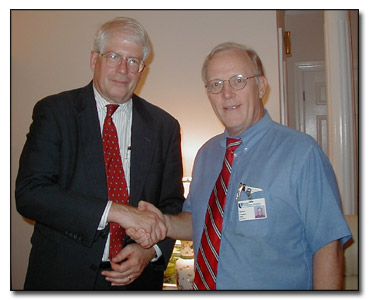
Bob, K4RLC, met Congressman David Price at a small reception recently and had a chance to discuss his support of the Amateur Radio Emergency
Communications Consistancy Act. An excerpt from an email to Eric, KG4CXW, who initially approached Congressman Price about the act follows. Bob wrote to Eric:
Followed up on your meeting with Congressman David Price at a small
reception tonight. He recalled your contact re the Amateur Radio Emergency
Communications Consistancy Act, and is proud to co-sponsor it. We discussed
the need for antennas for emergency services and he empathized abt it. His
first question to me was "Do you do morse code?" Of course, that was an
affirmative. I mentioned my HF contacts with Antarctica, and he was
fascinated with that. He asked how it could be done. I said that I was
lucky to have a 135' Zepp in the backyard. And that hams really needed to
have a decent antenna to help with local and national emergency services.
He agreed.
It was a very positive meeting, with his having a very positive view of ham
radio.
Eric, thanks for your good work, and happy to be able to follow-up.
73, Bob K4RLC
20020830-20021030.html
posted August 28th, 2002
As part of the commemoration of the tragic events of Sept 11 last year,
the Triangle Red Cross is hosting several events.
One important event is a free "Preparing for the Unexpected" which will
give information on preparing for any type of disaster, including a
terrorist attack, and how to work to keep your family safe.
This program is offered Tuesday Sept 10 at the Peartree Lane office and
Creedmoor Rd offices in Raleigh.
On Sept 12, it is offered again at Peartree Lane and the ARC office in Cary
on Ashville Ave, near Western Wake.
Also, all blood donors during Sept 9 to 13 will receive an "American Hero"
T-shirt.
Call 231-1602 to register for any of these events. On the web,
www.trianglearc.org
20020828-20020911.html
posted August 27th, 2002
The Summer edition of Cross Links, the newsletter for the Triangle Chapter
of the American Red Cross, had some nice things to say about Bob K1RCB, the
RARS Vice President.
In an article on the Hurricane Preparedness Fair, it stated, " 'We are so
grateful to Bob Breyer, Lowe's administration manager, for all his
assistance," stated Rod Thomas, Red Cross disaster mitigation chair and
event organizer. "Mr. Breyer helped us with all the logistics and supported
our Red Cross volunteers every step of the way.' "
There also is a photo of the Hurricane's mascot, Stormy "testing emergency
communications equipment" with Dick KD4ISC.
Nice work.
(Thanks to Bob K4RLC for this story)
20020827-20021027.html
posted August 18, 2002
RadarWatcher is a pet project of mine that I've recently updated and placed on the RARS web site for anyone interested in monitoring multiple weather radars simultaneously. Full documentation on how it works is available on the RadarWatcher page. Please check it out and let me know what you think.
WA2UZO
20020818-20021101.html
posted August 6th, 2002
Following is a list of the remaining training for the third quarter at the Triangle RC on Peartree La.
Logistics Operations & Simulation
Tue 8/13 & Thurs 8/15 from 6-10 PM (Both sessions must be attended)
Logistics-Generator Workshop
Sat 8/17 from 9-12 noon
Damage Assessment
Tue 8/20 from 6-10 PM
E.O.C.
Tue 8/27 & Thurs 8/29 from 6-10 PM
Family Well Being Inquiry
Sat 9/14 from 9-5 PM
Anyone interested, please e-mail Bob Scott (KG4IZA/AEC Wake County/Red Cross Liaison) your name, address and home telephone number at kg4iza@arrl.net.
20020806-20020914.html
posted July 26th, 2002
The location for the Triangle East Amateur Radio Association (TEARA)
August through November VE sessions in Smithfield, NC is being changed
from the Smithfield Public Library to the Smithfield Fire Station due
to library renovations. Dates and times remain the same.
The fire station is located about one block from the library on Fourth
Street, near it's intersection with Market Street (US 70 Business).
If you are coming west from Raleigh, it will be a right turn from
Market onto Fourth. From Goldsboro, it will be a left turn. (NOTE:
Some intersections downtown do not allow left turns. I'm not certain
about this one, so you may need to circle the block to get onto
Fourth.) Directions will be posted on the library doors on exam days
directing people to the fire station, and staff will be aware of the
move as well.
Dates for the remainder of the year are as follows:
August 17, September 21, October 19, November 16
All sessions begin at 9:30 am.
We should be returning to the library in January 2003 after the
renovations are completed.
For more info, e-mail w4fal@sera.org
Also, rumor has it that the entire group meets for BBQ after the exams!
20020726-20021116.html
posted July 20th, 2002
Rep. Price Co-Sponsors HR 4720
Amateur Radio Emergency Communications Consistency Act
Thanks to efforts by Eric Haywood KG4CXW of Durham, Congressman David Price
(D-NC) has agreed to co-sponsor the Amateur Radio Emergency Communications
Consistency Act, H.R. 4720. This bill would expand PRB-1 antenna
protection to cover private "CC&R" contracts enforced by homeowners
associations. Price is the representative for North Carolina's 4th US
Congressional District, covering most of the Triangle.
Introduced on May 14 by Rep Steve Israel (D-NY) at the request of the ARRL,
H.R. 4720 consists of one sentence:
For purposes of the Federal Communications Commission's
regulation relating to station antenna structures in the
Amateur Radio Service (47 CFR 97.15), any private land use
rules applicable to such structures shall be treated as a
state or local regulation and shall be subject to the same
requirements and limitations as a state or local regulation.
More information on H.R. 4720 can be found on the ARRL web site:
http://www.arrl.org/news/stories/2002/05/14/102/
Haywood wrote to Rep. Price in early June, asking him to co-sponsor the
bill. Price responded with a concise analysis of the bill, showing that he
understood it and its importance to Amateur Radio. Price is a co-sponsor
of the Amateur Radio Spectrum Protection Act, H.R. 817, which is also
currently before Congress.
Price was concerned, however, that "such a task would be more difficult
than reasonably accommodating modern satellite television dishes, and I
would like to know more about how reasonable accommodation might be defined
in this case."
Haywood replied that accommodation wouldn't be that hard. He said Amateurs
are resourceful in ways to erect antennas that are difficult to see, but
that when these antennas are eventually discovered in a "restricted"
environment, the Amateur is forced to take them down. He concluded,
saying, "reasonable accommodation could be defined as 'anything other than
outright refusal to work towards a reasonable and mutually beneficial
agreement.'"
To this, Rep. Price responded, "I am convinced by your description of
creative ways to accommodate the placement of amateur radio antennas in
neighborhoods subject to private land use agreements. As a result, I have
decided to cosponsor H.R. 4720."
Sincerely,
DAVID PRICE
Member of Congress
The fate of H.R. 4720 is uncertain, of course. Historically, Amateur Radio
legislation has not fared well in Congrress, usually dying without action
at the end of a congressional session. This bill's chances will improve if
all Amateurs write to their representatives asking them to support it by
co-sponsorship. ARRL President Jim Haynie W4JPB said, "It becomes
important for all of us to write your congressman, call your congressman
and voice your support. This will have to be a grassroots effort, and
we're going to pull out all the stops."
The ARRL requests that you send a copy of that mail to "ccr-bill@arrl.org".
Gary Pearce KN4AQ
NC Section Public Information Coordinator
20020720-20020915.html
posted July 9th, 2002
For those of you new to Ham radio, there is a great way to work a little DX with a few watts on 2m. Most new Hams start out on 2m so this works out well. You'll need something more than an HT antenna but most base station rigs (or mobiles) will do the trick.
During the summer, usually in the mornings, but not every morning, atmospheric conditions are just so to allow signals from as far away as New York and Boston (sometimes farther) to seep into North Carolina. This morning, for example, I was monitoring 146.64 and heard a repeater ID of K3HKI. Doing a quick lookup on QRZ.com I found that this repeater belonged to the Saint Marys County ARS in Hollywood, MD, just SE of Washington, DC.
Here is the email response I received from the Pete Butt, President of the SMCARA, after emailing him about the encounter:
---
Wow.. that is quite a long haul from southern Maryland
to Raleigh. I've noticed that the band has been ducting
in and out over the last few days.
Tom Clarke (W4OKW) and I built the local K3HKI .64
machine you heard in 1971. It has been on the air
continuously ever since. We have made some changes over
the years (upgrading and improving the system) but it has
always been located aboard the U.S. Naval Air Station at
Patuxent River, Maryland. Pax River is located about 65
miles south/southeast of Washington, D.C., on the western
shore of the Chesapeake Bay. If you look at a map, Pax
River NAS sticks out into the bay right at the mouth of
the Patuxent River. The area's claim to fame is that
we are the home of Naval Aviation where every Navy aircraft
ever produced has been tested prior to fleet introduction.
We also have the U.S. Navy Test Pilot School here which
is world famous... many of the astronauts come through here
for advanced test pilot training prior to going to NASA.
About 22,000 folks work at the base and in the vicinity in
support of the mission.
The K3HKI repeater is owned by the St. Mary's County
Amateur Radio Association (SMCARA) and you can go to our
website at http://www.qsl.net/smcara for more info about
the club. Hey...I'm the President and Tom is the VP so
we have to do some blatent advertising once in a while :)
Best of luck to you and thanks so much for the signal
report via the web.
---
What was probably happening was that I was hearing the folks talking on this repeater directly - that is - it wasn't coming THROUGH our 146.64. It doesn't mean they will hear me but there is a good chance if I transmit, they might. Mind you, if I transmit hoping to reach their 146.64 up there I will most definitely be hitting our 146.64 down here. If the repeater is not busy then a little experimentation may be OK, but be aware that you may ultimately be bringing up multiple 146.64 repeaters for hundreds of miles! Note also that some distant repeaters may require a PL tone.
Not long ago I was talking to a guy on a similar morning through a repeater up in Roanoke, VA - I looked up different repeaters in the SERA Repeater Journal. After our QSO I tuned to 146.52 and threw my call out with 50 watts and the same guy came back to me, clear as day! Pretty neat trick for a dual-band vertical mounted in the peak of an attic (yes, indoors!).
A few summers ago while driving near Nags Head, NC I recall speaking simplex with a fellow in Long Island, NY (who had a really high Yagi antenna pointed our way!) and a few other beachcombers, all while mobile!
Some fun repeaters to try on these types of mornings (that you're almost guaranteed to hit) are 145.21 in Trenton, NC 146.685 in Grifton, NC and 146.82 in Wilmington, NC. See the online repeater list for more information on these repeaters. Most of all, have fun on 2m in the early AM this summer!
de WA2UZO
20020709-20020901.html
posted June 30th, 2002
News 14 Carolina has an online story about the Hurricane Preparedness Fair.
20020630-20020815.html
posted June 26th, 2002
News 14 Carolina aired a story about Field Day. They also have an online version.
20020626-20020815.html
posted June 24th, 2002
Amateur Radio At Raleigh
Hurricane Preparedness Fair:
Saturday (June 29) - 9 to 3
Amateur Radio will be on prominent display at the Raleigh Hurricane
Preparedness Fair, sponsored by the Triangle Chapter of the American Red
Cross and Lowes Home Improvement Warehouse. The Fair will be in the
parking lot of the Lowes store near Glenwood Ave. and Lynn Rd. in northwest
Raleigh. The official address is 4831 Grove Barton Rd. The Fair runs from
9 AM to 3 PM.
Wake County ARES and Central Carolina SKYWARN will set up displays and
demonstrations. We will need some hams to help set up and operate
equipment, and act as "tour guides" for the visiting public! Another great
opportunity to get involved (and you old timers don't want the new guys to
have ALL the fun, do you?)
If you'd like to help, check the web page and schedule here:
http://www.wakeares.org/hpfair/
more info on the fair itself is available here:
http://www.trianglearc.org/ARCweb/Disaster/hurricane/prepfair.htm
20020624-20020630.html
posted June 23rd, 2002
John LeMay reports that the NEW Durham FM Association Repeaters are on the air.
444.450 Hillsborough WR4AGC (100.0 PL)
Located on the same tower
as the NEW 147.225 repeater and the NEW 224.260, just off I-40 a few miles
east of I-85 west of Hillsborough NC. Includes open auto patch.
20020623-20020801.html
posted June 17th, 2002
Read an article about Field Day Safety on eHam.net!
20020617-20020624.html
posted June 13th, 2002
I've placed a copy of a map of the counties of North Carolina for anyone who is interested. I've found this to be handy during Summer Storm and Hurricane season.
http://www.rars.org/art/nccountymap.gif
Please keep this link handy should you ever need it.
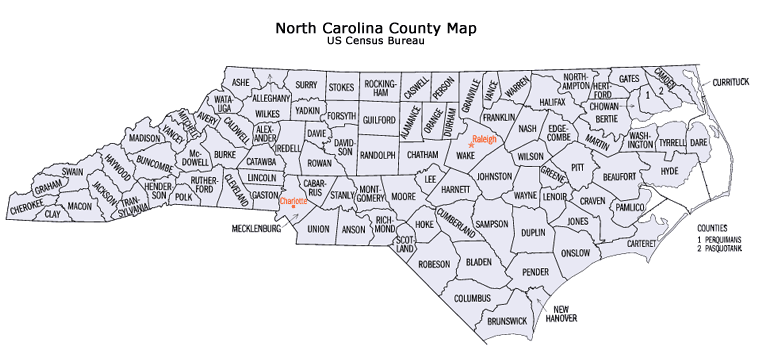
20020613-20021230.html
posted June 13th, 2002
The Virginia Beach Hamfest will be a two-day affair this year after all.
Hamfest organizers advertised earlier this year that the fest would be
reduced to one day - Sunday, Sept. 8, at it's regular location.
This week, they announced another change:
The hamfest will be two days, September 28-29, and at a new location:
PEMBROKE MALL
RT 264 EAST ^ EXIT 17 B NORTH
GO 4 STOP LIGHTS ^ TURN RIGHT IN FRONT OF SEARS AUTO CENTER
FIRST LARGE BUILDING ON RIGHT AFTER SEARS
SHOW SATURDAY 9:00 AM TO 5:00 PM
SHOW SUNDAY 9:00 AM TO 3:30 PM
DEALER LOAD ^ IN FRIDAY 12:00 NOON TO 9:00 PM
DEALER LOAD ^ IN SATURDAY 6:00 AM TO 9:00 AM
E-MAIL INQUIRIES TO HAMFEST@EXIS.NET
As of Wednesday morning, June 12, their web page was still showing the old
information, but should change soon: http://www.vahamfest.com/
20020613-20020930.html
posted June 10th, 2002
K4OO will be doing a Kid's day operation from 2PM to about 5PM in W4FAL's
neighbourhood, Saturday June 15,2002. We will be active on the following frequencies:
- 28350 to 28400 kHz
- 21380 to 21400 kHz
- 14270 to 14300 kHz
- 147.105 + Offset, PL 82.5 Hz
Purpose: Kid's Day is intended to encourage young people (licensed or
not) to enjoy Amateur Radio. It can
give young people hands-on on-the-air experience so they might develop
an interest in pursuing a
license in the future. It is intended to give hams a chance to share
their station with their children.
Dates: June 15, 2002.
Time: 1800 to 2400Z. No limit on operating time.
Suggested exchange: Name, age, location and favorite color. You are
encouraged to work the same station again if an operator has changed. Call "CQ Kid's Day."
More details at http://www.jzap.com/k7rat/
20020610-20020616.html
posted June 4th, 2002
FYI from John LeMay Durham ARES EC
Please let everyone on your local nets know that Durham ARES now has a
weekly NET!!!
Durham ARES Net
Saturdays at 10 am on the DFMA, WA4AGC 145.45(-) MHz repeater located on the Durham V.A. Hospital.
Future nets will include:
Dave WA4NID net control
20020604-20020901.html
posted May 17th, 2002
Members can visit the Members Only area to download the latest issue of The Exciter by Denyse, KG4CXR!
20020517-20020601.html
posted May 12th, 2002
Vince Yakamavich, AA4MY, became a SK on May 1st, 2002.
20020512-20020601.html
posted May 3rd, 2002
Thanks to Woody (KJ4SO) for the link to the Houston Chronicle editorial about Hams in public service.
20020503-20020801.html
posted April 27th, 2002
Although there are public service events all year long, the Spring and Summer are the most active of all. Be sure to volunteer as often as you can for upcoming public service events. You can find them listed on the RARS Calendar, on the RARS Mailing List and on the 8pm net on 146.64.
Remember, Amateur Radio is a public service first! See you at an event!
20020427-20020801.html
posted March 26th, 2002
The Cameron Village branch of the Wake County Library is currently
displaying a complete set of ARRL publications. Two sets of books were
donated by RARS member Alan Pitegoff AB4OZ, in memory of his wife Lynn
KO4QH, who died last year. Lynn had been RARS Education Director for many
years.
One set of books will be on display until the end of March at Cameron
Village (though they may be checked out from the display). The other set
is in circulation among the other Library branches.
You can see the display in the RARS Gallery.
20020326-20020501.html
posted March 21st, 2002
The Cary Amateur Radio club is sponsoring SKYWARN Spotter Training by Rod
Gonski of the Raleigh NWS office on Thursday, March 28, 2002, at 7:30
PM. Doors open at 7 PM for registration (a certificate will be mailed to
those attending). There will be NO formal cost to attend the meeting.
The location is the McKimmon Center on the NCSU Campus, on Western at
Gorman, about 3/4 mile east of the I-440 Beltline.
RSVP
The Cary club needs to give the McKimmon Center a close head-count to set
up the room, so they've requested that each person planning on attending
RSVP to: N4NC@ARRL.NET as follows:
Make the Subject of your mail: Spotter Update
and include this info:
1. your last name,
2. first name, and
3. one of the following:
Amateur callsign OR
the public service agency you represent
(e.g., Fire, Police, EMT, Sheriff, etc.).
Questions? e-mail Herb W3HL at InfoManag@aol.com
Please pass the word on the air, mention it on nets, etc. But remind
people they should try to send the RSVP. No, it's not required... just
very helpful.
20020321-20020328.html
updated March 26th, 2002
The 2000-foot tower near the small town of Broadway in Lee County was
destroyed this afternoon. The tower (or guy wires) was hit by a
small plane.
The tower supported the WKFT-TV 40 transmitter (licensed to Fayetteville),
and the PCRN's 147.105 repeater, in addition to many other two-way radio
services.
Read Details on WRAL.com
Detailed Photos
20020315-20020501.html
posted March 15th, 2002
RARS Members:
The RARS Class is humming along. We've picked up a few late class members,
and nobody's dropped out, so we stand at 15!
Now, it's your part... coming Monday, April 8, is Tune In The World
Night. This is where we have a bunch of club members bring equipment in to
demonstrate to our class members, and give them some ideas of what they
might want in their own ham shack.
You can get an idea of how it works by looking here:
http://www.rars.org/gallery/1999/fallclass/classpix-2.html
but each one is different, depending on the mix of hams and what they bring.
HOW IT WORKS:
You arrive by 7pm and set up your stuff on a table in the cafeteria at the
Nortel Technical Education Center (see http://www.rars.org/class for
directions). At 7:30, class begins with a very brief introduction of
everyone. Then, students are turned loose to investigate whatever catches
their interest. You talk to them one-on-one or in small groups.
If the weather is good enough, we assemble some mobiles in the parking lot
and bring the class out there at about 8:30 or so.
Here are some ideas of things to demonstrate:
- HF Demonstration (probably Mike WA4BPJ and Neal N4HAf)
(we have very limited space for HF antennas, so only one HF
demo can take place). Can we add PSK31 to the demo this year?
- Entry level HF equipment (you can power it up, but no
antenna facilities are available). If you want to show
some older stuff, that's OK, but be prepared to explain
the steps a new ham would have to take to make it work right.
- VHF/Dual-band mobiles and handhelds and accessories,
including a typical "first installation" of an HT, Magnet Mount,
and "life support" (power, speaker mic). Radios should be
late-model, stuff a new ham might buy new or used (no 10-
year old HTs or mobiles with no PL).
- Packet/APRS Demo
- ATV (Mark WD4KSE?)
- Antennas (Max KO4TV?)
- Accessories: Wattmeter, SWR Bridge, antenna tuner,
batteries/chargers...
- Mobiles - with HF and VHF/UHF. If you'd like to show off your
mobile, we'll gather in the parking lot and bring students out when
activity inside slows down - weather permitting.
RSVP to ME! kn4aq@arrl.net
Thanks and 73,
Gary KN4AQ
20020315-20020408.html
posted March 11th, 2002
Jim W4CAD writes about the new Raleigh Ragchew Net website run under the GRA (Graham Repeater Association) group.
Jim writes, "Several RARS members, I am also a RARS member, use the GRA 145.19 repeater and check into the net every Wednesday night at 9:30. The GRA 145.19 repeater has become very active during the last 6-9 months."
Jim also mentioned that "...additional plans are underway for using the 440 [GRA] linked system besides the ragchew, and I will keep everyone posted via the Raleigh Ragchew website exactly when we will be ready to go with nets on the 440 system."
You can contact Jim at w4cad@bellsouth.net for more information.
20020311-20020501.html
posted March 10th, 2002

For the North Carolina QSO party, I had the pleasure of operating W1VOA at
the VOA Site C in Greenville. The event was organized by Doug K4ROK (EC of
Pitt Co) who is attempting to keep this antenna field of 62 acres from
being destroyed by developers and neglect. This site formally was known as
the "Edward R. Murrow (how many remember his CBS broadcasts?) Relay Site."
Radio transmissions from around the world were received, recorded, decoded
on the eight or so huge rhombic antenna focused on political hotspots
around the world, or with the huge Log Periodic. Data was then sent to the
Pentagon via the large microwave dish. Doug hopes to keep the site alive
for use by ECU's telemedicine department and for emergency ARES
communication. Let's hope he can.
The attached photo shows part of the
rhombics to the far left, the rotatable log periodic, and the dish focused
on the Pentagon.
Bob K4RLC
20020310-20020501.html
posted March 10th, 2002
The Central Carolina Helping Hams (CCHH) in conjunction with the Durham
Red Cross chapter are pleased to announce the following two classes
available for any Amateur Radio operators in the area. These classes
are:
1.) Red Cross Communications Workshop, - Durham NC. This workshop will
outline the communications needs that the Red Cross needs fulfilled
during a Disaster situation. Participants will learn about the
available communication roles and the infrastructure provided by the Red
Cross for Disaster preparedness.
Instructor: Dave Marable
Date: March 16, 2002
Time: 9:00 am - 12:00 pm
Sponsored by: CCHH & the Triangle Red Cross
Status: This course will be held at the Durham Red Cross. There is
no cost to attend this training. However a limited number of seats will
be available for this course. All attendees must RSVP in advance to
guarantee a seat. See the sign-up page at
http://www.hampublicservice.org/CommWkshp.html for additional
information. Contact Bill Cole KG4CXY if you'd like to attend.
2.) Red Cross EOC Workshop, - Durham NC. This workshop will outline
role of a Red Cross liaison with Emergency Operation Center (EOC)
activities. Participants will learn about how Red Cross Communications
integrates with ARES and other Public Safety functions during a
Disaster.
Instructor: Dave Marable
Date: March 23, 2002
Time: 9:00 am - 3:00 pm
Sponsored by: CCHH & the Triangle Red Cross
Status: This course will be held at the Durham Red Cross. There is
no cost to attend this training. However a limited number of seats will
be available for this course. All attendees must RSVP in advance to
guarantee a seat. See the sign-up page at
http://www.hampublicservice.org/EOC.html for additional information.
Contact Bill Cole KG4CXY if you'd like to attend.
Bill Cole KG4CXY
Central Carolina Helping Hams
http://www.hampublicservice.org
20020310-20020323.html
posted March 7th, 2002
View photos of the March meeting celebrating RARS 33rd year and awarding those who have helped the club throughout the year! Public service volunteers, officers, board members, net control operators, and more were recognized!
20020307-20020501.html
posted March 2nd, 2002
KJ4SO/R is back on the air !!!! The two yagis are in place with 7/8" heliax
to the equipment building. Forward power out of the duplexer is 65 watts
with hardly a flicker of reflected power. The duo-band vertical is
connected to the control receiver with 7/8" heliax. Two runs of rotor-type
cable and two runs of CAT-5 cable also go from top of monopole to the shack.
Both antennas are 160' above ground, 852' above mean sea level, and 400'
above average surrounding terrain.
The picture looks great at my QTH. Pass the word on to the the rest of the
group so they can try it.
73 de WA4WTX.
20020302-20020501.html
posted February 8th, 2002
The Cary Amateur Radio Club is going to hold the March 28, 7:30 p.m., meeting at the
McKimmon Center, NCSU Campus, Western Blvd., Raleigh, NC, to host the NWS
Spotter Update by Mr. George Lemmons, NWS.
The meeting will forego the usual CARC business to devote the entire
meeting to the Spotter Update.
All interested Radio Amateurs are invited to get "updated" at the meeting.
Amateurs from Wake, Durham, Chatham, Johnston, Franklin Counties are
invited to attend this very timely meeting. The hurricane and bad weather
season is about to start.
Mr. Lemmons has asked us to publicize this meeting within the Amateur
community ONLY. Please do not "go public" with information about this
meeting (e.g., TV, newspapers, etc.). But DO talk it up on the repeaters,
at meetings, etc.
The Cary ARC will be sending letters of invitation to as many clubs as we
can get addresses for.
CARC's only purpose is to try to make Mr. Lemmon's valuable time more
effective by gathering as big a group of hams as we can for his interesting
and informative presentation.
73 :-)=)
Herb, W3HL
20020208-20020328.html
posted January 19th, 2002
The RARSfest coordinators are looking for volunteers for security, stage help, tickets, etc. You name it, there is probably a spot for you! Please contact Chairman Hank Montgomery (K4HM) at k4hm@arrl.net and he will put in touch with the correct volunteer coordinator given your interests.
20020119-20020414.html
posted January 5th, 2002
The activated county map is now up at the NC QSO Party page-
http://www.w4nc.org/ncqsoparty.html
Please forward this info to any hams you know who might be interested,
especially in state- ARES officials especially- who can let their
counties know. Our goal is 100% county activation!
73, Henry, N4VHK
posted January 11th, 2002
The Raleigh Ragchew net held a Holiday QSO Get Together hosted by w4cad (Jim) and N4bev (Bev).

BACK ROW: Jim (w4cad), David (kf4vxj), John (kb4dgj), Ray (k4tex), Jeff (kg4pql), Bruce (kc4uqn)
FRONT ROW: Bev (n4bev), Shirley (k4tey), Virginia (kg4pfa), Robert (kg4bdx)
Raleigh Ragchew net...145.19 GRA Repeater every Wednesday night at 9:30pm.
posted November 22nd, 2001
Danny Hampton K4ITL has put up a new, wide-coverage 220 repeater on 224.16 MHz (no tone, and the usual 1.6 MHz offset). The repeater is on one of the big TV towers southeast of Raleigh, "way up in the air" according to Danny. Initial coverage looks very good, with a bit of a null to the east toward Wilson.
Danny has included a UHF link to the PCRN network, but ran into some glitches after the repeater was installed, so the link isn't available yet.
Time to dust off the 220 gear and give it a try!
73,
Gary KN4AQ
posted December 9th, 2001
The packet node RNCLAN has been removed from service, with no plans for replacement. The node, operating on 147.54 MHz under Will Harper's callsign K4IWW-3, had been on the air from the North Hills area for over a decade, providing a link from stations in north Raleigh to the local packet BBS. Recently the management of the building housing the equipment decided to use the closet and roof space for other things. If anyone used the RNCLAN regularly, please contact Will at k4iww@attglobal.net.
posted November 10th, 2001
An MP3 file is up on the http://www.kd4raa.net web page. It's about a 2 MB download, easy for DSL/Cable and not too bad for dial-up. The audio runs about 16 minutes, and includes the whole contact, plus many hams from around the world checking in on IRLP (KD4RAA and K4JDR took the local broadcast and put it out on IRLP, where it was picked up by 37 repeaters worldwide).
posted October 29th, 2001
The 2001 Field Day results are now on the ARRL Members Only web
page. Here's how we did:
W4DW placed 2nd in 8A!
Our 10,828 points put is right in the rocking chair. First place was taken
by N6ME, the Western ARA, with (better sit down...) 17,326 points, blowing
our previous 8A wins off the map. They placed 6th overall in the "top 10"
box. And third place went to the Mississauga (Ontario) ARC, VE3MIS, with
5,692 points.
If we hope to capture 8A again, we'll need to brush up, or hope CA really
does crack off into the ocean!
Meanwhile, downtown, W4RNC shows up at #124 in the very competitive 2A
class. That's out of about 448 total entries (I counted quickly - might
have missed a couple). Not bad at all!
The Cary ARC, N4NC, placed #32 in 2A, a very respectable showing, so
congratulations to them!
The Orange County Radio Amateurs (OCRA), W4EZ, WON the 6A Battery class
(again!). Congrats to you guys, too!
The Cape Fear ARS (Fayetteville), N4NG, came in 12th in 2A - the highest NC
showing in that class.
The Knightlights, WQ4RP, took 14th in a very busy 3A Battery class.
A group called the Frogmore Stew and Brew Crew, with the familiar call WW4M
(that's Jim Price, who made the IRLP presentation at the October RARS
meeting), almost had the distinct honor of bottoming out the 2A
class. Only three other groups managed to slink below their 506
points. And there's a story there that's I've only heard part of. Ask Jim
or Danny KD4RAA.
Our neighbors in Franklin County, using KQ4MS, placed in the middle of 4A.
DFMA brought up the rear of 6A Battery with a 6th place finish.
Time to relive those Field Day moments - check the pictures in the RARS
Gallery - http://www.rars.org/gallery.
73,
Gary KN4AQ
posted October 29th, 2001
Georgia Orienteering Club (GAOC) has been selected to host the Second USA
ARDF/Radio-Orienteering Championships, to take place April 19-21, 2002 at F.
D. Roosevelt State Park near Pine Mountain, Georgia. The competition will
get under way on Friday afternoon with a practice event, followed on
Saturday
by the main two-meter hunt and on Sunday by the 80-meter hunt.
In addition to the hunts, there will be a cookout on Friday evening, a
spaghetti dinner on Saturday night, and an award ceremony following the
80-meter hunt, all included in the registration fee.
The USA ARDF/Radio-Orienteering Championships are open to anyone, from
beginner to expert. Competitors will be placed in age/gender categories,
with
awards for first/second/third place in each category. Foreign visitors are
welcome. Awards will be presented in two divisions, Overall and USA-Only.
Pine Mountain is approximately 90 minutes southwest of Atlanta. Lodging
options include cabins in the park and campgrounds with RV hookups. There
are also many local motels and bed-and-breakfast inns.
Laurie Searle KG4FDM of GAOC is the Meet Director. Sam Smith N4MAP will set
the ARDF courses. Robin Shannonhouse is Registrar.
For more details, go to the Georgia Orienteering Web site and click on "Special Events - Radio-O
Champs." There you will find the event flyer, rules, and registration
forms. Registrations are now being accepted.
Slovakia will host the next ARDF World Championships in fall 2002.
Positions
on Team USA for these championships will be determined by individual
performances in the Pine Mountain events, as well as in last summer's USA
Championships in Albuquerque.
Joe Moell K0OV
USA ARDF Coordinator
www.homingin.com
posted October 7th, 2001
The RARS Forum has been updated and is now the RARS Yahoo! Group.
To join the group and begin posting messages and chatting immediately, visit the RARS Yahoo! Group page.
Using the RARS Yahoo! Group you can not only post and read messages online but you can also choose to receive them via email either individually or as a digest. Searching the archive is also available as are many other message-related tools to make communication between members even easier than ever!
You can also chat live with other RARS members in the Java-enabled RARS Chat area. Chat during nets or whenever you like.
We hope you enjoy the new RARS Yahoo! Group!
updated September 25th, 2001
There is now one consolidated RARS calendar that contains all club events, public service events and other types of events of club interest. Please visit the dynamically updated RARS Calendar and be sure to volunteer for an upcoming public service event.
Also, I've implemented a web search form on the site. If you go to the main page and scroll to the "Searches" section you will see a fourth search added. Type text into the RARS.org box and press your Enter key. You will see a listing of all pages on the RARS web site that contain the text you typed. The search is pretty nice, please play with it and let me know what you think. You can also click here to play with the search if you're too lazy to go back to the main page.
Note also that the search has a Site Map feature. Lastly, you can see What's New on the site as well. The site is re-indexed every Monday at about 3am ET so all the weekend updates should be available when you get to work in the morning!
Hope you enjoy this great new feature!
posted October 22nd, 2001
The Phillips Middle School in Chapel Hill has an ARISS Space Station
contact scheduled for early November. NASA hasn't given them the exact
date, but it should be the week of November 12.
Barbara Pedersen KE4JZM is a teacher at Phillips. She uses Amateur Radio
in class, and teaches ham classes to students as well. Her classroom is
equipped with a working satellite station, including 144 MHz and 440 MHz
beams that can be rotated in elevation and azimuth, which will be used for
the ARISS contact. Several hams from OCRA (Orange County Radio Amateurs)
are assisting in setting up the contact.
The contact will be "broadcast", probably on the OCRA 442.15 repeater, as
it happens.
Stay tuned for updates.
posted October 31st, 2001
Barbara Pedersen KE4JZM's science class at Phillips Middle School in Chapel
Hill will "reach new heights" next Tuesday, with a scheduled contact with
the International Space Station. The contact, part of ARISS (Amateur Radio
on the ISS), was just confirmed today (Wednesday, Oct. 31). Members of
OCRA (Orange County Radio Amateurs) are helping make the contact possible.
The contact is scheduled on a Space Station pass that begins at 12:46 PM
EST on Tuesday, November 6th. This pass lasts just over 10 minutes, and
reaches an elevation of 72° over Chapel Hill at 12:51 PM, travelling from
northwest to southeast. If a problem prevents a successful contact on
Tuesday, a backup is scheduled for Friday, November 9th at 11:31 AM.
Students from throughout the school submitted questions to ask, and a panel
of teachers selected the "winning" questions. The prize for the students
who wrote the questions is getting to step up to the microphone and ask the
question live during the ISS pass. KE4JZM's classroom features a permanent
amateur radio station for HF, VHF/UHF and satellite operation. The
satellite station will be use to make the contact.
The contact will be broadcast live over the OCRA 442.15 repeater, and the
school's cable TV system.
This is only the second school contact with space for the Triangle
Area. In 1992, RARS helped Wake County students complete a contact with
the Space Shuttle Endeavour in what was then termed SAREX, the Shuttle
Amateur Radio EXperiment. The program transferred to the Space Station
after a permanent Amateur Radio station was installed earlier this
year. For several years, the ham station aboard the MIR space station was
also used to make school contacts, supplementing the SAREX
program. Pedersen and OCRA applied for a shuttle or MIR contact nearly
five years ago.
There are many web sites featuring ARISS operation. A good place to start is:
http://www.arrl.org/ARISS/, and
http://spaceflight.nasa.gov/station/reference/radio/
posted November 5th, 2001
Barbara Pedersen KE4JZM's science class at Phillips Middle School in Chapel Hill will "reach new heights" this Friday, with a scheduled contact with the International Space Station. The contact, part of ARISS (Amateur Radio on the ISS), was originally scheduled for Tuesday, but was just postponed by NASA until this Friday, November 9, at 11:28 AM.
This pass lasts just over 10 minutes, and reaches an elevation of 60° over Chapel Hill at 11:33 AM, travelling from northwest to southeast. Since this is the "back-up date", no additional back-up has been scheduled at this time.
Students from throughout the school submitted questions to ask, and a panel of teachers selected the "winning" questions. The prize for the students who wrote the questions is getting to step up to the microphone and ask the question live during the ISS pass. KE4JZM's classroom features a permanent amateur radio station for HF, VHF/UHF and satellite operation. The satellite station will be use to make the contact.
The contact will be broadcast live over the OCRA 442.15 repeater, and the school's cable TV system.
This is only the second school contact with space for the Triangle Area. In 1992, RARS helped Wake County students complete a contact with the Space Shuttle Endeavour in what was then termed SAREX, the Shuttle Amateur Radio EXperiment. The program transferred to the Space Station after a permanent Amateur Radio station was installed earlier this year. For several years, the ham station aboard the MIR space station was also used to make school contacts, supplementing the SAREX program. Pedersen and OCRA applied for a shuttle or MIR contact nearly five years ago.
There are many web sites featuring ARISS operation. A good place to start is:
http://www.arrl.org/ARISS/, and
http://spaceflight.nasa.gov/station/reference/radio/
73,
Gary KN4AQ
posted September 17th, 2001
What: RARS Code (CW) Classes
When: Starting on Monday, October 1st and running on Monday and Thursday nights until Thursday November, 8th. Classes are from 7pm-8pm all nights.
Where: The classes will be held at the Nortel Training Center on Rt. 54 west of the Fairgrounds.
For more information please contact:
Clyde Carl (wb2eyc) 481-0888 fourcarls@g12.com
Neal Fisher (n4haf) 848-8840 n4haf@nc.rr.com
Charlie Brown (w4vfj) 556-8551 w4vfj@aol.com
Class minimum is 6, class maximum is 11 for each trainer.
See the RARS Online Calendar for scheduled dates.
posted September 17th, 2001
TEARA Technician Licensing Class
General: The Triangle East Amateur Radio Association is proud to sponsor a Technician licensing class for prospective amateur radio operators. This class will be held on Monday nights beginning October 1, 2001 and running through November 26, 2001 at the Knightdale Fire Station Number 2. This class will prepare the student to take the "no code" Amateur Radio Technician exam. In addition, for those who wish to obtain high frequency (HF) privileges, code instruction will be provided at no extra charge.
Costs: Fee for this class is $25.00 and includes the text, "Now You're talking", and code practice software for all who desire it. The last session will be an examination session conducted by the TEARA VE Team. A separate examination fee of $10.00 will be collected by the VE team as required by the F.C.C.
Location: The Knightdale Fire Station Number 2 is located near the intersection of Poole Road and Clifton Road in Knightdale!
Time: The first session begins at 7:00 p.m sharp and goes to 9:30. For all subsequent sessions, the code class begins at 7:00 and the theory class begins at 7:30.
Additional Information: For additional information, contact: k4bwc@arrl.net, w4fal@arrl.net, ka4puv@arrl.net or call Bill Edwards at Omega Electronics at (919) 266-7373.
posted August 26th, 2001
The N4ZBB 444.675 + (100.0 pl) repeater signs on the air from Hwy 55 and
Cornwallis in the Research Triangle Park. Designed coverage area favors
the west-southwest of the RTP but includes mobile penetration as far east
as RDU airport. The repeater will be linked to the KD4RAA- K4JDR repeater
linking system and will have the features of the link system including the
MTS Weather Alert, autopatch and IRLP internet linking access.
Primary
participants in the project include: Charles Durst WA4WTX, Danny Musten
KD4RAA, Ken Edwards N4ZBB, Ron Casey K4JDR, Harold Henion KF4AUF, Charles
Bruckner KG4MXV, and David Thompson. More information on the 444.675
repeater can be found on the KD4RAA Repeater Group website at
http://www.musten.com/kd4raa.
posted August 26th, 2001
The KD4RAA repeater group recently activated North Carolina's first node
for the Internet Repeater Linking Project on 146.775 MHz. IRLP is a
growing cooperative effort linking more than 150 repeaters across North
America, Australia and England. Participating repeater owners use
full-time high-speed internet access, allowing local users to link to
repeaters around the world. Information on IRLP can be found at
http://www.irlp.net, and global maps of IRLP nodes are at
http://www.ipass.net/~jimprice/irlp/. The IRLP Linux-based interface and
control board is the brainchild of Dave Cameron VE7LTD in Vancouver,
British Columbia.
The 146.775 NC4SU repeater is operated by the KD4RAA Repeater Group for
the NCSU StARS, W4ATC ( http://w4atc.ncsu.edu ) and is linked to several
440 MHz repeaters operated by the Group. It's on the air from a 350-foot
tower west of the North Carolina State Fairgrounds in Raleigh and requires
88.5 Hz tone. Regular coverage extends from Pittsboro and Durham to
Smithfield.
Needless to say this is VERY COOL. For information on IRLP
operation see http://www.musten.com/kd4raa/guide.html.
posted August 19th, 2001
Cary-based Marshall Brain's HowStuffWorks web site has a nice article on How Ham Radio Works.
updated August 20th, 2001
Jay Diepenbrock KM4EP, Assistant Scoutmaster, Troop 104, is coordinating the Radio Merit Badge program at the Occoneechee Council Fall Camporee to be held October 12,13,14 at Fort Bragg.
Jay is mainly interested in help from some hams who can set up a
demonstration station and operate it from the event. This would probably
be a Field Day type station, but Jay can give you details on what
facilities are available.
Anyone a little deeper into Scouting can also help teach the Radio Merit
Badge material, but that wouldn't be required.
posted August 1st, 2001
Gary (KN4AQ) sends the following:
"One other network that's been around a while in the Southeast is called
SEDAN (Southeastern Emergency Digital Association Networks). SEDAN is
dedicated to keyboard-to-keyboard live communication (chat-room?),
operating on 145.77 at 1200bps throughout the Southeast, with a network
backbone on six meters at 9600bps. There's a good chance that there's a
node near you. SEDAN says their purpose is emergencies, but they're tested
by regular ham use... so connect and use it up!"
Gary continues, "On one recent attempt where I *thought* I was doing things right, I got from home near Raleigh, NC, to a node outside Atlanta, GA, before things got so agonizingly slow that I called it quits (responses took more than 4 minutes to come back from the Georgia node). I was going through three or four nodes at the time, but without a good map it was hard to tell just where I was. I stopped to CQ on each one, with no replies anywhere on that Saturday afternoon. I suspect I was making more than one mistake, but I didn't know what to expect."
Visit http://www.sedan-central.org/ for complete information.
posted September 13th, 2001
Call-in:
Both 146.52 simplex (amateur) and C.B. Channel 10 will be monitored
if anyone needs help finding the gate.
Location: Jordan Lake Crosswinds Pointe Park (same as last year).
Directions: From Raleigh, take highway U.S. 1 south to highway 64 west. Follow
highway 64 west to Wilsonville. (stoplight, Exxon on left, Amoco on
right). Go through the stoplight past the Amoco market to the next
place where you can make a right turn. This will be Crosswinds
Pointe Park. There will be a white "USCG-AUX" signs posted close to
the road that have arrows on them pointing to the park entrance. The
park entrance has a closed gate. The gate will not be locked. Open
the gate to enter and close the gate behind you when entering or
leaving the park.
Time: Arrive anytime after 3:00 pm. We can stay until 10:00 pm???
Facilities: There will be 2 picnic tables, electricity, some enclosed shelter,
BBQ grill, drinking water and basic bathroom facilities (portable
john)
Bring (all optional, if needed): Radios, Accessories, headphones, extension cord / power strip,
folding chair, folding table, frequency lists, any personal care
items (bug spray, sun screen,...), flashlights, food and drinks. NO
ALCOHOL DRINKS PERMITTED IN THE PARK.
Antenna: For the desktop type of receivers, we plan to have set up a random
wire that will be feeding an amplifier / splitter to feed several
receivers at the same time. This worked out very well last year.
(Thank you Charles.)
Rain: Event cancelled if raining. No rain date.
Questions: Send e-mail to Bob Zeher; ke4jvy@nc.rr.com
posted July 30, 2001
The Maysville, NC ARS is having their hamfest on October 14, 2001. For more information please contact Jean Dupree (KB4OHX) at jeanhd@icomnet.com.
posted July 24, 2001
Gary (KN4AQ) has provided some great photos and copy of the State Capitol 2001 Field Day location. Be sure to check them out here. Thanks Gary!
posted July 1, 2001
Jeff AC4ZO has calculated the score for the RARS Capitol Field Day operation. Operating in the competitive 2A class (and not trying to be competitive), Jeff predicts a top 25% finish anyway! Details are available here.
posted July 16, 2001
The following is from a posting to the tarheelscanner mailing list:
The CC-AWA presents the "Summer Swap/Antique Radio Collector Meet" at the NC State Fairgrounds L.R. Harrill Youth Center in Raleigh, NC. The event will be held Saturday, July 28th, 2001 from 8am until 12 noon. Admission and setup are FREE. Meet chairman: Mr. Ed Bell.
Directions to L.R.Harrill Youth Center Take Exit 3 (from either direction) off of the Raleigh Beltway (440) onto Hillsborough St. Go West (right) on Hillsborough St. Go past N. C. State Fairgrounds. Turn right on Youth Center Rd. Enter L. R. Harrill Center at Gate 6. You're there!!!
For complete information about the Carolinas Chapter of the Antique Wireless Association visit their web site.
posted July 15, 2001
Macintosh Users will want to check out Stimpsoft's new Solscape "Solar Data Browser" application. Check out the screenshots on the web site.
From the Solscape web site: Solscape is a "Solar Data Browser" application that grabs real time, up to the minute images of the Sun in multiple light wavelengths. Solscape also monitors current solar flare, geomagnetic, and Aurora activity, providing current Aurora Borealis information and warnings for your location, along with real time Aurora images when available. Solscape gets all of its information via the Internet and compiles it in a single, easy to use application. You can save and archive the data that Solscape collects for later use, and you can tell Solscape to automatically grab the data when you want.
posted July 10, 2001
The Crohn's and Colitis Foundation of America (CCFA) sent a letter today thanking Amateur Radio Operators for their volunteer work at the 20th annual Run and Walk for Research in RTP, NC.
"The event was a huge success. With over 475 participants, and your generosity, we raised over $26,000 for CCFA research and education."
"We are grateful for both your time and energy, which has helped us make a difference [to more than one million Americans, including 100,000 children who suffer from these devastating diseases.]"
Thanks to all the Amateur Radio operators who helped out with the event this year!
posted July 2, 2001
Mike WA4BPJ has posted the score for the RARS Apex Field Day operation. We don't see them on the web site yet, so we'll put the details here:
We were 8A. 42 people participated in one of the best operations ever! 5 of those were unlicensed. This year saw 3 new band captains and one of those was out for his first field day! 165 digital contacts on PSK31 and RTTY!
| BAND | QSOs | POINTS | BONUS POINTS | |||
| 80CW | 65 | 260 | Emergency Power | 800 | ||
| 80PH | 197 | 394 | Site Visit | 100 | ||
| 40CW | 812 | 3248 | Press Release | 100 | ||
| 40PH | 1098 | 2196 | Unusual Modes Demo | 200 | ||
| 20CW | 73 | 292 | Copy ARRL Bulletin | 100 | ||
| 20DIG | 165 | 660 | ||||
| 20PH | 810 | 1620 | ||||
| 15CW | 22 | 88 | ||||
| 15PH | 168 | 336 | ||||
| 10PH | 126 | 252 | ||||
| 6PH | 87 | 174 | ||||
| 2PH | 4 | 8 | Total Points = 10,828 | |||
Some 8A History...
| YEAR | 1st | 2nd | 3rd | Entries |
| 2000 | 12510 (RARS) | 11730 | 7510 | 14 |
| 1999 | 11170 | 9772 | 9650 | 15 |
| 1998 | 13802 (RARS) | 10658 | 6934 | 14 |
| 1997 | 12096 (RARS) | 11372 | 7370 | 7 |
So based on the past 4 years, we're a probable 3d, 50- 50 for 2nd and not a likely 1st in perhaps 15 entries.
73,
Mike, WA4BPJ
posted June 30, 2001
Joe Zobkiw WA2UZO is the guy responsible for the new look on the RARS web site (we won't call him webmaster - he doesn't like the term!). So far, that look is just on the home page, but over time, expect many pages to be spruced up. And a lot of the work Joe has ahead of him won't be seen by site visitors - there's a lot of "background noise" to clean up on the web server, debris left by many hands contributing to the site over the years.
RARS thanks Ashby Spratly III KB5ZIH, who took on the webmaster job at the beginning of the year. Ashby never had time to dig in the way he wanted, and recently he has announced his engagement (!), a little item in life that will keep him very busy for the next few months. Ashby graciously backed out instead of letting things drag on.
And speaking of behind the scenes, thanks to Errol Casey KD4IHW. Errol does a lot of the technical work at our host, RTPnet, and has kept the RARS site up to date as we've moved through various web wizards. He also keeps the NCARRL web pages together.
The RARS web site has a lot of content. If you haven't browsed it lately, spend some quality time looking around.
posted June 30, 2001
A special Tarheel Net met Saturday morning, June 30, to find out how many counties could communicate and send messages to the State EOC in Raleigh. Lots of new operators got training across the state. For info, see the Wake ARES web page.
posted June 26, 2001
The Cary Amateur Radio Club Midsummer Swapfest is coming Saturday, July 21st. The Swapfest is located in the Cary Community Center, at the corner of Academy and Chapel Hill Road. The doors open at 8. Advance tix are $4, and $5 at the door. Indoor tables are $10. Talk-in on 145.39 (82.5 tone). For tables or more info, contact Will Harper K4IWW . The Swapfest is mostly indoors, but also has a free outdoor section in the parking lot that guarantees heat, rain, or both.
To get there from north Raleigh, take I-40 to the Harrison Ave. exit, and go south about two miles to Chapel Hill Rd. Turn left and go one block to Academy, then turn right, drive a hundred feet or so and turn left into the Community Center driveway.
From farther south, take I-40 to NC 54 (or just head west past the Fairgrounds on 54), and go west to Academy St. Then turn left on Academy, and left again into the driveway. (Note to oldtimers: NC 54 has been re-routed as it passes through Cary, and the section of Chapel Hill Road by the Community Center is no longer NC 54).
posted June 26, 2001
Well known DX'er Pedro Allina, HK3JJH, from Bogata, Columbia will the featured guest at a reception at the Holiday Inn, Winstead Avenue, Rocky Mount. The reception will be held on Saturday, July 7, 2001 from 1 pm to 5 pm. This event is sponsored by Carl Smith, N4AA, publisher of The DX Magazine and the QRZ DX Newsletter. Carl is also the QSL manager for Pedro's recent HK0/M Malpelo Island DX operation.
The reception will be very informal, drop in any time for as long as you like. Soft drinks, coffee, and snacks will be available throughout the afternoon. Details here.
posted June 25, 2001
Members of the Castalia Island DX Assn. and the Tar River ARC of Rocky Mount NC will participate in the International Lighthouse Weekend August 18 & 19th with an operation near the Currituck Beach Lighthouse (USA 212) on the Outer Banks of North Carolina. The callsign for the operation will be K4UP. QSLs go to K4UP. More information can be found at:
http://www.qsl.net/cidxa/currituck.html
A list of scheduled amateur radio operations at lighthouses all over the world during this weekend can be found at:
http://vk2ce.com/illw/2001.htm
We look forward to many contacts from North Carolina hams!
posted June 25, 2001
RARS dual Field Day effort - 8A at the Carrol's farm in Apex and 2A downtown on the lawn at the State Capitol - was a great success. New band captains volunteered in Apex to provide both cw and phone on 80, 40 and 20, plus one station each on 15 and 10, plus VHF. The only stations missing were Novice/Tech and data (RTTY, PSK, Pactor, etc). Most available bonus points were collected.
Meanwhile, downtown, the brand new 2A operation made a big impression on the public from the southwest lawn of the State Capitol. Operation was a bit more laid-back as each station roved across whatever bands were open. Many RARS members, and a soaking overnight rain, visited both locations.
Next, the scores will be totaled and entries submitted, and we'll process the mass of photos taken. You'll find results of both efforts here on the web site in the coming days.
If you have a story to share in the Exciter, send it to Karl K4LNX.
posted June 25, 2001
Vince Heffron KF4ZMV (heffer-at-mindspring dot com) is looking for help with a substntial APRS effort at the MS-150 bike tour this September 8-9. The biggest need is for many "trackers" - packages combining a GPS, TNC and transmitter - to be placed on key vehicles to track their location. If you have APRS equipment, or are interested in learning about it quickly, drop Vince a line.
revised June 28, 2001
And speaking of public service events, the Public Service Calendar is filling up. The MS-150 is set for September 8-9, with a new course centered on New Bern. On just the 9th is the Familias Del Pueblo 10K Run in Chapel Hill. September 20 brings the Light the Night walk in downtown Raleigh, followed by the Duke Liver Center Triathalon at Jordan Lake on the 30th. The last thing currently on the schedule is the State Fair, where we provide radio operators for the Red Cross for three 5-hour shifts all 10 days, from October 12-21.
This all adds up to a lot of ham radio participation! The hams in the Triangle are up to it, but please do your volulnteer coordinators a favor - don't wait to the last minute to let them know you'll help. Volunteer early, and if something comes up and you have to drop out, they'll understand.
posted June 19, 2001
Lynn Pitegoff KO4QH died early Tuesday morning, June 19, at her home in Raleigh. Lynn was a long-time member of the RARS Board of Directors, as Education Director. She also served as a VE, and chief promoter of the RARS Crystals (a group for the women in RARS).
Lynn is survived by her husband Alan AB4OZ. They did not have any children.
posted June 13, 2001
A new SKYWARN operation has begun south of the Triangle. SANDHILLS SKYWARN has picked up the reins from Fayetteville SKYWARN, and moved to the Broadway PCRN repeater on 147.105 (with a new 82.5 Hz tone). This gives much greater coverage than was obtained from the Fayetteville 146.91 repeater. More info on the Central Carolina SKYWARN web page.
posted June 7, 2001
The Piedmont Coastal Traffic Net needs volunteers to act in many capacities. The PCTN is slated to meet each and every night at 9 PM on the 146.88 repeater. Our purpose is to handle incoming and outgoing traffic and to train traffic handlers and net controllers for the real world emergencies that can sometimes catch us all off guard. Our greatest need at the moment is for Net Controls. Experience is not required, we can get you up and running. We also need people to handle traffic to and from various local, area, and regional nets, if possible.
PCTN has been in limbo for about a year or so, mostly due to my fault, but we are trying to get this thing back up and running. If there is anyone who feels they can help us any night at 9PM on the 146.88 repeater, please contact me in any of these various ways:
- k2ezx@arrl.net
- ezx@bellsouth.net
- you can post at our Yahoo groups, which is "pctn"
- you can soon see our web page coming up on qsl.net (not there now...)
- you can write me, go to a callsign search and look for me
- you can call me! I AM in the phone book, but no phuny phone calls, please!
Thanks, and 73s! Eric K2EZX
posted June 6, 2001
Karl Ulrich K4LNX has agreed to take over editing the RARS Exciter newsletter from Gary KN4AQ. Gary is stepping up to edit the SERA Repeater Journal. Gary handed off Exciter production matierials to Karl in late May, and Karl will be producing the July issue.
The Editor position is an elected position on the RARS Board. Karl will be officially the assistant editor until the next elections in November. Then (assuming you all elect him), he'll become the editor.
Thanks, Karl, for jumping into this important club position! Anyone with information for the Exciter please contact Karl (address changes to to the club Treasurer).
posted June 2, 2001
Greg Seamster KE4PAX, RARS' treasurer, has announced that RARS members can now choose to receive the Exciter in both print (mailed to you via the post office) and pdf (e-mailed - required Acrobat Reader). Up until now, you had to choose one or the other. Click for details. Note that the print issue does cost the club treasury considerably more than the nearly free pdf version. KN4AQ has proposed a revision to the RARS dues structure that will essentially create two "tiers" - higher dues to receive a print copy, and lower dues for those who take only the pdf. The proposal will be discussed at the June Board Meeting.
posted May 21, 2001
Club dues for most RARS members are due July 1st. The June Exciter includes a renewal form and information update sheet. Electronic Exciter subscribers will get a separate mailing from the Treasurer.
RARS Approved for State Capitol Field Day site (this item posted June 6, 2001)
The North Carolina Department of Administration has approved RARS' application to set up a Field Day station on the lawn at the Capitol building on Salisbury St. This will be in addition to the main RARS Field Day effort at the usual site in Apex. Gary KN4AQ, Jeff AC4ZO and Dick KD4ISC will "band captain" the Capitol operation (and will need some help with setup and operators). Mike WA4BPJ is in charge of the Apex operation. Click here for more Field Day information.
147.135, 442.15 Repeaters Back on air in Orange County (this item posted May 9, 2001)
PCRN's 147.135 (82.5 tone) repeater, at 1000 feet up the WUNC tower in Orange County, is back on the air after an extended absence. Actually, it was hardly missed, since it had only worked for a few weeks before an amplifier failure took it down last fall. Danny Hampton K4ITL says it's still not working the way he thinks it can - it needs some more antenna work. But it should provide wide-area coverage between the Triangle and Triad.
And OCRA's wide area 442.15 (131.8 tone) is also back on the air, after a controller failure a few weeks ago. New repeater hardware and the "PCRN Audio" treatment have improved it's sound as well. The two repeaters sit side-by-side on the WUNC tower. OCRA's Six Meter machine on 53.45 is also getting some work done and should have a better signal soon..
And RARS new repeaters? We haven't said a lot about them, but we will soon. A new 146.64 and 444.525 are almost ready to put on the air. 525 should be improved to the point of actually being on the air... it's been down since the tower move except for a brief appearance last year. 146.64 might be a wee bit more sensitive, and should have better weak-signal squelch performance. The 88.5 tone will return to the transmitter. Keep an eye on the Exciter Web Update for news.
KG4HDT, N4TAB Appointed full ECs (this item posted May 10, 2001)
Tom Brown N4TAB , and John Guerriero KG4HDT are now full-fledged ECs for their respective areas, though they continue to insist that there is no sharp division of responsibility. SEC Dave Fleming KE4JHJ has removed the "acting" from their titles as of May 9th. Tom is now officially the Wake County EC, and John is NCEM EC. Their combined responsibility covers Wake County ARES (County EOC and field operations) and the State EOC.
Congratulations to both, and thanks for stepping into these critical jobs for Wake County and NC Amateur Radio.
Hams Provide Critical Tour de Cure Communications, May 5/6 (this item posted May 8, 2001)
More than 40 hams from the Triangle, RARS, and clubs across Eastern NC joined to provide logistics and safety communications, and all the SAG Wagons, for the American Diabetes Assn. Tour de Cure, May 5th and 6th. The Tour is a 180 mile bike tour that starts in Zebulon (at the Mudcats' stadium) and follows the back roads to Manteo, at the Outer Banks. The overnight stop is in Williamston.
Communications generally went well, although unusually poor propagation to the Farmville 145.27 repeater caused some difficulty near the starting line. The Farmville, Williamston 145.41, Rocky Mount 147.12 and Columbia 146.835 repeaters were linked together to provide coverage. All positions were filled with hams to spare, thanks to recruiting efforts by Gary KN4AQ, Eric KF4OTN, and hams from many clubs. Up to 21 SAGS were on the course at the high point.
The highlights included taking care of a rider who fell crossing a railroad track and broke his arm on Saturday, and high winds that required SAGGING all 120 riders across the long bridges at the Alligator River and Mann's Harbor on Sunday.
Jeb Brookshire, the Tour Coordinator for the ADA, expressed his appreciation (more than once as the tour progressed to his shadow KN4AQ), and said he didn't know how they could do this kind of operation without help from ham radio.
Watch the Exciter and the Gallery for stories and photos from the Tour.
Senate Bill 838 Would Eliminate $10 Amateur Radio License Plate Fee
(this item posted April 19, 2001)
State Senator Robert A. Rucho (R, Mecklenberg County) has introduced a bill that would eliminate the $10 fee for Amateur Radio license plates. That would put Amateur Radio operators on par with Active Members of the National Guard , 100% Disabled Veterans, Ex–Prisoners of War, Legion of Valor and Purple Heart Recipients, and Silver Star Recipients who get special plates with no extra fee. The sponsor estimates that the bill would cost the state about $27,000/year in lost revenue.
You can see the bill at the General Assembly web page. The bill is currently in the Finance Committee.
The bill is opposed primarily by Senator John Kerr. His opposition is based on expecting many of the other groups who also pay a surcharge to ask for their fee to be eliminated, too. A few of those groups provide public service that may be on par with Amateur Radio (Special Olympics, March of Dimes, Kids First). Senator Kerr does not oppose Amateur Radio, but he may not fully appreciate the extent of our service effort.
This Amateur Radio friendly bill deserves:
1 - a note of thanks to Sen. Rucho.
2 - Most Important - an e-mail, phone call or letter to your own state Senator and Representative asking them to support the bill.
This bill was brought to my attention by Milton Alford K4WOX, who works in the Governor's budget office. Thanks, Milton!
Fox Hunts Return for Spring (this item posted April 15, 2001)
Charles Scharlau NZØI is again organizing ham radio Fox Hunts (that's direction finding for hidden transmitters, not little furry animals) this spring. For dates and details, visit his web page at http://www.qsl.net/nz0i/. The hunts take place at various locations, from Chapel Hill to Umstead Park. Most are walking hunts in the woods, but a few include a drive-to hunt done mostly in vehicles. Some are run in cooperation with the Backwoods Orienteering Klub. And while they could be strenuous, Charles plans them for low to moderate physical activity. This could be just the opportunity you need to get out from behind the operating desk and enjoy ham radio outside!
K4RLC appointed Wake ARES AEC (this item posted April 19, 2001)
The Wake County/NCEOC EC Team has appointed Bob Condor K4RLC as AEC Wake County/NCEOC. Bob brings a unique professional status to the local ARES organization as well as a strong commitment to the overall development of the local ARES Team.
We are particularly proud to have Bob join the local ARES Team as a
member of a growing, responsive organization. As the team momentum increases, look for additional appointments and assignments of responsibilities. All radio amateurs are invited to join the activities of the local ARES efforts.
Tom N4TAB
John KG4HDT
Wake County/NCEOC EC Team
Acting ECs appointed for Wake County ARES (this item posted April 15, 2001)
Tom Brown N4TAB and John Guerriero KG4HDT have been appointed Acting ECs for Wake County ARES. Tom's job is actually Wake County EC, while John will be EC for North Carolina Emergency Management (the State EOC). The appointments were made by NC Section EC David Fleming KE4JHJ at a Section leadership meeting in Raleigh on Saturday, April 7, at the State EOC.
In other ARES news, new radios have been installed at the Wake County EOC. A pair of Kenwood TM-V7A dual-band radios are no on the air, thanks to John KG4HDT and Karl K4LNX, who programmed the radios to match the V7 at the State EOC.
Details on the Wake County ARES Web Page.
RARS Class Featured in Cary News (this item posted March 31, 2001)
The RARS Tech License Class received coverage in the Thursday, 3/29/01 issue of the Cary News. The paper interviewed instructor Jeff Wittich AC4ZO, and included a photo of Jeff demonstrating HT's to the students. Jeff gave the paper lots of good information on ham radio. Read the story here!
Hams help MS Walks close quickly as thunderstorms sweep area (this item posted April 1, 2001)
RARS members and area hams had a busy weekend, with four MS Society walks spread between Durham, Chapel Hill, Cary and Raleigh on Saturday and Sunday. The Saturday walks in Durham (RTP) and Cary went off without a hitch. But on Sunday, with hundreds of walkers still out on the courses, the National Weather Service suddenly posted severe thunderstorm warnings due to storms that developed rapidly right on top of the Triangle.
SKYWARN activated, and the walk coordinators were given up-to-the-second reports on the storm progress. Both the Chapel Hill and Raleigh walks were closed quickly, and SAGS and busses rounded up walkers (some of whom didn't understand the problem, and wanted to keep walking).
Hams to provide all SAG Wagons at Tour de Cure, May 5/6 (this item posted March 31, 2001)
Ham radio will provide all the SAG Wagon recruiting and support to the American Diabetes Assn. Tour de Cure, May 5th and 6th. This is in addition to our other communications duties. The Tour is a 180 mile bike tour that starts in Zebulon (at the Mudcats' stadium) and follows the back roads to Manteo, at the Outer Banks. The overnight stop is in Williamston.
Of course, we need lots of hams for all positions, but we particularly need hams with vehicles capable of carrying two to three riders and bikes in reasonable safety and comfort. The ADA does not pay gas or expenses, but you can deduct the milage from your income taxes as a charatible contribution. Visit the Tour ham communications page for details.
Scanner/SWL SIG Field Day - May 12, 2001 (this item posted April 19, 2001) (note - this event was cancelled!)
Mark the date of May 12, 2001 on you calendar. I am happy to announce that we will be having our second annual Scanner and S.W.L. SIG Field Day Event on May 12th. The even will run from around 3pm until about 9pm. Some final details need to be confirmed before I can announce the location, but I wanted to let you all know about the date as early as possible so that you can reserve the time in your schedule now. Those that attended last year and brought radios and related items, the rest of the group and I would be appreciative if you considered doing the same this year. I will be advising further details on this event by the end of this month.
Our SIG web page is rising from the dead. The page is being moved to a more public location and being re-designed. In the future I will be looking for members who would like to own specific sections of the page and would be willing to create and maintain that section. More on this in a few weeks. You can check out a sneak peak of the page at http://trianglescanner.homestead.com . The name will most likely change in the next couple of days to tarheelscanner to better reflect our club name. Bob Zeher KE4JVY
KG4CXR Featured in April QST (this item posted March 20, 2001)
RARS Membership Chairman (Chairwoman, person, etc.) Denyse Walter KG4CXR is featured in the April QST "YL" column. The article tells how Denyse got into ham radio through an interest in SKYWARN, and has jumped into public service and RARS with both feet. The picture accompanying the article is the same one used for the cover of the March RARS Exciter. Congratulations, Denyse!
Wake County ARES Drill - Shearon-Harris Nuke Plant Test - Wednesday, April 24
(this item posted April 13, 2001)
Wake County Emergency Management has asked for ARES participation in a drill testing emergency and evacuation procedures. The drill runs from approximately 10:30 am to 3:30 pm, Tuesday, April 24. Info at the Wake ARES web page.
Tune In The World Night/VE Exams round out Class (this item posted March 31, 2001)
Tune in the World Night is set for Monday, April 2nd at 7:30 pm. Everyone's invited to either demonstrate some equipment, or be part of the audience (there will probably be something you're interested in being demonstarted). Get more information here. TITWN is held in the cafeteria and parking lot of the Nortel Techinical Education Center. For directions, download the map that's part of the registration form (an Adobe Acrobat pdf file). The center is located along NC 54, about two miles west of the NC Fairgrounds. We'll be listening on 146.64 up to 7:30 or so.
The class will finish up on Thursday, April 5th, with an open VE Exam. Anyone is welcome to take a test, and the full range of exams will be offered, Tech thru Amateur Extra, along with 5 wpm code. Questions go to Charlie Brown W4VFJ.
146.88 Jammer Identified? (this item posted February 21, 2001)
The FCC Enforcement Log (on the ARRL web page) for February 15 lists this information:
"LOUISBURG/CARY, NC: The FCC wrote Richard Phillip Cantwell on January 23, 2001, citing monitoring information before the Commission alleging that radio signals were transmitted from a vehicle registered to Cantwell "at various times in November and December 2000," FCC Special Counsel for Amateur Radio Enforcement Riley Hollingsworth wrote. "The apparent purpose of those signals was to interfere with repeater operations on 146.88 MHz in the Raleigh, North Carolina, area." Hollingsworth enclosed a photograph of the vehicle, which bears a logo of Consolidated Delivery and Logistics Inc.
Hollingsworth said the company informed the FCC that the vehicle was registered to Cantwell as an independent contractor for the company. Hollingsworth
cautioned Cantwell that such unlicensed operation would be a violation of federal law and could lead to a fine and seizure of transmitting equipment. Hollingsworth requested that if Cantwell is an FCC licensee he respond to the letter within 30 days with an explanation and list any call signs he holds. "
The phone book lists a Richard P. Cantwell in Louisburg (and another in Raleigh). There is no match for the name Richard Cantwell in the FCC ULS database (for any radio service).
Spring Events posted to Public Service Calendar. (this item posted February 4, 2001 )
The Public Service Calendar is beginning to fill with events for Spring. The MS Society has walks around the Triangle area on March 31/April 1; the American Diabetes Assn. has a big new, 2-day bike tour from Zebulon to Manteo on May 5/6; and the CCFA walk in RTP is slated for June 2. These and likely several more events will need lots of hams to provide logistics and safety communication. Stop by the Public Service Calendar for more information.
KG4FJA Resigns as Wake EC. (this item posted February 12, 2001)
Wake County ARRL Emergency Coordinator Ron Ford KG4FJA resigned from his position effective today (Monday, February 12). In an e-mail to SEC David Fleming KE4JHJ, Ron cited personal reasons for resigning. He said that he would not be able to devote the time necessary to fulfill the duties of EC, and added "but I feel the current organizational structure in Wake County is sound and will continue to operate until you find a replacement."
Ron told me that he will not be leaving ham radio - we'll continue hearing him on the air, and he'll continue to support ARES when he can. He is very proud of the AECs and others who have worked with him building Wake ARES. And I want to thank Ron for stepping up and getting Wake ARES off the ground. I'm sure your knowledge, abilities and contacts in Wake County will continue to serve ARES and Amateur Radio. I hope you'll be able to return to full participation soon.
The next step for Wake ARES will be to identify an EC candidate. The position of EC is an appointment normally made by the Section Manager (John Covington W4CC, Charlotte). The SM can deligate that authority to his Section Emergency Coordinator (David Fleming KE4JHJ, Winston-Salem), and John has done that, so David will make the appointment. We in Wake County will need to help him identify a qualified candidate (or two). Gary KN4AQ
Cell Phone Bill Introduced in NC House. (this item posted February 9, 2001)
Rep. Mary McAllister (D-Cumberland) has introduced a bill in the North Carolina House that would limit cell phone use in motor vehicles while in motion. House Bill 62 would give handheld cellular users one minute to complete a call, or make a safe and legal stop to continue the conversation.
By specifically limiting “handheld” cellular phones, the bill would permit calls conducted with headsets or other hands-free systems.
AMATEUR RADIO EXEMPT?
The bill includes very specific language limiting it to a “radio-link telephone that provides dial tone access to a portable, mobile, or fixed location for which a charge is levied.” Specific exemptions are provided for “any public safety, emergency service, or law enforcement agency.”
Amateur Radio operators are not specifically exempted, but our operation is clearly not targeted. Nevertheless, to avoid any confusion, Amateur leaders across the state have requested a specific exemption.
NC QSO Party, February 24/25. (this item posted Dec 21, 2000)
RARS Tech License Class begins late February. (this item posted Dec 15, 2000)
The RARS Technician License Class will swing back into operation beginning Monday, February 26th. We'll be following the usual schedule, Monday and Thursday from 7:30 to 9:30, at the usual place, the Nortel Technical Education Center on Rt. 54 west of the Fairgrounds. Fee for the class is $25, which includes the textbook Now You’re Talking. If you know someone interested in getting their ham license, have them stop by the RARS class page.
No Code means... No Code. There is one big change. We will not be offering a code class along with the Tech class. The codemasters, Charlie W4VFJ and Neal N4HAF, will set up a separate code class for anyone in the club a little later in the year. We’ll also be switching to commercial code practice tapes.
SKYWARN Conference - February 17. (this item posted Dec 12, 2000)
The Second Annual Central Carolina SKYWARN Conference is schedule for Saturday afternoon, February 17. Time is 1:00, and location is Jillians, 117 S. West St. in downtown Raleigh. The conference will feature a speaker from the National Storm Center in Oklahoma, local NWS meteorologists and television meteorologists. For more information, visit the SKYWARN web page..
RARS 145.13 Repeater Down. 444.525 Expected Back Soon. (this item posted January 25, 2001 )
The RARS 145.13 repeater has been experiencing some trouble, and you're likely to find it off more than on over the next few weeks.
Most of the problem is external - a weak signal generated somewhere in the neighborhood of the repeater drifts around the input frequency. There is also a desense problem that is coming and going.
Right now, we don't have time to pay an extensive service call to the repeater, but we'll be looking into it as soon as we can.
The 444.525 repeater, though, is expected back soon, so put it back in your scanner rotation!
W4FAL's Amateur Extra Upgrade Class is almost full.(this item posted February 9, 2001)
W4FAL's Amateur Extra Upgrade Class is almost full, with over 20 students registered. The class will begin in late March, at a fire station in Knightdale. Frank says the class will focus on the math and more difficult technical subject matter needed for the Extra license, using the ARRL Extra Class License Manual (7th Edition). Rumors about most of the class focusing on the finer details of Smith Charts are apparently not true.
If you want a last-minute seat in the class, send Frank e-mail .
NC ARES 75 Meter Drill, Sat., January 13. (this item posted January 8, 2001)
North Carolina ARES will hold a drill this Saturday (January 13) on 75 meters, beginning with the NC Morning Net at 7:45 AM, on 3927 kHz. The net will later move to the TarHeel Net frequency, 3923 kHz, and may also test 40 meters, at or near 7232 kHz. Monitor the net and follow instructions from net control. Note: this overlaps the Wake ARES meeting that begins at the State EOC at 10. We'll open the State EOC station early (8:00 AM) for anyone who wants to come operate during the drill.
Wake County ARES Meeting, Sat., January 13. (this item posted Dec 21, 2000)
Wake County ARES will have a general planning meeting on Saturday, January 13, 10:00 AM at the State EOC. All amateurs interested in participating in Wake County ARES are invited to attend. More info on the Wake ARES web site.
Kid's Day - Net on 146.64 Saturday, January 6, 1:30 pm. (this item posted January 3, 2001)
This Saturday is Kid's Day, sponsored by the ARRL. Kevin W4KJD will be holding kids at his shack, and we've heard several others in the area talking about it as well. Kevin is arranging for a net on the 146.64 repeater at 1:30 Saturday afternoon for some local contacts. For more Kid's day info and rules, check out the Kid's Day article on the ARRL web page. And your Exciter editor wouldn't mind a story and picture or two.
Traffic Training available on RARS 8 pm Net. (this item posted Dec 4, 2000)
Handling "formal message traffic" is easier than it sounds! Jeff AC4ZO and his group of instructors can teach you how, in a series of individual sessions held as part of the RARS evening net. Just tell Net Control you would like to take Traffic Training, and you'll be paired up with an instructor. The instructor will send you three messages at a time, and the training is contained in the messages. You can begin the series any time, and proceed through it at your leisure. There are 53 messages in the initial set. Complete them, and you can move on to advanced training! You can also be an instructor. For more info, e-mail Jeff AC4ZO.
HT Programming Clinic at January RARS Meeting. (this item posted Dec 15, 2000)
The program for the January RARS meeting will be another HT Programming Clinic. We will split up into groups based on make and model of radio. We will provide worksheets with repeater lists showing frequency, offset and tone for all area repeaters. And the wizards and hotshots in the club will help you get that useful stuff into your radio. (You can get a head start by visiting the RARS web site “Repeaters Around the Triangle” section).
WIZARDS WANTED! Are you one of the
wizards and hotshots? Your fellow club members need you, whether
they’re new hams
or just new to 2 meters. If you know a little about the area repeaters
and can dump that information into an HT or two, you’re who we’re looking
for. Please make it a point to come to the meeting.
Computerize - do it the easy way!
There is an alternative to punching in dozens of frequency/offset/tone
combinations in your radio. Most of the new ones work with programming
software and cables. You still have to determine what channels you want
to load, but typing them into the com-puter is a lot easier than punching
them into the radio’s keypad. RARS VP Bob K1RCB has become a programming
expert, and will have the hardware and software to show you how... and
maybe program a few radios.
Bob has also worked a deal with RT Systems. At the meeting, you’ll
be able to order their software and cable for $30. They sell
it on their web site for $39. That site is: www.cloningsoftware.com.
Fox Hunt, Sunday, Dec. 10. (this item posted Nov. 25, 2000)
On-foot fox hunt scheduled for Sunday, Dec. 10, at the south end of Umstead Park (Camp Whispering Pines). Start anytime between noon and 1:30 pm. More info here.
Raleigh Marathon Postponed until next Sunday, December 10. (this item posted Dec.2, 2000)
The same snowstorm that will open the State EOC has closed the Raleigh Marathon, at least until next week. Race director Butch Robinson announced the postponement Saturday morning. Amateur Radio operators will be providing communications for the race. Please contact Ralph Embry KF4NIR or check the Public Service Calendar about rescheduling. Some new volunteers are needed to replace those who are unable to reschedule.
Winter Weather Exercise CANCELLED, Thursday, Dec. 7. (this item posted Dec 3, 2000)
North Carolina Emergency Management has cancelled the Winter Weather Exercise scheduled for December 7th, due to the actual weather activation over the weekend of December 3/4. For details, visit the Wake County ARES web site.
RARS Holiday Party Tuesday (Dec. 5)! (this item posted Dec 4, 2000)
The December RARS meeting is our holiday party. We'll provide the food and entertainment (NCSU's Grains of Time). You provide the hungry ham ready to have a good time. Haven't been to a meeting in a while? Now's the time to come. Here's how to find it.
State EOC Activation Terminated - Sunday, December 3. (this item posted Dec.3, 2000)
North Carolina Emergency Management has terminated Amateur Radio operaton at the State EOC following the Winter Weather activation. Details at the Wake County ARES web page.
RARS Meeting, Tuesday, Dec. 5th. (this item posted Nov. 30, 2000)
This is the regular December RARS meeting, and as usual it's our Holiday Party! Don't bring a thing... just come hungry. Entertainment by the NCSU Grains of Time. They are an a capella harmony group, and they really sound sweet! Bring the family.
NC ARES Prepares for Winter Weather Exercise, Thursday, Dec. 7. (this item posted Nov. 21, 2000)
Wake County and NC ARES are beginning preparations to take part in a Winter Weather Exercise, planned by North Carolina Emergency Management for all counties. For details, visit the Wake County ARES web site.
Wake County ARES Nets Continue Thursdays. (this item posted Oct. 28, 2000)
Wake County ARES first net was pretty successful. The net will continue to meet Thursdays on the PCRN 146.88 repeater at about 9:10 pm, immediately following the Piedmont Coastal Traffic Net, which is held nightly at 9 pm on 88. Plans are also under way for a Wake ARES SET sometime in November. Stay tuned to the Wake ARES net, and the RARS nets for information.
New RARS Officers Elected. (this item posted Nov. 14, 2000)
RARS elected a slate of officers and board members at the November meeting. The Nominating Committee's slate of candidates were elected:
Officers and Board:
- Vice President: Bob Breyer, K1RCB (formerly KG4FIO) (two year term)
- Treasurer: Greg Seamster, KE4PAX (two year term)
- Public Service Director, Bill Cole, KG4CXY (all one year terms)
- Education Director, Lynn Pitegoff, KO4QH
- RARS Hamfest 2001 Chair, Hank Montgomery, K4HM
- Exciter Editor, Gary Pearce, KN4AQ
- RARS Membership Chair, Denyse Walter, KG4CXR
- RARS Net Manager, Bill Cole, KG4CXY
- At-Large Director, John Jascolka, N4YRD
- At-Large Director, Alan Pitegoff, AB4OZ
- ARRL Liaison, Chuck Littlewood, K4HF
(note: President KF4RTX and Secretary AC4ZO begin the second year of their two year terms)
- RARS Vol. Exam Coordinator, Charlie Brown, W4VFJ
- RARS Librarian, Jim Walter, KG4FIJ
- RARS Web Master, Ashby Spratley, III, KB5ZIH
W4DW, W4RNC Trustee, Jeff Wittich, AC4ZO
Hams Needed for Raleigh Marathon, December 3rd. (this item posted Oct 21, 2000)
Amateur Radio operators are needed to provide communications for the first Raleigh Marathon, coming Sunday, December 3rd. We will provide approximately 35 volunteers. Some will cover an aid station; some will patrol a sector of the course; some will travel with the race directors will provide added support. This event will be from 6 am until approximately 2:30-3 pm. Start planning power needs now. They said they will provide us with special shirts for race day. And...will feed us! I will put out a race course guide soon and more details will follow. Visit the Public Service web page for updates.
Raleigh NWS Active for SKYWARNSpecial Event - Saturday (Dec. 2nd). (this item posted Nov. 28, 2000)
Bill Boyes KB1G will operate a special event station from the Raleigh NWS office on NCSU Centennial Campus this Saturday. Other hams will be operating from NWS offices across the country in this event sponsored by the ARRL and the NWS to recognize the contributions that amateur radio operators make to the National Weather Service during severe weather. Bill is the Triad SKYWARN EC. Local SKYWARN operators are invited to help man the station. Contact KB1G. For more info on the event, see the event web page.
Orange County SKYWARN Spotter Class - Tueday, November 28. (this item posted Nov. 7, 2000)
Orange County Emergency Management is hosting a Skywarn Training session conducted by the National Weather Service. The session will be held at the Southern Human Services Center, located on Homestead Road, just off Airport Road, in Chapel Hill. The session is scheduled for Tuesday, November 28, 2000, from 7:00 PM until 9:00 PM.
Please reply via email or contact our office at 968-2050 to register by the 22nd of November (just before the Thanksgiving Holiday) to get a close to accurate head count for training materials.
Feel free to contact our office if you have questions about the session.
Tammy
Comar
JARSfest - the Benson Hamfest coming November 19th. (this item posted Oct. 29, 2000)
The JARS hamfest is coming Sunday, November 19th, at the VFW Hall in Benson, NC. Hours are 8:00 am to 4:00 pm. Tickets are $4 advance, $5 at the door. VE testing by the RARS VEs at 10 am. Details and a map at the JARS website.
Fox Hunt - Piedmont Trackers On-Foot Hunt at Lake Johnson, November 19th. (this item posted Oct. 30, 2000)
Follow these directionsto the forest. Five synchronized transmitters on 146.565 MHz will be placed next to trails in the forest. You can begin the hunt anytime between noon and 1:30 PM. There will be a charge of $4 per individual (or group hunting together) payable to the Backwoods Orienteering Klub (BOK) who is sponsoring this event. The fee entitles you to an excellent map and a score card.
Bring your two-meter handheld or scanner plus a portable beam and attenuator if you have them. A limited amount of direction-finding gear will be available for loan.
BOK will be offering two free classes: an Introduction to Intermediate Orienteering Class, and a Beginners Orienteering Class. Both classes will start at 12:30, and last 30 - 45 minutes. You can find out more about BOK, orienteering, and their classes at the BOK web site. More Fox Hunt info here.
Orange County SET scheduled for Saturday, November 11th. (this item posted Oct 29, 2000)
The Orange County ARES SET will take place on Saturday, November 11. Activation will commence shortly after the close of the Orange County ARES Net. Notification will occur by pager, voice on the 442.150 repeater (pl 131.8) and also by APRS bulletin. This year's SET will simulate a local incident, primarily for the benefit of our new members who have not had a chance tp participate in a real callout.
If you are brand new, do not be afraid to participate- I will deploy new personnel teamed up with an experienced operator so they can be coached through the operation. I do not anticipate the SET to run more than a couple of hours. Dave Snyder W4SAR
Hams Needed for the Old Reliable Run, November 12th. (this item posted Oct 29, 2000)
Amateur Radio operators are needed to provide communications for the Old Reliable Run in Raleigh on Sunday, November 12. This will be a good warm-up for the Raleigh Marathon. See the Public Service page for more information.
Wake ARES to staff State EOC this weekend for training/SET Support. (this item posted Nov. 2, 2000)
Wake County ARES will activate the State EOC station this weekend (November 4/5) to support many counties around the state that will be running their SET exercise (Wake will not have it's own SET this weekend - we hope to plan one in another week or two). This will also be a major training opportunity for hams who want to become more familiar with the State EOC operation. The station will be in operation from 8 am to 8 pm Saturday, and 8 am until interest dies out on Sunday. Hams will be scheduled in two-hour shifts, and training will include operation of the EOC radios, basic net procedures, area repeaters and a bit of formal message handling. You don't have to be from Wake County to participate - hams from surrounding counties are invited.
Check the schedule at http://www.ipass.net/~garypearce/SETsked/, find a shift and e-mail KN4AQ to sign up. And you might also review the information at the Wake ARES web site to prepare.
State Fair/Red Cross Communicators Orientation Tuesday, Oct. 10th . (Oct 8, 2000)
The final orientation meeting for hams providing Red Cross First Aid Station communications for the State Fair will be Tuesday, Oct. 10th, at the Red Cross office in Cary. The address is 305-A Ashville Ave., just north of Tryon Rd, two blocks west of Western Wake Medical Center. The meeting will start at 7:30 pm. For more info on State Fair/Red Cross Communications, and all the fall Public Service events, stop by the Public Service web page.
ARRL Web Domain Name Hacked! (April 25, 2000)
Hackers attacked the ARRL web domain name on Monday, according to ARRL officials. Some visitors to www.arrl.org today were met with an obscene message and the statement "Pirate radio for life, baby." Within hours, the offensive web page was no longer accessible, but the DNS listing for the League's website is still being restored to many internet Domain Name Servers (DNS).
The hack targeted the domain name entry on the master DNS maintained by Network Solutions, Inc. When informed of the illegal modification of the domain name Network Solutions corrected it on their master DNS, but it takes up to 48 hours for changes to propogate to all of the DNS computers on the internet.
ARRL Information Services Department Manager Don Durand was emphatic
that the ARRL Web server had not been compromised at any time. Also,
the ARRL email redirection wervice was unaffected.
Administrative VE Session to be Held at the May 2nd RARS Meeting. (April 17, 2000)
A special Administrative VE session will be held during the May 2nd RARS General Meeting. This is a paperwork only session to file CSCE's and upgrades that so many people have earned and have been holding since the FCC announced Amateur Restructuring. No written or code tests will be given at this session, it is for paperwork processing and filing only. Regular testing sessions during even numbered months will resume in June.
RARS May 2nd General Meeting Location Change. (April 17, 2000)
The RARS General Meeting for May 2nd will be held on the top floor instead of the usual meeting room at the Church. Park on the Clark Avenue side of the church and enter through the back door. Take the stairs or the elevator to the top floor. The dining room where we usually meet is being used as an election polling place.
SKYWARN Training Tuesday, March 28 in Durham. (Feb. 28, 2000)
SKYWARN severe weather spotter training will be held on Tuesday, March 28 from 7:00 to 9:00 pm. It will be presented by George Lemmons of the National Weather Service at the Central Carolina Chapter of the American Red Cross off University Drive in Durham, near South Square Mall. Contact Dave or Karen Snyder at <w4sar@arrl.net> for info or directions.
John Covington, W4CC Elected NC Section Manager (Feb 22, 2000)
Ballots have been counted in contested section manager races in North Carolina and South Dakota. In North Carolina, John Covington, W4CC, of Charlotte outpolled G. Roger Allen, KD4MYE, 951 to 891. Covington will succeed outgoing SM Reed Whitten, AB4W. Terms of office for successful candidates begin April 1, 2000.
(Excerpt from ARRL bulletin ARLB011 Section Managers Elected)
New Question Pools Released by NCVEC QPC! (Feb. 20, 2000)
To accommodate the FCC Restructuring Order, the National Council of Volunteer Examiner Coordinators (NCVEC) Question Pool Committee (QPC) has been working hard to produce and has now released a new set of question pools for the Element 2, 3, and 4 exams. Major amateur radio websites have been posting them, and developing sample exam software with them. The new questions will replace the existing question pools and exams as the FCC Rule changes go into effect on April 15th.
A review of the exam pools shows that the Technician pool, Element 2, is taken from both the old Novice and Technician pools, along with a number of new questions. Element 3, the General Exam Pool, is essentially the old General question pool, with a few new questions, and even a question or two from the Novice pool! The Extra Exam Pool, Element 4, is a combination of questions from the old Advanced and Extra pools, along with about nine new questions. Dropped from all of the pools are questions rendered obsolete because of rules changes. Other, erroneous questions in past pools have been corrected or removed. Look for typographical errors and other corrections over the next few months as the QPC deals with these minor problems.
Bottom line: the material hasn't changed much, just rearranged.
The Exam Pools have been created from existing pools with limited new questions,
and corrections of existing problems. If you're looking to upgrade
or to get a new license, the old study guides still have the content, although
it may be spread around between them. See the ARRL
website for the Question Pools, or the QRZ
site for a sample online
exam!
RARS Winter 5 WPM Code Class begins Monday, Feb. 28 (Feb 20, 2000)
A code class is being offered to anyone wishing to pass their 5 WPM code exam, the only code requirement under the new FCC Amateur Radio rules! The class will run for six weeks, starting Monday, Feb. 28 and running through Thursday, April 6. Class sessions will meet Mondays and Thursdays from 7:00 pm until a little after 8:00 p.m. at the Nortel Training Center. See code class webpage.
April will be raining Foxes. (Feb 20, 2000)
Foxhunts will be the activity of the month in April, with two of them announced.Both of these are two-meter multi-transmitter on-foot hunts. At least five transmitters will be on the air. All ages are welcome. There is no charge for participation. A ham radio license and/or knowledge of radio equipment is not required. The latest details and other foxhunt info can always be found at http://www.qsl.net/nz0i/ or by contacting NZ0I at nz0i@qsl.net.
FIRST HUNT: Saturday, April 1, 10:00 AM to 1:30 PM at Carrboro Community Park, Off of Hwy 54 in Carrboro. This will be a great warm-up hunt for the...
SECOND HUNT: Date: Sunday, April 16, 2:00 PM, at William B. Umstead
State Park.
(All details for this hunt are tentative at this time!)
Two Meter SSB Net augmented with Internet Chat and Streaming Audio
(Feb 20, 2000)
The Raleigh 2 meter SSB net held on Sundays at 8:30PM on 144.220 is
now using some Java and internet technology to help in net participation.
Both local and distant stations are invited to check into the real-time
chatroom DURING the net for sideline comments and special "listen up for
station" requests. This should help considerably those stations which may
be wondering what is going on during the net or couldn't get in during
check in. The Raleigh SSB net may also be heard
in streaming real audio. Visit http://www.qsl.net/n1gmv
for more information.
The RARS Forum now online in test
mode! (Feb 4, 2000)
Starting today, the RARS Forum is online.
Initially in a test mode, this new feature allows visitors to the RARS
website the opportunity to ask questions, express opinions, or pass on
information. Visitors are invited to contribute on topics related to Amateur
Radio and to RARS. Check the Forum
page for more details.
QPC to publish the New Question Pool Today or Tomorrow. (Feb.
3, 2000)
Responses to inquiries sent to ARRL and W5YI have stated that the Question
Pool Committee (QPC) of the National Council of Volunteer Examiner Coordinators
(NCVEC) has finished the new question pools and are planning to release
them any minute. Following this, expect several hours or a day before
the new pools are posted to the internet. Both ARRL and W5YI have
indicated that they expect to have the new question pools posted by late
Friday.
RARS Meetings cancelled due to snow! (January 25, 2000)
The following meetings scheduled this week have been cancelled:
- RARS Hamfest Committee 1/24, postponed to Monday, Feb. 7
- RARS Dinner 1/25 cancelled.
- RARS January Board Meeting - see below -- now cancelled. Possible reschedule date for combined Jan/Feb meeting in early Februery. Details to follow.
RARS Gallery
now open! (January 24, 2000)
With more and more people showing up at local Ham events with digital
cameras, it was time to create the RARS
Gallery on this website. Go back and check out photos from
last year's Field Day, see who graduated from the last Technician class,
or just laugh at someone judging eclairs at the State Fair!
SWL/SIG Net to resume Monday, February 7th. (January
24, 2000)
The Shortwave Listening (SWL) net will resume weekly operation Monday,
Feb. 7th. This net meets Monday evenings at 9:00 p.m EST. The goal of the
SWL net is to provide a discussion forum of the latest happenings for the
SWL community (both HF and VHF). Topics include Air Band stations
(ATC, Terminal, etc), Public Service (Fire/Police) stations, Pirate/Clandestine
stations/loggings, Military stations/loggings, and Utility/Beacon stations/loggings.
Special thanks to Kelly Mills (AE4FG) for his efforts in helping to re-start
this net! Email questions or comments to KG4CXY@arrl.net.
RARS January Board Meeting Rescheduled
due to snow. (January 18, 2000)
The RARS Board of Directors meeting scheduled for Tuesday, Jan 18 has
been rescheduled one week later, for January 25 due to the snowstorm.
Location to be announced.
NEW Two Meter SSB Net Sunday Evenings 8:30 p.m EST/EDT
(January
15, 2000)
N1GMV in Zebulon, NC (FM05) Announces a 2 meter ssb net for Eastern
North Carolina. Due to increased ownership of radio equipment with 2 meter
SSB capability there has been an expressed interest for more activity on
2 meter sideband. Nets will be informal and will be held on Sunday Evenings
at 8:30 PM ET on 144.220 Mhz.Horizontal Polarization is recommended however,
check-ins are expected to be primarilly from the RTP area so most should
stations should be heard regardless of antenna polarization. All are invited
to check-in. Mark you calendar for Sunday Evenings 8:30 PM on 144.220 Mhz
right after the RARS net (on 146.64 FM. Ed.).
RARS Exciter Available
via E-mail or printed -- YOU CHOOSE! (January 1, 2000)
You now have a choice: receive the printed version of the RARS Exciter
by mail, as you do now, or by e-mail! Sorry, you can't have both, it's
an either-or choice. For more information, click
here.
RESTRUCTURING IS HERE! (December 30, 1999)
The FCC has released the Report and Order reducing the ham licenses
classes to three: Technician, General and Amateur Extra, with a maximum
code test of 5 wpm.Details on the ARRL Web
Site.
November Meeting starts EARLY at 7:00 Elections
and Auction - Upstairs.
(Oct.
25, 1999)
Remember, we're UPSTAIRS again this month! Because of the auction,
we're starting early. Registration for the auction at 6:00, meeting
at 7:00 and auction to follow the meeting, hopefully at 7:30.
Election:
This month's meeting will be the annual election of officers.
Nominations will be accepted from the floor, in addition to those already
made by the nominating committee ( http://www.rars.org/archive/nominations99.html
). Nominations will then be closed and elections will be held.
Auction: click here.
RARS Attains 501-c-3 Status! (Oct 25, 1999)
After years of debate and effort, RARS has finally been granted 501-c-3
status by the I.R.S. This means that we are now recognized as a non-profit
organization by the government. Some of the benefits of this status include
breaks on bulk mail rates, a new tax status, and, of course, donations
to RARS are now tax deductible. (Sorry, your membership dues are NOT deductible.)
More info to follow later.
Hams
support Red Cross at State Fair. (Oct 25, 1999)
An October tradition in North Carolina is the N.C. State Fair, and
with that is another tradition, ham operators supporting the Red Cross
by operating their radio communications center at the fair. This
year's event was another success as area hams donated their time once again.
Thanks to Gary Pearce, KN4AQ for organizing this year's effort and for
all the photos!
To all those that helped out,
GREAT JOB!
HAMS
support MS-150 ... 100? (Oct 25, 1999)
Another tradition is support for the annual MS-150 bike ride in support
of Multiple Sclerosis in September. Normally, this is a two-day affair,
where cyclists pedal 75 miles a day , from Clayton to Emerald Isle.
However, because of the impact of Hurricanes Dennis and Floyd, and subsequent
rains and flooding, the event became a one-day event, around Clayton.
Cyclists had a 75 mile course, with an option to add another 25 mile loop
near the middle of the route. And, as usual, area hams served as
volunteers or as participants. Once again, area hams have shown what public
service means. Of course, there are photosof
the day to see, thanks again to Gary, KN4AQ.
Technician License Class Starts with Great Turnout.
(Oct. 5, 1999)
The Fall 99 edition of the RARS Ham Radio Technician got underway last
night (Monday, Oct. 4) at the Nortel Training Facility with a great turnout.
Eighteen students attended the introductory class, ready to start learning
the basics for a Technician Class license, or to start on Morse Code.
But the student turnout wasn't the only good news! Over a dozen current
Hams and club members turned out to help get things started. Photos from
this class are available at http://www.rars.org/class/classpix/index.html.
Many thanks again to Nortel for the use of the classroom facilities.
Meeting Upstairs in October and November. (Oct
3, 1999)
Remember, the club meetings in October and November are upstairs in
the Chirch because of Elections. Park on the Clark Avenue side of the church
and enter through the back door. Take the stairs or the elevator to the
top floor.
Red
Cross and State Fair need radio operators! (October 3, 1999)
It's State Fair Time again! That means that volunteers are needed
to staff the communications center at the Red Cross operation at the State
Fair! It's a lot of fun and an easy effort. This will be on
Red Cross radios, not on Amateur radio frequencies, so anyone can volunteer,
but licensed hams are preferred for their communications skills and experience.
To sign up, check the schedule,
or email Gary Pearce, KN4AQ or call
him at 380-9944.
RARS Nominating Committee Reports Nominations (October
2, 1999)
The RARS Nominating Committee reported its recommendations for Officer
nominations at the last Board of Directors meeting. The reported nominations
can be viewed at http://www.rars.org/archive/nominations99.html
and will be officially reported at the October club meeting. Additional
nominations may be made from the floor at the October and November meetings,
with elections following the close of nominations at the October meeting.
RARS Micro-Exciter mailed (October 1, 1999)
You should have received a postcard from RARS today -- the Micro-Exciter.
The regular RARS Exciter hasn't been published since the July/August issue
for a number of reasons, but certain information needed to be distributed
this month. Look for the regular RARS Exciter in the very near future.
RARS Elections Approaching!(August
20, 1999)
RARS will hold elections for President, Secretary, and all Board of
Directors positions in the next few months. Do you have any ideas on who
would be great as one of these officers? Check out the Electionspage.
Field Day Commemorative Pins have arrived.
(September 4, 1999)
Jeff, AC4ZO reports that the order which he placed for Field Day Commemorative
Pins has arrived from the ARRL. If you were one of the lucky ones
that placed an order with him for your pin, Jeff says that he will bring
them to the club meeting on Tuesday.
RARS Elections Approaching!(August
20, 1999)
RARS will hold elections for President, Secretary, and all Board of
Directors positions in the next few months. Do you have any ideas on who
would be great as one of these officers? Check out the Elections
page.
KD4ACW, N0WP Nominated for
Hamfest, Field Day Chairs (August 20, 1999)
The RARS Nominating Committee is recommending Bill Pond N0WP for the
position of Field Day Chair, and Cyndi Pearce KD4ACW for Hamfest Chair
for 2000. Both Bill and Cyndi currently hold those positions, and
have volunteered to take them again next year. The election for these
two jobs will be held at the September RARS meeting.
Field Day Pins On Order.
(August
20,1999)
This is the first year that the ARRL has offered Field Day pins to
participants. Jeff Wittich, AC4ZO placed a group order on behalf
of the club for those that were interested and paid for their pins.
However, the ARRL underestimated the demand for these pins. It seems that
they sold out and the League has ordered another 3500 pins manufactured.
As soon as they are shipped, we'll pass the word along. See the FieldDay99
page.
Field
Day Graphical Summary courtesy of WA4BPJ. (Aug 20,
1999)
Speaking of Field Day, Mike Murphy, WA4BPJ, one of our past Field Day
chairs, has taken the logs from the RARS Field Day 99 effort and
has created a series of graphics showing our contact rates on the various
bands during the event, and placed them on his website. Nice job,
Mike.
Web Page Updates! (Aug 20, 1999)
Updates have been made to several web pages on this site lately, including
the RARS Contacts page, the Field
Day99 page, the club calendar, among others.
More updates will be coming soon. Web site work had to be suspended
for the last few weeks as your webmaster was away, due to a death in the
family. If you have any suggestions, please send them to webmaster@rars.org
July / August Exciter Delivered.
(August
20, 1999)
The July/August issue of the RARS Exciter was mailed out around August
14th. This issue included the latest version of the RARS Roster, the first
roster in over eighteen months. You may have wondered why you had
no July issue. Well, because of Field Day, the Fourth of July holiday
schedule, summer vacations, and other factors, it was decided that it made
more sense to send out a larger August issue than to send out two issues
within two weeks of each other.
This may be your last issue! Have you renewed your RARS membership yet? If you haven't sent in your check with yourrenewal form then you will not be receiving any further Exciter issues, so get that renewal in now!
WRAL-TV
Runs Story On Scanner Listening. (August 20, 1999)
On Friday, Aug. 7, WRAL-TV in Raleigh ran a fairly lightweight news
story about scanner listening. You can see the web of version of
the story at: http://www.wral-tv.com/news/wral/1999/0807-scanners/
(Yes, that's Gary, KN4AQ in the picture.)
RARS Hotline Discontinued. (August 20, 1999)
Due to a lack of interest and use, the RARS Hotline has been discontinued.
RARS News and Events are being communicated more effectively via net announcements,
the Exciter newsletter, this website and email. Therefore, the RARS Board
of Directors have authorized the discontinuance of the hotline.
Field
Day Results and Photos (July 7, 1999)
Field Day 99 is over, the results are compiled and it was a lot of
fun! Check out the results, photos, and place your pin order now!
RARS
Members Only (July 2, 1999)
If you want access, and you're a paid member in good standing for 1999-2000,
send an email to webmaster@rars.org
(It's membership renewal time, see below)
Triangle
radio operators to ham it up at Field Day -- Raleigh News and Observer
Article (June 30, 1999)
Read the article appearing in last Saturday's N&O covering Field
Day.
Membership Renewal Time. (June
30, 1999)
July means Membership Renewal Time for RARS. This year, our goal
is to renew as many members of RARS as possible by the middle of July.
This is a substantial portion of the RARS budget, so please support your
club and renew soon.
You should have received your membership renewal form containing the current data in RARS membership records with your June edition of the RARS Exciter. Please verify the info, add any corrections and additions, and bring this form and your checkbook to the next RARS meeting or mail your form and payment to our Treasurer.
Can't find your form? Not a problem, just download
the membership form PDF file and fill it in. This form is
now designed so that you can fill in the blanks and then print it out.
You
MUST have a membership form to renew. Payments cannot be accepted
without the paperwork for record-keeping reasons.
RARS Dinner - A Moveable Feast! (June 19,
1999)
Last month saw the initiation of the RARS Dinner, a monthly get-together
of all club members and their families for the simple purpose of meeting
and socializing over dinner. No programs, no business, just food
and friends. This month, the RARS Dinner takes on another aspect,
it's moving! Okay, so they're not moving very far, just across the
street, this time. The June RARS Dinner
will be held at Old Country Buffet, located on Rte. 70, about 3 miles west
of Crabtree Valley Mall on Tuesday, June 22, 6:30 p.m.. This is right
across the street from Golden Corral in N.W. Raleigh.
So why move? Simple, starting with this month, the dinner will be moved to various restaurants around the area to provide a little more variety in the menu and to make it easier for amateurs and their families to attend. Yes, the first move is only across the street, but we want to get people used to the idea. So, in case anyone goes to the wrong place by accident, they need only come across the street to the right one!
Hope to see you there.
Repeater FAQ
and News Archive web
pages added. (June 10, 1999)
Thanks to Fred Decker, KE4IXL, we have now added a Repeater
FAQ page to the website, with details on the RARS 146.64 repeater installation.
Also, we've added a News Archive web page, somewhere to find those items from What's News from last month or last year.
Exciter Extras web
page added to this site! (June 5, 1999)
Check out the new feature on this site, Exciter
Extras. Well, actually, it's a new feature page. Often,
stories need to be published immediately because of their timeliness or
because of an event schedule. Other times, stories of interest simply
cannot be published in the Exciter newsletter because there simply isn't
enough space to print them all. For these and other reasons, feature
stories like these may be published in the Exciter Extras section of this
site. Dolly Sickles, your Exciter Editor, and Cliff Broughton, your
webmaster, will review all the stories submitted to both the website and
the Exciter and will bring you stories of interest to RARS and Amateur
Radio in the Raleigh Area.
Exciter June Issue Delivered. (June 5, 1999)
The latest issue of the RARS Exciter was mailed out earlier this week.
If you haven't received your copy, please send an email to the Exciter
Editor and let her know. Another fine job, Dolly. Look
for your membership renewal form inside this newsletter (see next story.)
Membership Renewal Time! (June 2, 1999)
According to RARS bylaws, membership is based on a calendar year that
ends on June 30th of each year, not on the date that you join. So,
it's time to renew for everyone. This year, a renewal form will be
mailed out with the June issue of the Exciter, with your membership information
already filled in. To renew, please review and correct the information
on this form, including the equipment and public service survey sections
and return this with your payment to David Fix,
RARS Treasurer at the July RARS General Meeting, or by mail.
In the past, payments have been accepted without any accompanying paperwork, but this has caused problems with record keeping functions. It is very important that you return a completed renewal form with your payment. If you do not receive a renewal form, or need a replacement or extra form, you can click here to download the blank membership form in PDF format.
RARS 10 Meter Net to Change Frequency. (May
30, 1999)
Since March, each Wednesday evening at 8:30 p.m, the call went out
on 28.42 Mhz for check-ins to the RARS 10 meter net, to be greeted by a
number of check-ins, sometimes lasting an hour or more. While it
wasn't a problem in the spring, the longer days and later hours of propogation
have created a problem. The frequency that was chosen, 28.42,
is also the worldwide calling frequency for the Ten-10 club. Oops!
Oh well, it seemed like a natural since 147.42 is the RARS simplex
frequency.
Effective Wednesday, June 2nd, the RARS 10-Meter Wednesday night Ragchew net will be moved to 28.364 Mhz., the same frequency that it was on years ago. So, if you're ham ticket says anything other than Technician on it, please join us this and every wednesday at 8:30 p.m. Eastern time ( right after the 8:00 2-meter net ) for a very enjoyable ragchew net. It may be a directed net, but it's still very informal.
RARS 10 Meter Net seeks New Net Control Operator.
(May 30, 1999)
Most of the credit for the popularity of the recentoy reactivated 10
meter net goes to its Net Control Operator, Gary, KN4AQ. Gary has been
doing a superb job of running the net and sparking interest in it's participants,
but alas, he is also the RARS President and has his hands full with a lot
of projects, so he has asked that we find someone to take over this net.
Have you had an interest in hosting an informal ragchew net? You have 10-meter privileges and the technical means to operate in the Novice phone portion of the band? Then maybe you can be our next 10-Meter net control operator! If you're interested, contact our Net COntrol Manager, Cliff - KF4RDP or Gary - KN4AQ. Either would be happy to answer any questions you may have. Also, check in to the 10-meter net and get a feel for how it is run and how well your station can copy other stations checking in. There's no better example to follow than Gary as an NCO for this net that this author can think of.
Wake County Gets New E.C. -- Matt Sickles, W2BYV
(May 29, 1999)
From a notice published by Reed Whitten, AB4W, NC ARRL Section Manager.
Matt Sickles, W2BYV, is the new Wake County EC. Wake County boasts
the greatest number of Radio Amateur's in the state, over 2,100 at last
count. Matt plans to work closely with the EC's in neighboring counties
to make area public service activities more a part of ARES training. (Matt
is also the RARS Public Service Coordinator. Ed.)
Thanks to Jerry Davis, KE4TTS, who has served as acting EC for Wake County for several years. Jerry has fulfilled the duties of EC, but preferred the title "acting EC". Jerry has maintained a close relationship with local government and planned and executed an extensive SET in 1997. He will continue as an Assistant EC in Wake County. Thanks also to Thomas Babb, KF4JKQ, Central Carolina SKYWARN EC, who took responsibility for the Wake County SET in 1998.
Net Control Operators Still Sought! (May
17, 1999)
With the return of the 146.64 repeater, everyone has been returning
to the nightly RARS Nets. In order to run these nets regularly though,
RARS still needs more Net Control Operators. As of this writing,
there are openings for NCOs on Tuesday and Friday nights. If
you'd like more information, please contact the Net
Manager for further info.
May Exciter delivered. (May 17, 1999)
After a two month absence, the RARS Exciter has once again been published.
Issue #346, the May 99 edition sports a totally new look, a new layout
and even color! Dolly Sickles,
our new Editor has done a wonderful job in getting publication of the club
newsletter back on it's feet and has done a professional job to boot!
Congratulations on a job well done, Dolly.
ARTICLES NEEDED! (May 17, 1999)
Printing the newsletter is only half the job! Both a newsletter and
a web site need articles to print!!! Do you have a story to
tell? Maybe some technical piece on how to build a QRP rig?
How you solved that interference problem? How about a tale of what
happened at the last event you attended? Rememberances of events
worth retelling? Or, dare I say, you have an opinion on matters current
in RARS or in Amateur Radio in general?
Both the RARS Exciter and the RARS Web Site need stories to publish! Don't worry about your writing skills, just tell it in your own words. The editorial staff at RARS can handle the task of making sure you spelled it all right and can even correct the grammer for you. We reserve all editorial rights. What that means is that while we won't deliberately change your meaning, we must decide what's fit to print, how much space to give it, and so on. Don't expect to see 20 pages about your Field Day experience, but something between a couple hundred to a thousand words in length is a good guestimate. Just remember to tell the story, one story at a time. I'm sure that Dolly will have some suggestions in the future too, so keep your eyes on the Exciter. If you have something larger that you think would make a good feature, we can discuss that too.
To submit material to the Exciter, email your story, letter to the editor, questions or comments to Dolly Sickles at isabeaux@mindless.com, or see the "Exciter Publishing Information" column on page 2 of the Exciter for the most current details.
To submit material to the RARS Web Site, email it to the webmaster@rars.org. We'll look it over and, just maybe, you'll have your fifteen minutes of fame on the web!
RARS 146.64 Repeater is Operational!
Other repeaters expected to be up soon! (May 10, 1999)
Saturday afternoon, May 8th saw the return of the RARS Flagship repeater
to the air! Check back here for more details in the next few days.
RARS Exciter is at the printers! (May 10, 1999)
New Editor Dolly Sickles has completed the latest issue of the RARS
Exciter and is expected to be delivering it to the post office this week.
Check your mailboxes.
Nets NETS and more NETS! (May 10, 1999)
With the reactivation of the RARS 146.64 repeater, it is time to reactivate
all of the club nets. Cliff Broughton, KF4RDP, the acting Net Manager
is seeking hams to serve as Net Control Operators for several of the nightly
8:00 p.m. RARS Ragchew nets. If you're interested, email him at kf4rdp@arrl.net
or call him at 787-8909.
There's also a 10-meter net on Wednesdays at 8:30 pm EDT on 28.420 Mhz SSB and discussions have started about creating a 6-meter net. More details to follow.
CQ Magazine May '99 Issue -- Who's that on the cover? (May 10, 1999)
Ham Radio Talk on WPTF (May 10, 1999)
The Raleigh Amateur Radio Society was invited to talk about ham radio
and the RARSfest on the Tom Kearney "Open Line" show on WPTF radio (680
kHz AM, 50,000 watts from Raleigh, NC) on Wednesday, April 7, 1999.
The show ran two hours. Story
and photos.
New Webmaster and New Look for the RARS Website (May 10, 1999)
See something different? Well, the RARS Website is undergoing
changes. Cliff Broughton, KF4RDP, has taken the reins as the RARS
webmaster. With the changes to the RARS homepage and the addition
of this page, we hope you will begin to enjoy and get more out of this
site. Please be patient for a while, as we go through all of the
existing pages and http://www.rars.org/update them. It takes a bit of time
to go through them all and to make sure we don't lose anything along the
way.
19000101-19000101.html